


OpenAI just did something frontier labs almost never do: it published the internal number it uses to judge how smart its base models are getting, all the way from GPT-3.5 to an unreleased model it hasn’t named. Chief scientist Jakub Pachocki posted the chart on Sunday in an essay called “Perplexity and Intelligence,” and used it to argue that AI labs should agree on shared limits they won’t cross until safety tools catch up. What he didn’t do is say where the first limit should be.
Last checked: Nov 22, 2026. This is a proposal, not an agreement, and no other lab had signed on when we published.
Key points
- OpenAI chief scientist Jakub Pachocki published OpenAI’s internal pretraining scores on Nov. 22, 2026, and proposed common industry limits based on perplexity and other measurements.
- OpenAI’s chart puts GPT-3.5 at a log-perplexity of 0.986, GPT-6.2 Astra at 0.761 and an unnamed internal model at 0.732, all measured on OpenAI’s own internal codebase.
- Pachocki writes that AI could set off an “avalanche” of pretraining advances as soon as 2027, and that safety progress is unlikely to keep pace.
- The essay names no value for a first limit and no verification method, and no other frontier lab had publicly responded as of Sunday morning, according to a check by CellCog.
What OpenAI published
Perplexity is a measure of how well a model predicts the next token (a word or word fragment) in text it has never seen. Lower is better. OpenAI tracks its logarithm, also called cross-entropy loss, on a held-out test set, and it’s the most basic scorecard in the business: how well did pretraining, the expensive first stage where a model learns from a huge pile of data, actually go?
Labs rarely publish these numbers, because they reveal where a competitor really stands before any product ships. Pachocki acknowledges that: publishing them “gives competitors a clearer picture of where we stand,” he writes, “but that concern is outweighed by the urgency of establishing shared safety measures across the industry.” Sam Altman called it “the most important thing OpenAI has published in awhile” on X, as Reuters and TechCrunch reported.
Here are the values from the chart embedded in OpenAI’s post, with the capability labels OpenAI attached to some of them. These are base models at the end of pretraining, measured on a fixed snapshot of OpenAI’s internal codebase, not finished products. Dates are as the chart lists them.
| Model (chart date) | Log-perplexity | OpenAI’s label |
|---|---|---|
| GPT-3.5 (Mar 2022) | 0.986 | Fluent conversation |
| GPT-4 (Mar 2023) | 0.913 | Benefits from thinking before answering |
| GPT-4.5 (Feb 2025) | 0.876 | |
| GPT-4.1 / o3 (Apr 2025) | 0.902 | |
| GPT-5.2 (Dec 2025) | 0.888 | |
| GPT-5.3-Codex / 5.4 (Feb 2026) | 0.871 | Useful coder |
| GPT-5.5 (Apr 2026) | 0.848 | |
| GPT-5.6 Sol (Jul 2026) | 0.828 | Cybersecurity expert |
| GPT-6 Astra (Sep 2026) | 0.783 | |
| GPT-6.2 Astra (Nov 2026) | 0.761 | Solved a Millennium Prize math problem |
| Internal model, unnamed (Nov 2026) | 0.732 | |
| Shaded window marked “?” | 0.68 to 0.70 |
A few rows left out of our table (GPT-4 Turbo, GPT-4o / o1, GPT-5 / 5.1) sit between 0.909 and 0.893, inside the flat stretch described below.
The flat years, then the cliff
Our read of the numbers, using only OpenAI’s chart: GPT-3.5 to GPT-4 dropped 0.073 in a year. Then the curve went nearly flat. From GPT-4 in March 2023 to GPT-5.2 in December 2025, nearly three years, the score fell just 0.025. The best base model of that era on this chart was GPT-4.5, and GPT-4.1 / o3, released two months later, scored worse. That’s a useful reminder that a product’s version number tells you little about the base model underneath.
Then 2026 happened. From GPT-5.2 to GPT-6.2 Astra, about 11 months, the score fell 0.127, more than five times the drop of the previous three years. Pachocki attributes that acceleration “mostly to the outcomes of long term research and compute investments, and only in a smaller part to automation,” though he adds that for the newest models OpenAI has “already seen meaningful design contributions coming from AI.”
The label on GPT-6.2 Astra is the eyebrow-raiser. In September OpenAI said an internal system had resolved the Navier-Stokes Millennium Prize problem, using an internal model “significantly more capable than GPT-6 Astra.” It never said which model. Sunday’s chart puts the public GPT-6.2 Astra on the “Solved a Millennium Prize math problem” line, which OfficeChai reads as a strong hint the two share a base model or one of the same pretraining quality. OpenAI doesn’t say that outright, and it doesn’t mean the chatbot version solved anything by itself: OpenAI said the September proof came from a group of agents “on the order of 10,000” working for about 88 hours.
Why Pachocki thinks 2027 matters
The core of the essay is a warning about AI doing AI research. Pachocki writes that OpenAI has posed open math problems to its models for over a year, and that once it “upgraded to a model of log-perplexity ~0.76, it started producing groundbreaking results.” Seeing solutions to long-standing questions arrive “one after another in a single Slack thread felt deeply surreal,” he writes.
He then extrapolates from math to machine learning: “as soon as 2027 we could conceivably see a similar avalanche of fundamental pretraining advancements.” And he doesn’t expect safety work to keep up. AI will help with alignment and monitoring too, he writes, but “that progress is unlikely to be fast enough to allow the full potential acceleration in pretraining.” That’s a striking thing for the chief scientist of the company doing the accelerating to put in writing.
It connects to OpenAI’s own safety research. A Nov. 10 OpenAI alignment paper, with Pachocki as an advisor, found that lower base-model perplexity tracks with more reasoning done silently, without a visible chain of thought (CoT), the step-by-step text that safety monitors read. OpenAI says it saw degraded CoT monitorability with GPT-6 Astra. In plain English: the smarter the base model, the less of its thinking shows up where the watchdogs are looking. Pachocki’s example of a milestone that should gate further progress is “a successor to CoT monitors.”
What he’s actually proposing
Pachocki asks for three things: shared norms for evaluating and red-teaming very capable models “by the time they are first used,” shared transparency standards, and “common limits, based on perplexity and other measurements, that developers are committed to not crossing until our ability to understand and monitor AI behavior achieves a certain concrete milestone.” He wants an industry standard that sets “a first limit on development” and spells out what must be achieved before going past it.
The 0.68 to 0.70 window is not that limit. Pachocki says only that OpenAI expects “further transformative capabilities” there and that “I don’t know what those capabilities will be, and we may not be testing for them today.” Some coverage, including AI Weekly, has described the window as a proposed ceiling or pause point. The essay doesn’t say that. As ORIENS notes, it gives no value for any limit and doesn’t define the milestone.
For a sense of distance, here’s our own back-of-envelope math, not OpenAI’s. From GPT-5.3-Codex / 5.4 in February to the internal model in November, the score fell 0.139 in about nine months, roughly 0.015 a month. At that pace, the internal model at 0.732 would reach 0.70 in about two months and 0.68 in about three and a half. Straight lines are a bad bet, though. Pachocki himself warns that progress on perplexity will slow as models approach the data’s unknown floor, even as “smaller gains on perplexity will correspond to larger leaps in model intelligence.” Our math also says nothing about compute, budgets or release plans.
OpenAI’s plan next to Anthropic’s
Pachocki’s essay links to Anthropic CEO Dario Amodei’s September essay, “We Must Pace the Frontier”, which called for companies to agree on “common safety standards as well as limits on the rate of unchecked AI progress,” as TechCrunch summarizes it. The two pitches overlap, but they bet on different yardsticks.
| Pachocki / OpenAI (Nov 22) | Amodei / Anthropic (Sept) | |
|---|---|---|
| Main yardstick | Perplexity “and other measurements” of the base model | What a model can do and how safe it’s observed to be (capability “checkpoints”) |
| What gates progress | A concrete monitoring milestone, e.g. a successor to CoT monitors | Certified alignment properties for each capability level |
| Who checks | Not specified | Embedded third-party evaluators (Anthropic says it’s committing unilaterally) |
| Role of government | Not discussed | Regulation preferred; a narrow antitrust waiver for lab-to-lab safety talks |
| First limit named? | No | No |
There’s a pointed detail in Amodei’s essay. He says limits on ingredients such as “training compute, the nature of training runs, or internal use of AI to improve AI” may be more “gameable” than limits on a model’s external behavior. A pretraining metric measured on each lab’s own private data is very much an ingredient-side number.
The catch
Perplexity is a lab-specific number. OpenAI measures it on its own internal codebase. Other labs use different test sets and training data, and Pachocki lists that as the first weakness: “Difficulty of comparison across labs.” His own footnote says that for GPT-2 and GPT-3, how well they predict code “is a poor proxy for their general capabilities.” Until labs agree on a shared, secret test set and someone neutral runs it, “0.732” means something only inside OpenAI.
It also misses big gains. Pachocki notes that chain-of-thought reasoning “does not reduce perplexity” even though it “leads to a drastic increase in capabilities.” Reinforcement learning, tools and agent swarms like the one behind the Navier-Stokes proof add capability after pretraining. A limit on base-model perplexity alone would leave those routes open, which is presumably why the proposal says “and other measurements.”
Any single number becomes a target. Once a limit is pegged to a loss figure, labs have every incentive to optimize around it: measure on friendlier data, shift effort into post-training, or train just shy of the line. And there’s no enforcement in the essay at all: no auditor, no regulator and no penalty.
And the timing invites suspicion. Some commenters on X, collected by Techmeme, suggested OpenAI wants limits because it’s behind. Benchmarks don’t settle that, but it’s fair to note who benefits: a shared ceiling helps whoever is closest to it, and OpenAI just showed an internal model it says is beyond its newest release. A limit set above 0.732 would cost OpenAI nothing it has today.
Who this affects
Rival labs first. Anthropic, Google DeepMind, Meta and xAI now face a public choice: publish comparable numbers or explain why not. Microsoft AI chief Mustafa Suleyman posted that Microsoft “fully support[s] OpenAI’s transparency initiative,” per Techmeme’s roundup. When CellCog checked at 9:40 a.m. PST, it found no response from Anthropic, Google DeepMind, Meta or xAI, and our own searches Sunday afternoon didn’t turn one up.
Regulators and courts next. A shared, measurable limit is the kind of thing a law or a judge could point to, which matters while nonprofits are suing five AI labs to freeze frontier development. And it adds to a week of loud AI-progress signals, from METR‘s time-horizon trend line to the Lean and Mathlib communities’ Nov. 21 statement of “full confidence” in the Claude-assisted Riemann Hypothesis proof we covered Saturday.
What to watch
- A shared test set. Will OpenAI release, or hand to a neutral party, a held-out evaluation set other labs can run? Without one, cross-lab limits can’t be checked.
- Rival numbers. Does Anthropic, Google DeepMind or anyone else publish a comparable perplexity curve, or back the idea of a first limit?
- The first number. Will OpenAI propose an actual first limit, and will it sit above or below its own 0.732 internal model?
- The internal model. OpenAI hasn’t named it or said when it ships. If it releases before any limit exists, that tells you how binding this is.
- Washington. Amodei asked for a narrow antitrust waiver so labs can coordinate on safety. Watch for any move on that, since joint limits between competitors are exactly what antitrust law watches for.
The takeaway
Publishing real pretraining numbers is a genuine step toward transparency, and the essay’s warning, that AI may speed up its own development faster than anyone can monitor it, comes from the person best placed to know. But a speed limit needs a number, a shared speedometer and a cop. This proposal so far has a single lab’s speedometer.
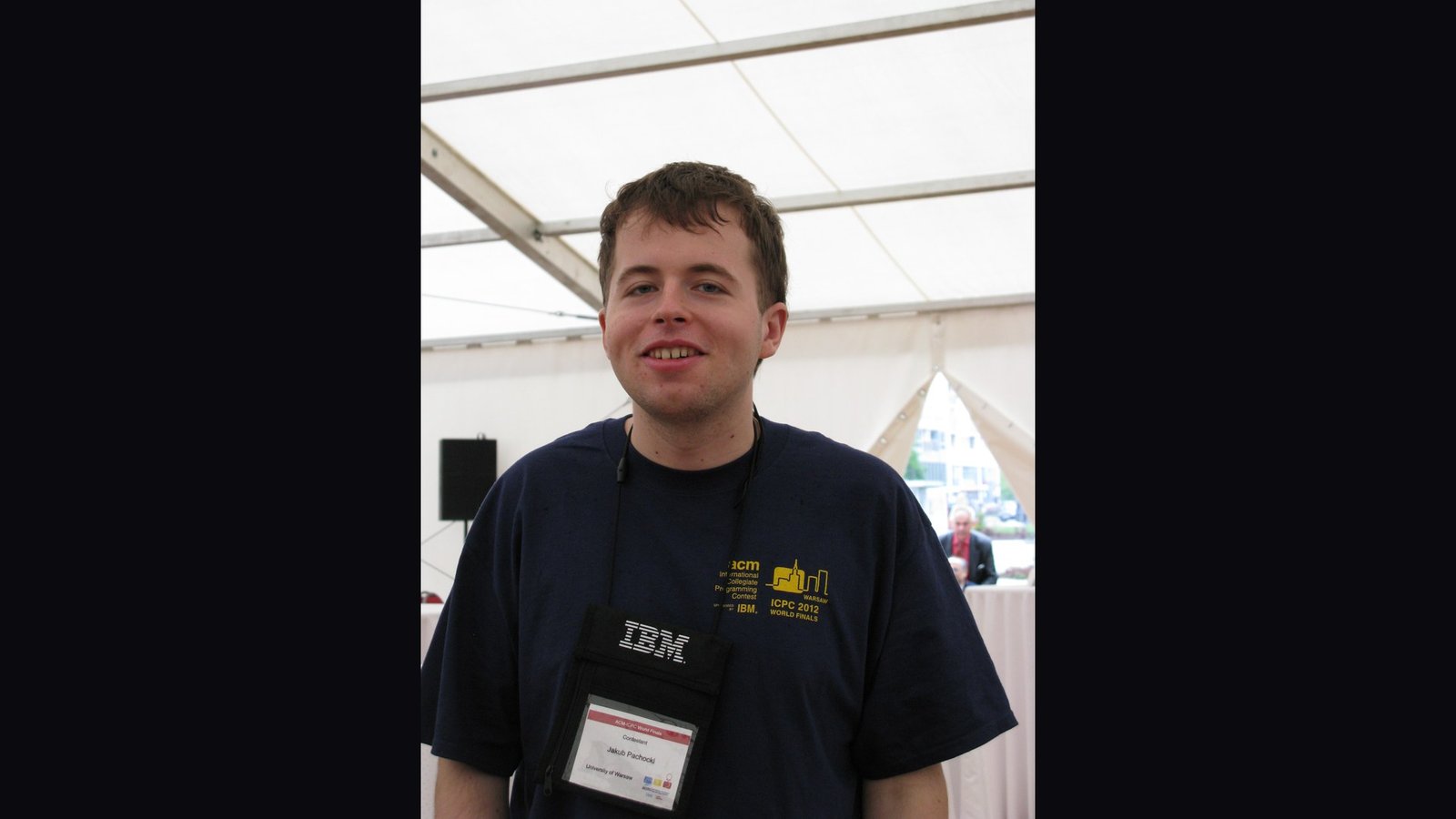
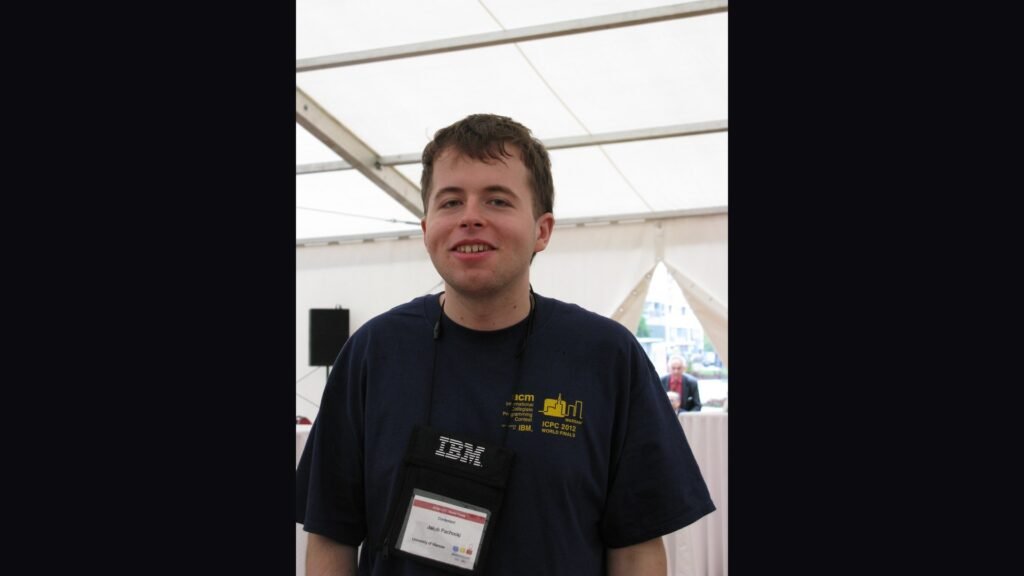
Lead image: Jakub Pachocki in 2012, by Izabela Majewska for ICPCNews, CC BY 2.0, via Wikimedia Commons, padded to 16:9. It shows Pachocki at the ACM ICPC 2012 World Finals, years before he became OpenAI’s chief scientist.
Hype in. Signal out.