



China launched a foreign astronaut for the first time on Tuesday. A Long March 2F rocket lifted off from the Jiuquan Satellite Launch Center at 4:18 p.m. PST (8:18 a.m. Wednesday in Beijing) carrying Shenzhou-24 and three people, one of them Pakistani air force pilot Muhammad Zeeshan Ali, the China Manned Space Agency (CMSA) said through Xinhua.
Update · Nov 25, 2026: Shenzhou-24 docked with the front port of Tiangong’s Tianhe core module at 11:56 a.m. Beijing time on Nov. 25 (7:56 p.m. PST Nov. 24), about 3.5 hours after launch, the China Manned Space Agency said through Xinhua. Tang Hongbo, Wu Yi and Muhammad Zeeshan Ali, whom Xinhua calls the first foreigner to visit Tiangong, were set to enter Tianhe next. This story earlier said docking had not been confirmed.
Ali is booked for a short stay. Pakistan’s space agency, SUPARCO, told Al Jazeera he’ll spend about a week on the Tiangong space station, and that the four Pakistani experiments he’s there to set up take “between six and 12 months” to finish. He installs them, then goes home.
Key points
- Shenzhou-24 launched from Jiuquan at 4:18 p.m. PST on Nov. 24 with commander Tang Hongbo, flight engineer Wu Yi and Pakistan’s Muhammad Zeeshan Ali, the first foreign astronaut China has flown, per CMSA via Xinhua.
- SUPARCO says Ali stays about a week to install four China-Pakistan experiments that take six to 12 months to complete, according to Al Jazeera.
- Ali returns on Shenzhou-23 with two of that crew, while Shenzhou-23 commander Zhu Yangzhu stays aboard for China’s first one-year stay, CMSA says.
- CMSA planned a 3.5-hour automated rendezvous with Tiangong’s Tianhe core module; we hadn’t seen a docking confirmation when this was published.
What launched, and who’s aboard
About 10 minutes after liftoff, the spacecraft separated from the rocket and reached its planned orbit, and CMSA declared the launch “a complete success.” The agency said the crew was in good condition.
The commander is Tang Hongbo, 51, who flew on Shenzhou-12 in 2021 and Shenzhou-17 in 2023. He’ll be the first person to visit Tiangong three times, CMSA said at its pre-launch briefing. Flight engineer Wu Yi, 39, comes from China’s third astronaut group and is making his first flight. Ali, 40, flies as a payload specialist, the crew member who runs experiments rather than the ship (ages per AP).
CMSA calls it the 41st flight of China’s human spaceflight program and the first in its history with a mixed Chinese and foreign crew. It’s also Pakistan’s first orbital astronaut. Space.com notes the asterisk: adventurer Namira Salim flew to space first, on a Virgin Galactic suborbital hop in October 2023. Ali is the first Pakistani to reach orbit, and the first professionally trained one.
The plan was a fast, automated rendezvous: about 3.5 hours from launch to docking at the forward port of the Tianhe core module, per CMSA. That puts the target around 7:50 p.m. PST. When we last checked, Xinhua and CMSA had reported the launch but not the docking or hatch opening.
A seven-month road from pilot to payload specialist
China and Pakistan signed their astronaut agreement in Islamabad in February 2025. The rest moved fast. Here’s the timeline as reported by Al Jazeera, the BBC and Space.com:
| Date | What happened |
|---|---|
| Feb 2025 | SUPARCO and CMSA sign the spaceflight agreement in Islamabad |
| Apr 22, 2026 | CMSA names two Pakistan Air Force pilots, Ali and Khurram Daud, as reserve astronauts |
| Apr 24, 2026 | Both start training at the Astronaut Center of China in Beijing |
| Nov 23, 2026 (PST evening) | China names Ali to the Shenzhou-24 crew, the day before launch, as is its habit |
| Nov 24, 2026, 4:18 p.m. PST | Shenzhou-24 launches from Jiuquan |
That’s about seven months from the start of training to launch. The hardest part, by Ali’s own account, wasn’t the centrifuge. “All the switches, all the software, all the programmes, all the voice announcements, everything is in Chinese,” he said in a CMSA promotional video quoted by Al Jazeera. The BBC, citing Reuters, reports he took seven months of intensive Chinese classes in Beijing.
Our read: Seven months is quick, and the job is built for it. Tang is the pilot and commander, Wu is the flight engineer, and CMSA says Ali’s work is mostly the China-Pakistan science, so his training could focus on experiments, safety drills and enough technical Chinese to follow commands. That’s a sensible design for a first guest. It also means this flight shows China can host a visitor, not that it can train a foreign astronaut to run a Shenzhou.
Daud wasn’t named to the crew, and it isn’t clear whether he’ll fly later. SUPARCO told Al Jazeera the backups will “serve as experts” to carry the program forward.
A week in orbit, a year of experiments
CMSA spokesperson Zhang Jingbo said Shenzhou-24 carries more than 90 experiments and technology tests. Four of them are China-Pakistan projects in biotechnology and materials, and Ali will also run an experiment on photosynthetic cyanobacteria, per Xinhua. The BBC adds a study of how radiation and microgravity affect quinoa seeds.
Then the math gets interesting. SUPARCO told Al Jazeera that Ali’s week is for starting and installing the experiments and recording data showing the hardware survived launch. “Completing the four experiments takes between six and 12 months,” it said. Neither agency has said publicly who tends those experiments after Ali leaves. The likeliest answer is the Chinese crew staying aboard, or automation, but that’s our inference, not something CMSA has announced.
Even the length of the visit is fuzzy. CMSA calls it a “short-term joint flight.” SUPARCO says about a week. The BBC’s China correspondent called it a “five-day flight.” Space.com says “a week or so.” We’ll know when Shenzhou-23 lands at the Dongfeng landing site.
The crew shuffle, and the year-long stay
Ali’s quick turnaround works because China rearranged its crew rotation. Here’s who rides what, per CMSA and Xinhua:
| Astronaut | Arrived on | Leaves on | Planned stay |
|---|---|---|---|
| Muhammad Zeeshan Ali (Pakistan) | Shenzhou-24 (Nov 24) | Shenzhou-23 | About a week (SUPARCO) |
| Zhang Zhiyuan | Shenzhou-23 (May 24) | Shenzhou-23, as return commander | About six months |
| Lai Ka-ying (Hong Kong’s first astronaut) | Shenzhou-23 (May 24) | Shenzhou-23 | About six months |
| Zhu Yangzhu | Shenzhou-23 (May 24), as commander | Stays aboard with Shenzhou-24 | One year (CMSA) |
| Tang Hongbo | Shenzhou-24 (Nov 24), as commander | Shenzhou-24 (expected) | About six months |
| Wu Yi | Shenzhou-24 (Nov 24) | Shenzhou-24 (expected) | About six months |
Every crew member still has a seat home, which matters on a station that learned the hard way. In November 2025, a suspected debris strike cracked a window on Shenzhou-20, so its crew came home in the newer Shenzhou-21 and left that crew without a working lifeboat. China launched an uncrewed Shenzhou-22 on Nov. 25, 2025, as a replacement, which Xinhua called the first emergency launch in its human spaceflight program. Shenzhou-24 launched almost exactly a year later.
Zhu’s year is the bigger science milestone. Space.com, citing the South China Morning Post, says he’ll be the first Chinese astronaut to spend a year in orbit. For scale, NASA’s Frank Rubio holds the US record at 371 days, and that stay stretched after his Soyuz sprang a coolant leak and a replacement capsule had to bring his crew home. Zhu’s year is planned from the start, and Space.com says it will help China prepare for long missions to the Moon and beyond.
Why China wants a guest now
The International Space Station is run by five space agencies from 15 countries, and NASA plans to operate it through 2030. China isn’t one of them. Al Jazeera notes that a 2011 US law bars NASA from bilateral cooperation with China, which helped push Beijing to build its own station.
Europe once looked like Tiangong’s first guest. ESA astronauts Samantha Cristoforetti and Matthias Maurer did sea-survival training with Chinese astronauts in 2017 and studied Chinese. In January 2023, ESA Director General Josef Aschbacher said the agency had “neither the budgetary nor the political, let’s say, green light” to take part in a second station.
So the first guest is Pakistan, which CMSA’s Zhang called China’s “all-weather strategic cooperative partner.” Asked about joint flights with Russia or others, Zhang pointed to the station’s transport and astronaut-training systems and said China hopes to work with more countries, Al Jazeera reported. That’s an open door, not a booking.
Why it matters: Once the ISS retires, a country that wants its astronaut on a government-run station may have one obvious place to ask. China’s pitch is that Tiangong can be an international lab, as BBC China correspondent Laura Bicker put it. A one-week visit by a close ally is a first step, and a careful one.
The catch
- No docking confirmation yet. This story was published before CMSA announced docking or hatch opening.
- The experiments outlast the astronaut. SUPARCO’s own six-to-12-month estimate means the science results Pakistan is touting won’t arrive while Ali is in orbit.
- Most of the claims are official. Crew roles, experiment counts and the one-year plan all come from CMSA briefings relayed by Xinhua. China rarely publishes mission details ahead of time, so we can’t check much independently until it happens.
- The Moon plan has no details. SUPARCO told Al Jazeera Pakistan is working with China on a lunar mission tentatively planned for 2028 but couldn’t share details. A SUPARCO rover is due to fly on Chang’e-8 around 2028.
The takeaway
China just showed it can fly a foreign astronaut, and Pakistan got its first person in orbit after seven months of training. What to watch: CMSA’s docking and hatch-opening announcement, the date Shenzhou-23 brings Ali, Zhang and Lai home, whether Khurram Daud gets a later seat, and whether another country is named for Tiangong. Zhu Yangzhu’s year aboard would run to about May 2027, if CMSA sticks to the plan.
Last checked: Nov 25, 2026, 5:21 p.m. PST. Docking confirmed by CMSA via Xinhua.
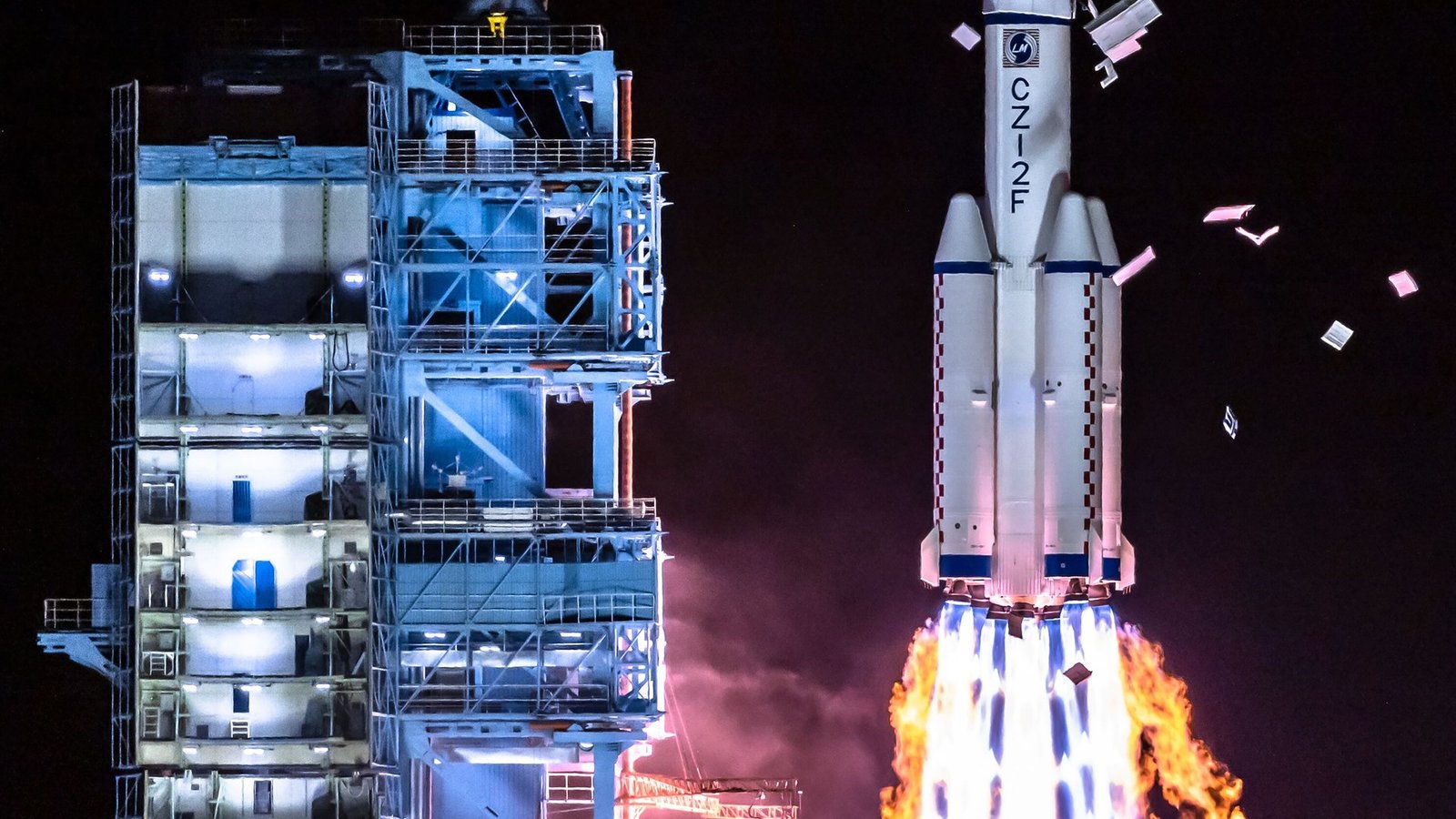
Lead image: Launch of Shenzhou-13 on a Long March 2F from Jiuquan, Oct. 16, 2021 (not Shenzhou-24), by ForrestXYC, edited by Ib, CC BY-SA 4.0, via Wikimedia Commons, cropped to 16:9.
Hype in. Signal out.