




France on Monday formally blamed Iran for the night last month when refrigeration controllers at about 700 French supermarkets and other food sites were remotely ordered to heat up. In an official attribution statement, the foreign ministry pinned the Oct. 11-12 attack on Shahid Kaveh, a cyber-offensive unit of Iran’s Islamic Revolutionary Guard Corps, and called it the first cyber campaign on French soil carried out “purely for sabotage.”
Key points
- France’s foreign ministry and its cyber crisis center attributed the Oct. 11-12 attack on refrigeration controllers at about 700 retail sites to Shahid Kaveh, a unit of Iran’s Revolutionary Guard.
- According to the government’s technical report, attackers set defrost temperatures to high values, causing heavy food losses and at least 15 fires, with losses the ministry puts at several tens of millions of euros.
- France is summoning Iran’s ambassador and will propose EU sanctions, and Paris prosecutors have opened a judicial investigation and requested international arrest warrants.
- The attribution covers only the October attack in France, not the November wave that hit stores elsewhere in Europe or the French blood service’s cold rooms.
It’s a strange-sounding story with very real consequences: spoiled food, burned equipment and a state-level diplomatic fight that started with ice cream freezers. It’s also an uncomfortable lesson about what happens when the computer that runs a supermarket’s cold chain sits on the open internet with an old password.
What France says happened
The details come from a joint technical report (PDF) published Monday by France’s Cyber Crisis Coordination Center, known as C4, which brings together the national cybersecurity agency ANSSI, military cyber command, the defense procurement agency and both of France’s intelligence services.
According to the report, the C4 was alerted on Oct. 12 to an attack on the cold controllers of about 700 large retail sites. Overnight from Sunday Oct. 11 to Monday Oct. 12, the attackers changed the equipment’s defrost settings to high temperatures. The result, the C4 says, was major merchandise losses and “in at least 15 cases” fires.
The report names the groups Casino, Leclerc, Coopérative U, Metro, Carrefour and Intermarché among the affected retailers, along with several small butcher shops, a slaughterhouse and cooperative food factories. It also links the same campaign to attacks on Schneider Electric equipment at small French hydroelectric plants, with what it calls “moderate effects.”
The foreign ministry’s statement puts the food losses at “several tens of millions of euros” and says the attacks caused “considerable material damage.” That is a government estimate; no itemized figure has been published.
How you weaponize a freezer
Many commercial freezers have built-in electric heaters, and that’s the trick. Freezer coils collect frost, so units run regular defrost cycles: they stop cooling and warm the coils, controlled by setpoints in a central “system manager” box that a store’s refrigeration contractor often reaches remotely.
Change those setpoints and the defrost never ends. The U.S. government fact sheet published Nov. 5 by CISA, the FBI, HHS, USDA and the Department of Transportation describes exactly this: actors forcing units “into continuous heating and defrost cycles,” with possible effects including inventory loss, a fire hazard, and a “denial-of-view” where operators can no longer see real temperatures.
Intermarché told French media 150 of its stores were affected and that temperatures were pushed to 50°C (122°F), according to a running write-up by industrial security firm Claroty. No exotic malware is needed. The attack is a settings change, made at scale.
The doors were mostly unlocked
On Oct. 13, Danish manufacturer Danfoss sent customers a notice saying the known affected systems “were directly exposed to the public internet (without VPN, not operating behind a firewall).” The affected models were its older AK-SM800 and AK-SC355 system managers, plus current AK-SM800A units running outdated software.
Those older boxes are out of support. The notice says the AK-SC355 was retired from sales in 2016 and the AK-SM800 in 2023; Danfoss separately told the Cooling Post that the AK-SM800 was “officially declared end-of-life in 2021” and that neither gets software or security updates. (The two dates measure different things, but either way, these controllers outlived their patches.)
Researchers had been warning about this hardware. Claroty’s Team82 says it disclosed three flaws in the AK-SM800A web interface, including a hidden “code-of-the-day” login bypass, which Danfoss fixed in August 2025, and that its scan found 2,765 of those devices exposed online. It is not known how many were patched. France’s CERT also widened its warning on Oct. 13 to Copeland and Dixell XWEB monitoring systems, Claroty reports.
Our read: this was less a break-in than a walk-in. A state unit gets the headlines, but much of the attack surface was put there by contractors who wanted remote access without a VPN.
How France tied it to the Revolutionary Guard
Attribution is the part readers should weigh most carefully, because it depends on evidence the public can’t fully check. The C4 report lists four indicators:
- The attack infrastructure was also used, in the same period, for reconnaissance of Schneider Electric equipment at small energy and water sites, using a Modbus-on-port-502 technique the C4 says the unit has used since at least April 2026.
- The operators used FOFA, a commercial internet-scanning search engine, which the C4 says this group habitually uses.
- CyberbanNews, a propaganda outlet the C4 associates with Shahid Kaveh, relayed the attack as early as Oct. 13.
- Traces of Farsi were found in the attack infrastructure.
Paris prosecutor Laure Beccuau added, in a statement reported by BFMTV, that investigators found “the use of Farsi and IP addresses pointing to terminals located in Iran.” Each clue alone is weak; FOFA is a public tool and language traces can be faked. France’s case rests on the combination, plus intelligence it hasn’t published.
The report says the unit is led by two commanders it names, and that it works through hacktivist-style personas including CyberAveng3rs, Soldiers of Solomon, Mr. Soul and Cyber Isnaad Front. The C4 says the unit claimed, via CyberAveng3rs, a November 2023 campaign against equipment made by Israeli industrial-controller maker Unitronics, and a large sabotage campaign against Israeli and U.S. targets, including Israeli refrigeration equipment, in March and April 2026. It also says the unit has held scripts to scan, access and control Schneider Electric, Siemens and Rockwell industrial systems since at least June 2024.
Those are France’s allegations. TechCrunch said Iran’s consulate in New York did not immediately respond to its request for comment.
A timeline of the cold-chain attacks
The French attack wasn’t the first odd freezer failure this year, or the last. Here’s the sequence, with the attribution status of each:
- August: Pentagon investigators begin treating a string of commissary freezer failures at U.S. military bases as a suspected hack, according to Reuters reporting summarized by Gizmodo. A blog called Signal and Silence had counted 14 reported outages in 11 states; Reuters confirmed at least six. No public U.S. attribution.
- Oct. 11-12: The French supermarket attack. Attributed to Shahid Kaveh by France on Nov. 9.
- Oct. 13: Danfoss tells customers the affected systems were directly internet-exposed (notice).
- Nov. 1-2: Remote-monitoring software for cold rooms at three sites of the French blood service, the EFS, has its temperature and defrost thresholds altered. Le Canard Enchaîné reported the rooms, normally at minus 30°C, were set to reach 110°C, according to La Croix. The EFS says its independent alarms caught it and no blood products were lost.
- Early November: A second wave hits supermarkets and butcher shops elsewhere in Europe. BleepingComputer counts more than 115 stores in six countries; Claroty lists seven, including Sweden, Ireland and the Netherlands. A Danfoss spokesperson told Dutch broadcaster NOS those systems used a default password, Claroty reports.
- Nov. 5: Five U.S. agencies issue the joint refrigeration and cold-chain warning.
- Nov. 9: France attributes the October attack to Iran’s Revolutionary Guard.
The distinction matters. As BleepingComputer notes, France has attributed only the October attacks on French retail sites, not the November wave. The blood service attack came through its refrigeration supplier, which BleepingComputer identifies via a statement from Coolworld, which says the exploited flaw was in a third-party component outside its control. Treat any claim that one actor did all of this as unproven.
What France is doing about it
The foreign ministry says France will summon Iran’s ambassador, propose new EU sanctions against Iranian entities and individuals involved, and “reserves the right” to take further measures, “public and non-public.” The EU already sanctioned another Iranian group, Emennet Pasargad, in March 2026 over earlier attacks on France, according to the statement.
Prosecutors are going further. According to BFMTV, the Paris prosecutor’s cybercrime section opened a judicial investigation into organized intrusion into computer systems and organized damage “by means dangerous to persons,” targeting the unit’s chief, his two deputies and anyone else identified, and requested international arrest warrants. EU foreign policy chief Kaja Kallas said ministers would discuss the attacks at next Monday’s Foreign Affairs Council, BFMTV reports.
Arrest warrants for Revolutionary Guard officers are mostly symbolic; nobody expects extraditions. The more concrete pressure is on the vendors and installers who left controllers reachable, and on retailers who may not know what their contractors plugged in.
Who should worry
Anyone who keeps something cold and lets a contractor reach it remotely. The U.S. fact sheet lists healthcare, chemical, food and agriculture, and refrigerated transport as the sectors that rely on these systems. Its fixes are basic: take controllers off the public internet, put them on a separate network, change default passwords, patch or replace end-of-life units, allowlist who can connect, and set hard limits on setpoints so a “defrost at 50°C” command is refused or at least sets off an alarm.
The blood service is the useful counterexample. According to La Croix, the EFS had temperature monitoring that was independent of the supplier’s system, and an on-call technician noticed the rise overnight. A separate thermometer that the attacker can’t reach is old-fashioned, cheap and, here, it worked.
This also fits a pattern we’ve covered lately: attackers moving fast on unglamorous, internet-facing systems, from Alpine’s locked SSH accounts to AI-boosted bug hunting like OpenAI’s GPT-6 Cyber. Refrigeration controllers were never interesting enough to defend. Now they are.
What to watch
- Next Monday’s EU Foreign Affairs Council. Whether sanctions on named Shahid Kaveh members move quickly, and whether other EU states hit in November make their own attributions.
- A U.S. attribution for the commissary freezers. Washington has issued warnings but, per TechCrunch, no formal or public attribution for the base outages.
- Danfoss’s installed base. How many end-of-life AK-SM800 and AK-SC355 units are still exposed online, and whether the company or regulators push replacement rather than advice.
- Insurance and liability. Who pays for the “tens of millions of euros” in spoiled stock: retailers, their refrigeration contractors or insurers, and whether a formal state attribution changes that answer.
France has put a name and a sanctions push behind the weirdest sabotage campaign of the year. The bigger lesson is in Danfoss’s first notice: the controllers that failed were sitting on the internet with no VPN and no firewall. The attacker turned up the heat, but someone else had left the door open.
Hype in. Signal out.
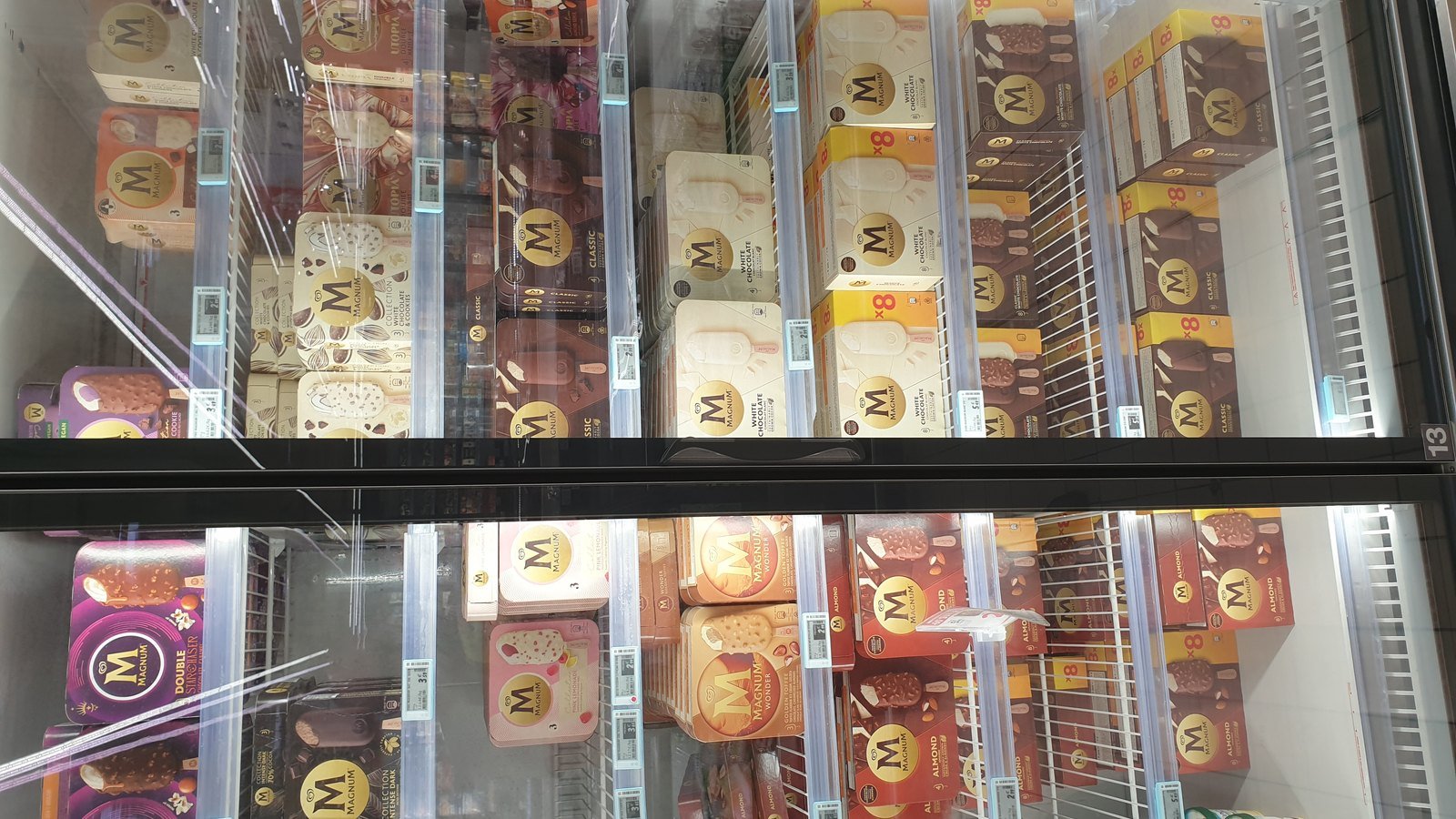
Image: Ice cream freezers at a Carrefour hypermarket in Vichy, France, July 2025. Carrefour is among the retail groups France says were hit. Photo by TCY via Wikimedia Commons, CC BY-SA 4.0. Cropped and resized for this post.