




Most item trackers are a plain little tag you forget about until your keys go missing. The Kodak SlideTag is a tiny photo frame first: a keychain shaped like an old Kodachrome slide mount, with a color E Ink screen where the film would be, that also reports its location to Apple’s Find My or Google’s Find Hub. It costs $34.99. The catch is the box. Like Reto’s viral Charmera keychain camera, the SlideTag is sold blind, so you don’t choose your design. And the odds Reto publishes for that draw don’t quite add up.
Key points
- Reto, which makes Kodak-branded gadgets under license, sells the SlideTag for $34.99: a keychain with a 1.54-inch, six-color E Ink screen that also works as a Bluetooth tracker on Apple Find My and Google Find Hub.
- Each tag comes in a blind box with a random design, and Reto lists odds of 1 in 8 for each of eight standard designs plus 1 in 64 for a secret edition, which adds up to more than 100%.
- Unlike Apple’s $29 AirTag, it has no ultra-wideband precision finding, and it is rated IP54 rather than IP67.
- PetaPixel gave it 9 out of 10, while its cons list named the price premium over plain trackers and the blind-box purchase.
What the SlideTag is
Reto is the licensee that makes Kodak-branded retro gadgets, including the Charmera, a keychain digital camera that was also sold in blind boxes. The SlideTag went on sale Nov. 22, according to Talk Android. Here is what Reto’s product page and support FAQ list:
| Spec | Kodak SlideTag (per Reto) |
|---|---|
| Screen | 1.54-inch, six-color E Ink, 240 x 240 pixels |
| Size and weight | 39.3 x 46 x 7.58 mm; 16.6 g; polycarbonate and PMMA body |
| Tracking | Apple Find My (iOS 26 or later) and Google Find Hub (Android 9 or later); Bluetooth 5.4; real-time tracking range up to 30 m in open areas |
| Finding it nearby | Built-in 75 dB buzzer (at 10 cm); no ultra-wideband listed |
| Power | Replaceable CR2032 coin cell, pre-installed; no official battery-life figure |
| Durability | IP54 splash and dust resistance; Reto says it is “not waterproof” |
| In the box | Tag, keyring, battery, and a “memory pocket” set: collector’s poster, collectible slide frame, mini film strip |
The screen does more than photos. Through Reto’s Kodak Memory Link app you can load up to 12 images as an album or a timed slideshow, or show a to-do list, a calendar, a countdown, a QR code or a name badge. Because it’s E Ink, the last image stays on screen without drawing power. That also has a strange side effect: Reto’s FAQ says photos “cannot be deleted or cleared directly.” To blank the screen, it suggests uploading a solid white image.
The odds that add up to 101.6%
Reto’s product page says there are nine designs: eight standard ones and one secret edition. It says “each basic style is with the odds of 1/8” and that “the probability of drawing the secret edition is 1/64.” Eight standard designs at 1 in 8 each already account for 100% of boxes. Add the secret edition’s 1 in 64 and the total comes to 65/64, or about 101.6%. The true odds for each standard design are probably a hair under 1 in 8, but Reto doesn’t say. We found no reviewer who noted it.
The math gets expensive if you chase a specific look. If each standard design really is about equally likely, collecting all eight from single boxes takes about 22 boxes on average, roughly $770 before shipping and tax. That’s the classic “coupon collector” problem, and it’s our estimate, not Reto’s. The secret edition, at 1 in 64, takes 64 single boxes on average, about $2,240. Reto also limits each order to two single boxes and one whole set, and it allows no cancellations or changes once you order.
There’s a shortcut for the standard designs. Reto’s “whole set” is eight boxes with no repeats for $279.92, exactly eight times the single price, per The Verge. If the secret edition shows up in a set, it replaces one of the standard designs, so even the full set doesn’t guarantee all eight.
How it compares with plain trackers
As a tracker, the SlideTag is basic. MacRumors and The Verge both point out that it lacks the ultra-wideband chip Apple’s AirTag uses for Precision Finding, the on-screen arrow that leads you to a nearby tag. Google’s Pixel Tag uses Bluetooth Channel Sounding for distance; the SlideTag lists neither. You get the crowd-sourced network location and a buzzer.
| Kodak SlideTag | Apple AirTag | Google Pixel Tag | |
|---|---|---|---|
| Price | $34.99 (Reto) | $29, or $99 for four (Apple) | $29.99, or $99.99 for four (Google) |
| Networks | Find My and Find Hub | Find My | Find Hub |
| Close-range finding | Bluetooth, 75 dB buzzer | Ultra-wideband Precision Finding, speaker | Channel Sounding distance (Android 16+), speaker |
| Water resistance | IP54, “not waterproof” | IP67 (1 m for 30 minutes) | IP67 |
| Screen | 1.54-inch color E Ink | None | None |
| Keyring hole | Yes | No (needs a holder) | No (needs a holder) |
Two practical points the spec table leaves out. The SlideTag supports both phone platforms, so if you switch from iPhone to Android, Reto’s FAQ describes removing and resetting the tag so it can be paired again, rather than buying a new one. And unlike the AirTag and Pixel Tag, it hangs on a keyring without a separate holder, which narrows the real price gap. Apple’s spec page lists the AirTag at 31.9 mm across and 11.8 g, so the SlideTag is bigger and heavier, as MacRumors noted, but slightly thinner.
What reviewers say
PetaPixel’s Jaron Schneider gave it 9 out of 10 and called it “an incredibly good product.” He came in skeptical, writing that his Charmera is “already broken.” He praised the replaceable battery, the dual-network support and the extra screen modes like QR codes for sharing a portfolio. His cons: it costs more than standard tracking tags, and the blind-box mechanic “may be frustrating.” He also pulled a design he didn’t like on his first try. One detail to note: his review says the tag uses a CR2025 cell, while Reto’s spec sheet, The Verge and MacRumors all say CR2032. Buy a CR2032.
DPReview warned that images will look “slightly pixelated and newspaper-like” on the e-paper screen, and The Verge said photos with bold, defined colors work best. Talk Android, citing Reto’s user guide, says each screen refresh takes up to 30 seconds. Reto’s FAQ also says uploads fail if you lock your phone or leave the app mid-transfer, and that the tag disconnects from the app once it sits idle in the background for over 10 minutes.
Who should buy it, and who should skip it
Consider it if you want a tracker you’ll actually look at: a rotating photo, a QR code to your website, or an emergency contact card on your bag. It’s also a rare tag that works with both iPhone and Android, and the blind box suits gift-givers who don’t care which color the recipient gets.
Skip it if you mainly want to find your keys. A plain AirTag or Pixel Tag costs less, adds more help finding a tag at close range, and is rated IP67. Skip it too if you want a specific design, because the only sure path is the $279.92 set. And it was hard to buy on Friday. Amazon has a Kodak-store listing for the single box, but it said “Currently unavailable,” and Reto’s own store caps orders at two single boxes.
What to watch
First, whether Reto clarifies its odds, since its own page puts them past 100%. Second, battery life: Reto gives no estimate, and no review we found has measured how fast slideshow refreshes drain the coin cell. Third, restocks and resale prices. The Charmera’s first run sold out within a day, Talk Android reported, and blind-box scarcity is where $34.99 gadgets start costing a lot more.
Hype in. Signal out.
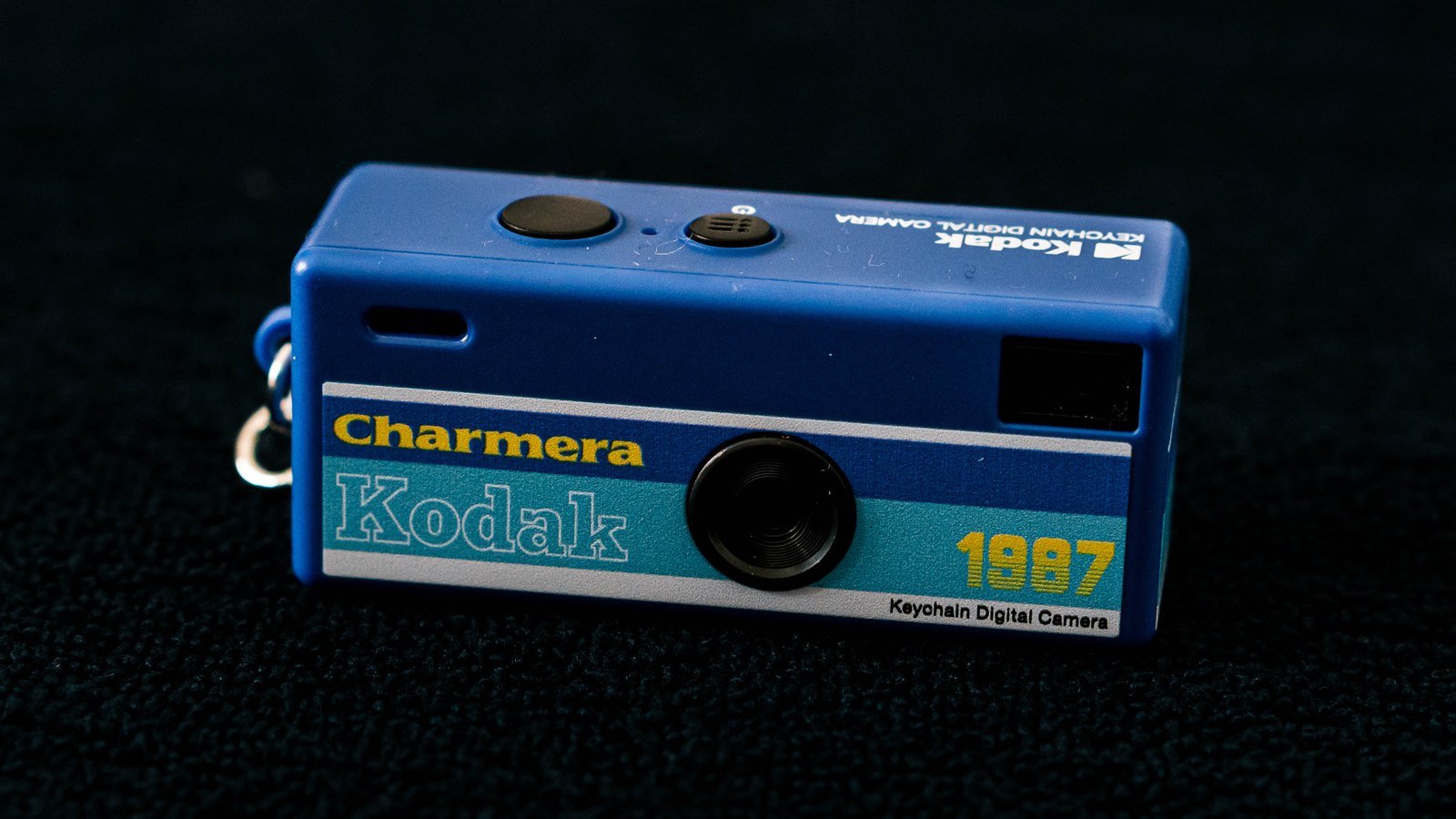
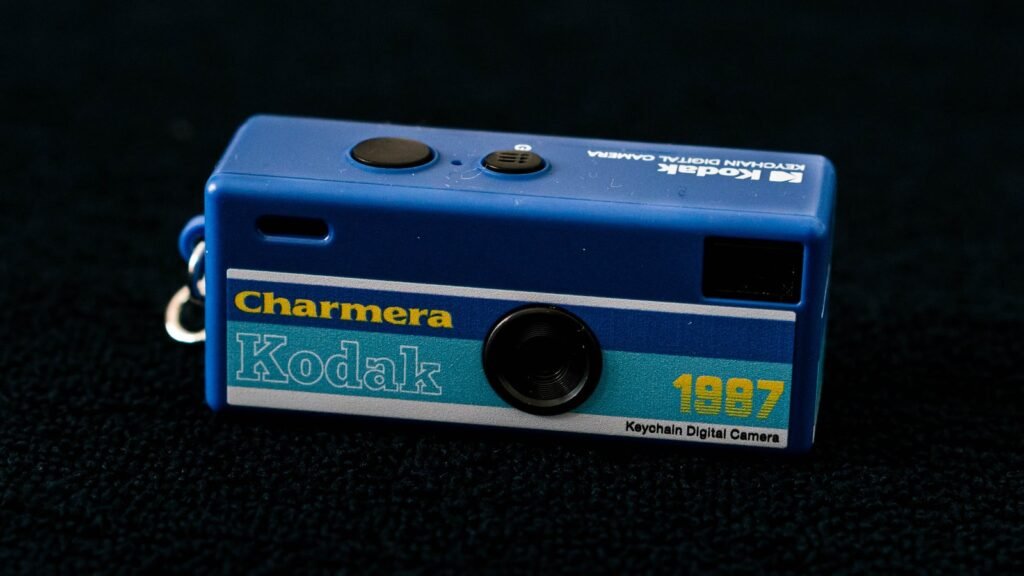
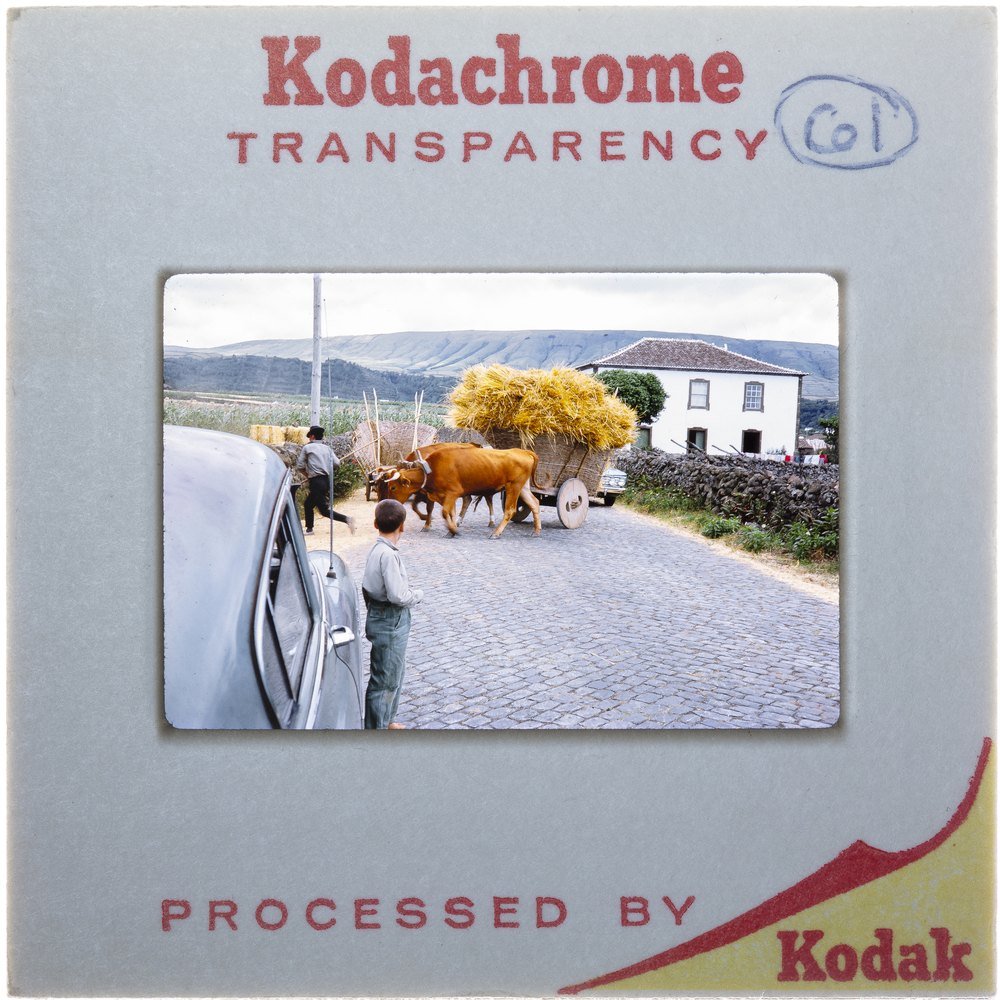
Lead image: not the SlideTag. Reto’s earlier Kodak Charmera keychain digital camera, 1987 design. Photo: Ryohei Noda, via Wikimedia Commons, licensed CC BY 4.0 (cropped). Second image: a 1961 Kodachrome slide, the kind of mount the SlideTag imitates. Photo: JoshuaGrove, via Wikimedia Commons, licensed CC BY 4.0 (resized).