


Tesla’s new self-driving software doesn’t just drive the car. It also paints you a picture of the road, and the picture is generated by AI. Tesla started rolling out Full Self-Driving (Supervised) v15 to a first group of owners on Saturday, with a feature called Reality View that replaces the old blocky driving display with a photorealistic, game-like scene. Tesla also says v15 is “25x better” at handling safety-critical cases. It hasn’t said 25 times better than what.
Last checked: Nov 22, 2026. The rollout is ongoing, and Tesla hasn’t said when v15 reaches all eligible cars.
Key points
- Tesla began rolling out FSD (Supervised) v15 to a first group of customers on Nov. 21, 2026, with a new generated driving display called Reality View.
- Tesla’s release notes say a new vision encoder, shared with Robotaxi and Optimus, improves the critical intervention rate by 25x, but Tesla hasn’t published the baseline rate.
- Elon Musk says Reality View is “real-time AI video generation” with no game engine, running on half of one AI4 TRIP accelerator.
- The update arrives while two NHTSA investigations into FSD remain open, and its notes say driver-attention checks get less strict in higher-speed profiles.

What Tesla actually shipped
Tesla announced the update on X and posted a 36-second launch video to its YouTube channel. The full release notes, first posted by Tesla’s “Tesla Super Intelligence” account and reproduced by Electrek, open with a big claim: “v15 upgrades every part of the end-to-end driving network.” The highlights, in Tesla’s words or close to them:
- An “upgraded vision encoder shared between FSD, Robotaxi, and Optimus,” trained “on millions of internet videos,” which Tesla says improves “the critical intervention rate by 25x.”
- Tesla Reality View, a “real-time generative driving visualization that continuously streams a view from an arbitrary virtual camera situated above your vehicle.”
- Navigation that learns from fleet route preferences, for now only at the start and end of a trip. Tesla says later v15 releases will cover the whole route.
- Better detection of road signs, small animals, debris, chains, potholes and deep standing water, plus better speed handling in school zones and bad weather.
- Driver monitoring that works more often with hats and sunglasses, and “decreasing strictness in higher speed driver profiles.”
- A setting that lets FSD slow down for speed cameras, and a Bike Rack Mode for cars with hitch accessories.
Tesla hasn’t said which cars get v15 first. Electrek notes Tesla has told investors its AI4 (also called HW4) computer is enough to run v15, and Drive Tesla says it expects Reality View to be limited to HW4 cars with the newer AMD Ryzen infotainment processor. Neither point is a Tesla statement about this rollout.
Reality View: the driving model draws its own map
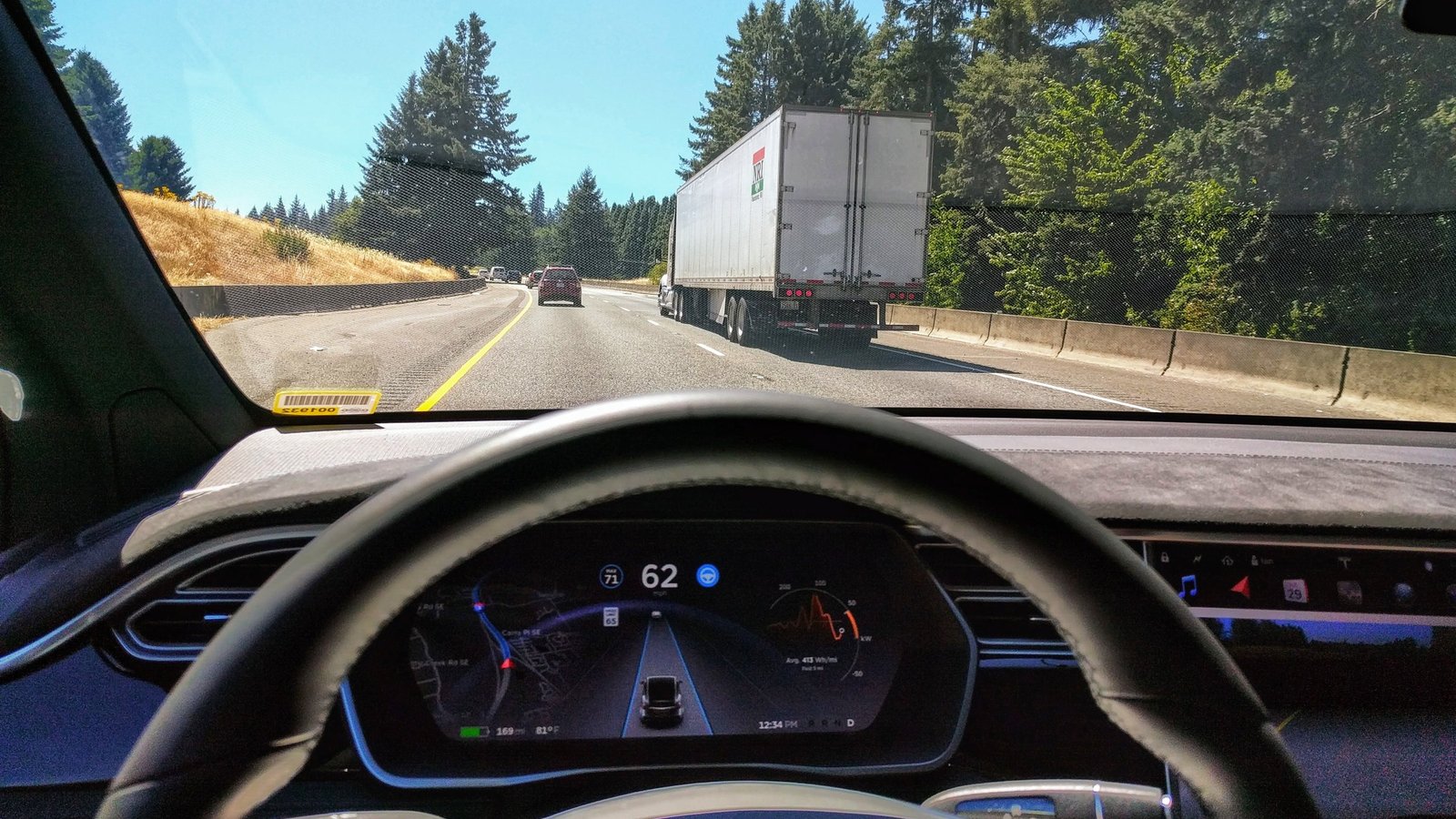
The flashy part is the screen. Tesla’s old visualization, as Gizmodo describes it, showed your car on the road “along with a few key features in an otherwise empty and mostly colorless dreamscape” (the 2017 display in the photo above is older and simpler still). Reality View renders a realistic road with the surrounding vehicles, and puts large arrows into the scene for upcoming turns and pins for parking spots. Musk says you can tap any point on the view to make the car go there.
Tesla VP of AI Software Ashok Elluswamy said on X, as quoted by Drive Tesla, that “the same end-to-end driving model also renders a realistic view of the world around the vehicle,” and that “it’s not there just because it looks cool, but it also communicates the intent of the car.” He also claimed the new view uses less computing power than Tesla’s 2020-era wireframe display. Elon Musk went further: “This is real-time AI video generation (no gaming engine!) using just half of one AI4 TRIP accelerator,” he posted. He also wrote “It’s like GTA,” days after Grand Theft Auto VI’s record launch.
If those claims hold up, it’s a genuinely impressive bit of engineering: real-time video generation on the car’s existing AI4 computer, rather than a separate graphics engine. It also means the driving display now comes out of a generative model, which matters for the regulatory question below.
The 25x number, and everything it leaves out
“Critical intervention rate” means how often a human has to grab control to avoid something bad. It’s the right kind of metric for a system that still needs a supervisor. But Tesla published only the multiplier. Without the starting rate, the period, the fleet, the roads and the software baseline, 25x can’t be checked.
The release notes also tie the 25x to the vision encoder, one component of the stack, not the whole driving system. And it’s a rate of driver takeovers, not crashes. TeslaNorth makes the same point: it’s “Tesla’s own intervention measure, not a crash-rate comparison.”
Tesla does publish a FSD safety report. As of Sunday, its counter showed about 17.9 billion FSD (Supervised) miles, and it compares collisions with FSD engaged against an estimated U.S. average. It counts a crash as FSD-related if FSD was active within five seconds beforehand. What it doesn’t publish is a critical intervention rate, or results broken out by software version. So the one number that would let anyone test the v15 claim isn’t on Tesla’s own scoreboard.
For a sense of scale, Electrek says crowdsourced data showed about 732 miles between critical disengagements when v14 arrived in October 2025, and that its data from earlier this year suggested v14 later reached “a couple thousand miles.” Electrek’s back-of-envelope math puts a 25x gain at around 50,000 miles. That’s Electrek’s illustration using unofficial data, not a Tesla figure, and nobody has measured v15 yet.
There’s history here, too. In April, Musk wrote that v15 “will far exceed human levels of safety, even in completely unsupervised and complex situations,” Electrek reports, and it notes he said similar things about v12 and v14. Electrek’s summary of the pattern: “FSD has never improved in a straight line.” v14 launched with hallucinations, brake stabbing and excessive speeding before it improved, then backslid in point releases.
What v15 fixes, next to what regulators are investigating
Here’s our comparison of the v15 release notes with the two FSD investigations NHTSA’s investigations index still lists as open.
| NHTSA PE25012 | NHTSA EA26002 | |
|---|---|---|
| Opened | Oct. 7, 2025 | Mar. 18, 2026 (upgraded from PE24031) |
| Subject | Traffic-law violations with FSD engaged, including red lights and driving the wrong way | Whether FSD detects reduced visibility (glare, fog, airborne dust) and warns the driver in time |
| Vehicles covered (NHTSA estimate) | 2,882,566 | 3,203,754 |
| Incidents in NHTSA’s summary | 58 incidents, 14 crashes, 10 injury incidents | 9 crashes, 1 fatality |
| What v15’s notes say | Better sign detection and speed handling in school zones and speed limits. No mention of red lights or wrong-way driving. | Reality View replaces “all of the explicit model signals” with one visualization. No mention of degraded-visibility detection or alerts. |
The second column is the one to watch. NHTSA’s EA26002 summary says that in the crashes it reviewed, the system “did not detect common roadway conditions that impaired camera visibility and/or provide alerts when camera performance had deteriorated until immediately before the crash occurred.” Its July 2026 information request adds that the drivers “may have been unaware” that FSD’s ability to see had been compromised.
So the federal question is literally about what FSD tells the driver about what it can and can’t see. v15’s answer to the display question is a model-generated scene that Tesla describes as replacing the explicit signals. We’re not saying Reality View hides anything; nobody outside Tesla has tested it in fog or low sun yet. But a photorealistic picture is very good at looking confident. Whether it shows uncertainty when the cameras are washed out is the question Tesla hasn’t addressed, and it’s exactly the question NHTSA has been asking since before v15 existed.
Two more details fit awkwardly. Tesla says v15 makes attention checks less strict in higher-speed profiles, at a time when, Electrek notes, Tesla is tightening monitoring in Europe at regulators’ request. And the new speed-camera slowdown suggests, as Electrek puts it, “Tesla is fine with FSD going over the limit when there’s no camera around.” Speed is a sore spot: Electrek cites a September test by Brussels nonprofit Johanna.be that found FSD exceeded the limit in 55% of the 30 km/h zones it drove through, and in most of those zones the car’s screen showed a 50 km/h limit. According to TeslaNorth‘s summary, drivers can cancel the slowdown by pressing the accelerator.
The catch
There’s an obvious tension in a supervision tool that looks like a video game. Gizmodo‘s Mike Pearl put it bluntly, wondering “what happens when the guy with the controller in his hands stops comprehending any difference at all between the video game world on his screen and the real world of metal, concrete, flesh, and blood.” A prettier screen can make a system easier to understand. It can also make a driver more relaxed than the software deserves, and v15 is still officially “Supervised.”
The generative angle adds a newer question. A generative model is built to produce plausible images. Tesla says this one renders what the driving network understands, which would make it a useful window into the car’s head. But plausible and accurate aren’t the same thing, and Tesla hasn’t published anything on how Reality View behaves when the driving model is unsure, or what it draws for objects it can’t classify.
Who this affects
First, owners in the initial rollout, who are now supervising a system with new perception, new routing and looser attention checks at higher speeds. Then everyone else on the road around them. The shared vision encoder also matters beyond cars: Tesla says the same component runs in Robotaxi and in its Optimus humanoid, so a 25x claim, if true, would be a claim about Tesla’s robot program too. And it lands a week after Tesla started inviting select buyers to order a $29,990 personal Cybercab, which only works inside zones Tesla controls.
Open questions
- 25x of what? Will Tesla publish the starting critical intervention rate, the comparison period and the fleet it measured?
- Does Reality View show what the cameras can’t see? How does it behave in glare, fog or dust, the conditions in NHTSA’s EA26002?
- Who gets v15, and when? Tesla hasn’t named the first cars or a date for wider release. Older HW3 cars weren’t mentioned.
- Will independent testers back up the claims? Crowdsourced trackers and the Brussels-style speed-zone tests Electrek cites are the first places real numbers could show up.
- Does NHTSA ask about the new display? The agency’s EA26002 request already covers driver alerts and Tesla’s updates to them.
The takeaway
FSD v15 is the most visually striking update Tesla has shipped, and if Musk’s compute claim is right, it’s a neat trick. But the most important numbers are the ones missing. A 25x improvement with no baseline is a marketing figure until Tesla shows its work, and a car that renders reality for its driver now has to prove its picture is honest when the road isn’t.
Lead image: Tesla Autopilot engaged in a 2017 Model X, by Ian Maddox, CC BY-SA 4.0 (license), via Wikimedia Commons, cropped to 16:9. It shows Tesla’s older driving display, not FSD v15 or Reality View.
Hype in. Signal out.