
Anthropic’s shares closed their first day on the Nasdaq at $97.17 on Thursday, 17% above the $83 offer price, after the Claude maker sold 980 million shares in what CNBC and AP call the biggest initial public offering on record. The stock, trading as ANT, opened at $111.50 and gave back much of that pop by the bell. Buried in the final prospectus filed the same morning is the part that will outlast the first-day chart: the people who bought $81.3 billion of stock got about 7% of the company, and Anthropic’s seven co-founders keep a guaranteed 50.1% of the shareholder vote.
Last checked: Nov 19, 2026, 4:40 p.m. PT
Key points
- Anthropic sold 980 million shares at $83 in an $81.3 billion base offering, and the stock closed its first day at $97.17 after opening at $111.50.
- Anthropic’s final prospectus gives a Founder LLC owned by its seven co-founders a fixed 50.1% of the shareholder vote and caps all Class A stock, the class the public bought, at 49.9%.
- The IPO shares are about 7.4% of all Anthropic shares outstanding, and the company’s Long-Term Benefit Trust elects a majority of its board.
- Anthropic reported $33.2 billion in revenue for the first nine months of 2026 and a $104.0 billion net loss, about $94.3 billion of it from a non-cash fair-value charge.
Wall Street spent the day arguing about whether $1.8 trillion is a sane price for a five-year-old company. That argument will run for years. The governance question is already settled, in writing, on page after page of a filing most buyers won’t read.
We covered the proposed structure when Anthropic set its price range on Nov. 10. The final prospectus locks it in, and the bigger, pricier deal makes the math starker: more money in, and still a fixed 50.1% of the vote for the founders’ LLC.
How the first day actually went
Anthropic priced the deal on Wednesday at $83, above its earlier $70 to $78 range, and lifted the share count to 980 million from the 825 million it had marketed. Of those, 956,351,354 shares were new stock sold by Anthropic and 23,648,646 were sold by existing holders, who keep that money. The pricing term sheet puts the base deal at $81.34 billion. Underwriters also have a 30-day option to buy up to 147 million more shares.
Trading didn’t start until about 11:50 a.m. New York time, per Reuters. The first trade printed at $111.50, 34% above the offer. The stock then slid for most of the afternoon and closed at $97.17. That close is 17.1% above $83 and 12.9% below the opening trade (our arithmetic). Secondary reports of Nasdaq’s quote data put the day’s range at $92.72 to $115.10.
CNBC reports more than 846 million shares changed hands, against 522 million on SpaceX’s opening day in June. It also reports that retail demand was the largest for any deal in history, citing unnamed sources, and that Anthropic targeted about 20% of the deal for retail buyers, well above the typical 5% to 10%. The debut came on a bad day for the broader market: Reuters says the Nasdaq Composite fell 2.2% and the S&P 500 lost 1.8%.
Is it really the biggest IPO ever?
By base deal size, yes. CNBC reports SpaceX raised $75 billion in its June IPO, below Anthropic’s $81.3 billion. But SpaceX’s total reached $85.7 billion after its underwriters exercised their extra-share option, which is still more than Anthropic has raised so far. If Anthropic’s underwriters buy all 147 million option shares at $83, its gross total would reach about $93.5 billion (our arithmetic). So the record is real at the headline number and still pending on the final one.
Separately, seven companies agreed to buy $26.0 billion of Anthropic’s non-voting Class N stock at the IPO price in a private placement: AMD, Broadcom, Google, Micron, Microsoft, Nvidia and TSMC Partners. That isn’t part of the public offering, and it shouldn’t be added to the IPO total. Anthropic estimates net proceeds from the IPO and the placement together at about $104.8 billion, or about $117.0 billion if the option is fully exercised.
What $81 billion bought: about 7% of the company
The prospectus says 13,219,642,276 shares of all classes will be outstanding after the offering and placement. The 980 million IPO shares are about 7.4% of that. At Thursday’s close, those 13.2 billion shares are worth about $1.28 trillion (our arithmetic). CNBC’s $1.8 trillion figure is on a fully diluted basis, which also counts shares that could come from options, restricted stock units and convertible notes. Both numbers are legitimate. They answer different questions, and the gap between them is about half a trillion dollars.
The vote is thinner still. Anthropic’s shares come in five classes, and only one of them, Class A, carries ordinary one-share-one-vote rights. Here’s how the prospectus describes them:
| Class | Who holds it | Economic rights | Vote on general matters |
|---|---|---|---|
| Class A | Public buyers, employees, many existing holders | Yes | One vote per share, capped at 49.9% of the total combined |
| Class F (one share) | Founder LLC, owned by the seven co-founders | None | A fixed 50.1% of the total vote |
| Class T | The Long-Term Benefit Trust | None | Elects and removes the directors who make up a board majority |
| Class N | Amazon, Google, the placement buyers and others | Yes | None, except as required by law; converts to Class A if sold to an unaffiliated buyer |
| Class E | Employees other than the co-founders | None | Only certain limited matters |
The 980 million IPO shares are about 12.9% of the 7.58 billion Class A shares outstanding after the deal. Because all Class A stock together is capped at 49.9% of the vote, the new public buyers hold roughly 6% of the general voting power (our arithmetic, using the prospectus share counts). The prospectus says the co-founders will hold about 11.0% of the vote through their own shares and about 61.1% once their Founder LLC stake is included.
The filing is blunt about what that means. The structure gives the Founder LLC “the ability to determine the outcome of all matters submitted to a vote of our stockholders generally,” including mergers and a sale of the company, “for the foreseeable future.” Before the founder stock sunsets, open board seats other than the trust’s can be filled by the board at the Founder LLC’s direction.
Two layers of control, and how they end
The trust is the older layer. Anthropic set up the Long-Term Benefit Trust in 2023. The prospectus describes it as five “financially disinterested” trustees with expertise in AI safety, national security, public policy and social enterprise. Trustee pay is a fixed cash amount, and trust policy bars trustees from owning Anthropic stock. Through Class T stock, the trust elects the majority of the board. It’s also why Nasdaq treats Anthropic as a “controlled company,” which lets it skip some standard governance rules.
The founder share is new with the IPO. Its sunset, as the prospectus defines it, comes after there have been fewer than three “Continuing Founders” for 90 straight days and a transition period runs out, or earlier if a supermajority of the founders agrees to redeem the share or the Founder LLC dissolves. There’s no fixed date. As long as at least three founders qualify as “Continuing Founders” under the LLC’s agreement, the 50.1% stays.
Our read: this is a sharper version of a familiar Silicon Valley trade. Founders at Alphabet and Meta kept control through 10-vote shares, which can shrink as founders sell. Anthropic’s founder vote is a fixed percentage that doesn’t dilute when the company issues more Class A stock, and the filing says so. The trust adds a second gatekeeper on the board. Anthropic’s pitch is that this protects its safety mission from short-term shareholder pressure. The cost is that the people who just put up $81 billion can’t change the board or block a deal.
Amazon and Google own a lot and vote very little
Amazon and Google are two of Anthropic’s largest outside owners and major suppliers: Anthropic is a big customer of both. The prospectus says Amazon will hold 14.6% of Anthropic’s outstanding capital stock and Google 13.4%, held as non-voting Class N shares. CNBC, citing the prospectus, put the stakes at 14.7% and 13.7%; the difference likely reflects the share counts used, and we’re using the final filing. If Amazon converted all of its convertible notes without the ownership cap that limits them, its stake would rise to 23.6%. The filing says Amazon chose not to waive that cap for the IPO.
That arrangement cuts both ways. Non-voting stock keeps Amazon and Google from steering Anthropic directly. It also means more than a quarter of the company’s economics sits with two companies that sell it the computing power it runs on.
The numbers behind the price
The revenue growth is the reason for the valuation. Anthropic reported $33.2 billion in revenue for the nine months ended Sept. 30, up from $2.5 billion a year earlier, and $17.0 billion in the third quarter alone. Its operating loss over those nine months narrowed to $1.3 billion from $5.2 billion. Anthropic also says its “run-rate revenue” reached about $81 billion as of Oct. 31. That’s a company-defined metric: the last 28 days of usage fees multiplied by 13, plus monthly subscription fees multiplied by 12. It’s a snapshot of momentum, not a year of booked sales.
The headline net loss looks alarming: $104.0 billion for the nine months. About $94.3 billion of that is a non-cash charge for the rising fair value of convertible notes, derivatives and SAFEs, the instruments early backers used to fund the company. When a company’s value soars, what it owes those holders on paper soars too. That charge says more about the share price than about the business, and it should largely fall away once those instruments convert into stock in the offering, though that’s our read, not company guidance. Another $10.4 billion of other expense also hit the period, and the filing’s summary table doesn’t break it out further.
As of Sept. 30, Anthropic had $131.8 billion in cash and short-term investments, or $232.4 billion pro forma after the offering and placement, according to the prospectus. It also had $130.5 billion of convertible notes on its books. CNBC notes that Anthropic has agreed to spend up to $120.5 billion on SpaceX computing capacity through 2029, per the filing.
Risks spelled out in the filing
The most unusual risk factor is the government’s. The prospectus says that in February 2026, after Anthropic said its models shouldn’t be used for mass domestic surveillance or fully autonomous weapons, the President directed federal agencies to stop using its technology and the Secretary of War directed the department to designate it a “supply-chain risk to national security.” Anthropic sued. A federal court in Northern California largely ruled for Anthropic on Aug. 27, 2026, finding the actions were retaliation for protected speech. But on Sept. 25 a split D.C. Circuit panel upheld one of the designations, made under a different law. Anthropic has asked the full court to rehear the case. The filing says it can’t predict the outcome.
Another risk factor is stranger. Anthropic says the Commerce Department imposed worldwide export restrictions on its Fable 5 and Mythos 5 models in June 2026, and that it disabled those models for all customers until the restrictions were lifted. A government can switch off a product line this company sells, and the company has disclosed that it’s already happened once.
Then there’s the supply overhang. Directors, officers and holders of substantially all existing stock, about 15.5 billion shares, are under lock-ups or standoff agreements of up to 180 days, and up to 365 days for the co-founders and holders of more than 0.5%. The $26 billion of placement shares aren’t under the underwriters’ lock-ups, though they’re restricted securities that can’t be freely resold without registration or an exemption. Lock-up expirations are when early holders can start selling, and with CNBC reporting that over 400 employees could be worth $100 million or more, there will be plenty of sellers.
In a speech at the Nasdaq, CEO Dario Amodei renewed Anthropic’s pledge to pace AI development. “Today puts the company in a stronger financial position, and in doing so, only strengthens our resolve to do the right thing,” he said, according to CNBC. Outside, CNBC reports, the debut drew protesters worried about an AI bubble and about the technology itself.
What to watch
- The option shares. If underwriters exercise all 147 million, Anthropic’s gross raise passes SpaceX’s $85.7 billion total, and the record stops needing an asterisk.
- The en banc ruling. If the full D.C. Circuit declines to rehear the supply-chain case, the designation stands, and the prospectus already warns it could hurt sales to government agencies and contractors.
- Run-rate vs. reported revenue. The first quarterly report as a public company will show whether the $81 billion run-rate turns into fourth-quarter revenue.
- The first lock-up window. Up to 180 days from the Nov. 18 prospectus lands in mid-May 2027. That’s when supply, not demand, starts setting the price.
- The founder count. The 50.1% vote only starts to unwind once fewer than three co-founders qualify as Continuing Founders for 90 straight days, so any founder exit is also a governance event.
The takeaway
Anthropic sold the public a share of the most valuable AI revenue story on Earth and kept the steering wheel. That’s disclosed, legal and, for a company that says it’s building something dangerous, arguably the point. Thursday’s buyers got the upside, the lock-up overhang and a fight with the Pentagon. They didn’t get a say in who runs the company, and they won’t for as long as at least three founders keep their status.
This story is not investment advice.
Hype in. Signal out.
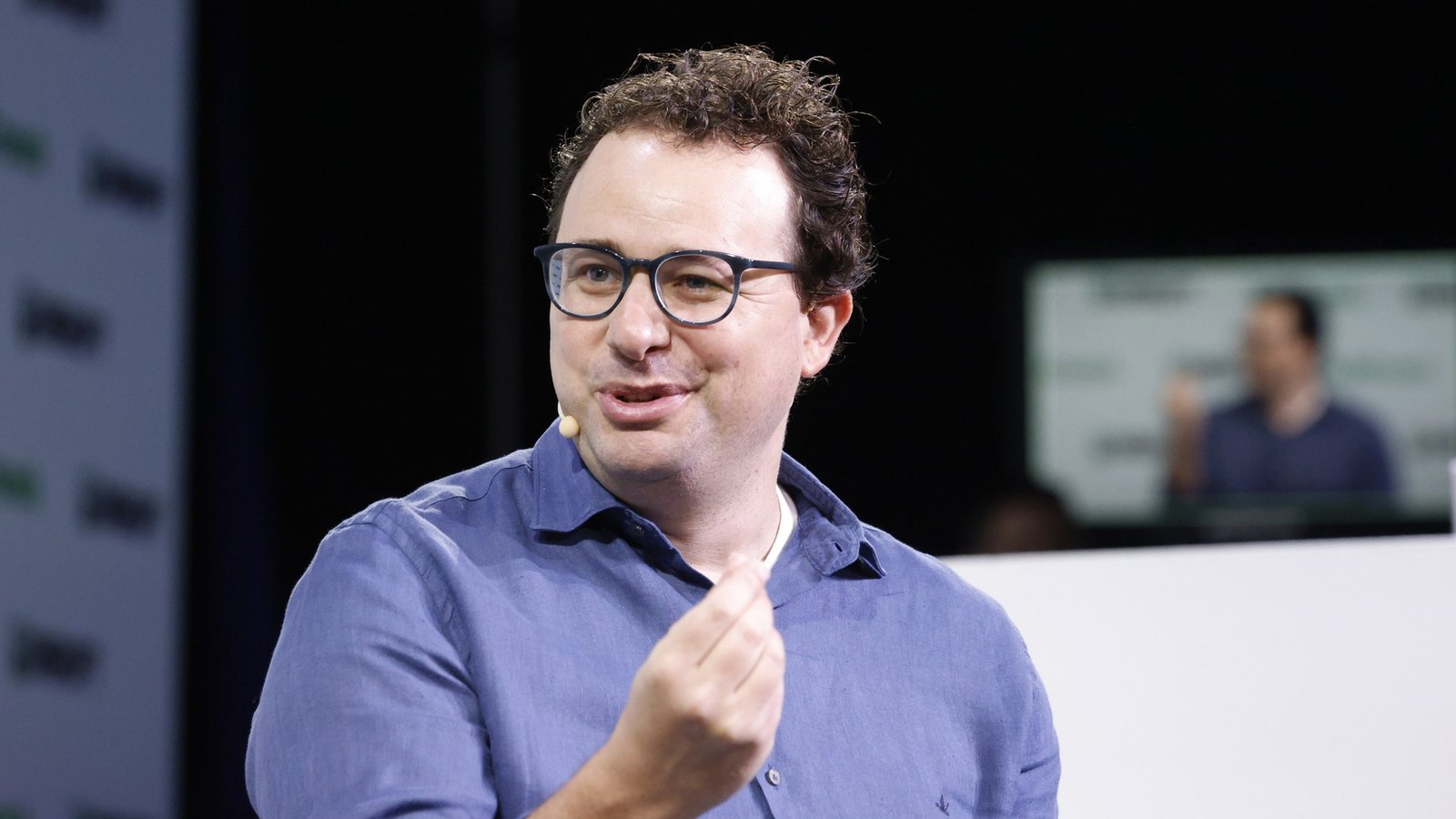
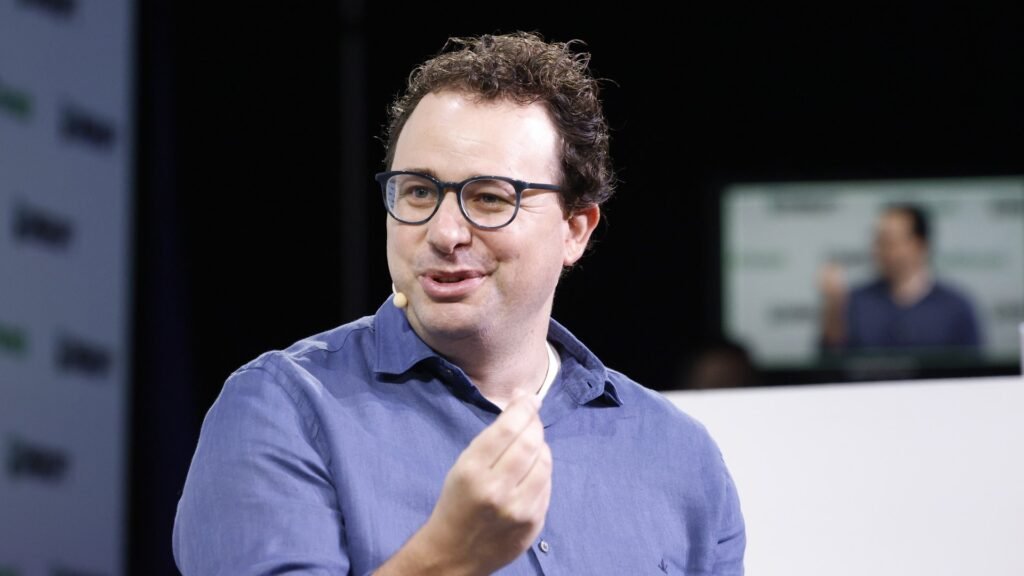
Image credit: Anthropic CEO Dario Amodei at TechCrunch Disrupt 2023 in San Francisco. Photo: TechCrunch via Wikimedia Commons, CC BY 2.0 (cropped).