



A robot insect at MIT can now find its own way through the air. The 1.29-gram flapping-wing machine carries its own sensors and microcontroller, and in a paper published Nov. 18 in Science Robotics it flew a 30-second course outside the lab’s camera-tracking system and landed on a sunflower. Its lab’s leader now has a deadline in mind for the whole field.
“The community has really reached what I think is a singularity moment,” MIT engineer Kevin Chen told Science in a feature published Nov. 24. The magazine reports that he predicts that within the next 2 years, “a fully autonomous flying robot the size of an insect could be ready to achieve the ultimate feat: leaving the lab to fly on its own.” The catch is sitting right there in MIT’s own announcement: the robot is still connected to an offboard power source.
Key points
- MIT’s 1.29-gram flapping-wing robot flew using only onboard sensing and computation and landed on a sunflower in a 30-second flight, according to its Nov. 18 Science Robotics paper, but it still gets power through a cord.
- MIT’s Kevin Chen predicts a fully autonomous insect-size flying robot could be ready to leave the lab within the next 2 years, Science reported on Nov. 24.
- A Chinese team’s 984-milligram FVW-Fly flew untethered on a 350-milligram battery for more than 240 seconds in low-power flight, its authors report, though it controls only its altitude.
- Earlier timelines slipped: a 2013 Scientific American essay by Harvard RoboBee researchers said such robots might be in widespread use 5 to 10 years after they first flew in the lab.
What MIT actually flew
Chen’s group in MIT’s Soft and Micro Robotics Laboratory builds a four-winged robot that Science calls SoftFly. Its wings are flapped by soft artificial muscles rather than motors. Until now, the robot flew blind: an external motion-capture system tracked it with cameras and an offboard computer did the thinking, MIT says.
The new version moves that work onboard. To carry the extra weight, the team made the artificial muscles 50% bigger, which MIT says raised the robot’s net lift by 46% and gave it a lift-to-weight ratio of 1.9. That margin carries a 244-milligram electronics package with an inertial sensor for orientation, an optical-flow sensor for sideways speed and position, and a time-of-flight sensor for height. MIT says the electronics use only about 6% of the robot’s total power; the wings take the rest.
In the sunflower demo, a person steered with a joystick that sent high-level position targets, and the robot’s onboard controller handled the flying. The paper describes it as a hierarchical controller in which “a human operator provides high-level commands.” So it’s onboard, not unsupervised. Science adds that assembling a SoftFly from scratch takes an experienced engineer about a week.
The prediction, and the word doing the heavy lifting
Chen’s 2-year call is a prediction, reported by Science, not a published plan. It also hangs on “fully autonomous,” which today’s MIT robot isn’t. MIT says the team’s next two goals are a camera for object recognition and obstacle avoidance, and onboard power electronics and batteries “which would enable untethered flight in an outdoor environment.”
Our read: a bug-size robot flying on its own, outdoors, for a short hop is a plausible lab milestone within 2 years. A robot that does a job out there is a different and much later milestone. Chen himself draws that line in the same story: “On the other hand, we have to recognize that there are cases in which we cannot compete with insects.”
The battery problem, by the numbers
Power has been the wall for nearly three decades. When Berkeley’s Ronald Fearing started his insect-flyer project in 1998, he assumed someone would invent a battery small enough by the time it flew. He now calls that “the most optimistic part of the whole project,” according to Science. “Fundamentally, the way batteries work is what needs to be changed,” Harvard postdoc Elio Challita told the magazine.
The closest anyone has come is in China. In an Oct. 22 paper in Nature Communications, a team at the National University of Defense Technology described FVW-Fly, a 389-milligram, four-actuator robot with a 6.8-centimeter wingspan. With a 173-milligram drive circuit and a 350-milligram lithium battery, the whole system weighs 984 milligrams. The authors report flights of more than 240 seconds in low-power mode and climbs past 10 meters, a height they say was capped by the lab ceiling and Bluetooth range.
Here’s how the two state-of-the-art robots compare, using each team’s own figures:
| MIT (Science Robotics, Nov. 18) | NUDT FVW-Fly (Nature Communications, Oct. 22) | |
|---|---|---|
| Total mass | 1.29 g | 984 mg |
| Power | Cord to an offboard source | 350 mg onboard lithium battery |
| Onboard sensing | Inertial, optical-flow and height sensors | Time-of-flight height sensor |
| What it controls | Hover and trajectories; joystick sets targets | Altitude only; yaw drifts while hovering |
| Longest reported flight | 30-second course outside motion capture | More than 240 s (low power); about 125 s of battery with altitude control |
| Wing muscles | Soft artificial muscles | Piezoelectric ceramics |
Our math: the battery is 36% of FVW-Fly’s weight, and battery plus drive electronics (523 milligrams, per the paper) are 53%. Holding altitude pushed the average power from about 400 to about 634 milliwatts, cutting the battery’s effective endurance to roughly 125 seconds, the authors write. Its lead author, Lu Xiang, told Science the bot has no directional control yet. The authors say heat and the battery’s discharge limits cap its flight time.
MIT has the brain; NUDT has the battery. Combining them isn’t a matter of bolting one onto the other. Science reports that the soft muscles that make MIT’s robot crash-tolerant “require much more energy” than the piezoelectric ones Harvard and NUDT use, which is why Harvard stuck with piezos.
Scorecard: how earlier timelines aged
Robot-insect researchers have made forecasts before. Here’s how they’ve held up:
| When | Who and where | What they said | What happened |
|---|---|---|---|
| 1998 | Ronald Fearing, UC Berkeley (per Science, 2026) | Assumed a small enough battery would exist by the time the robot flew | He now calls it the project’s most optimistic assumption |
| Mar 2013 | Wood, Nagpal and Wei (Scientific American) | Lab flight “within a few years”; “within five to 10 years beyond that, you may see them in widespread use” | Science‘s 2026 feature is still asking when they’ll fly beyond the lab |
| May 2013 | Kevin Ma, Harvard (Science news) | Hoped RoboBee would fly untethered with its own power and sensors within about 2 years | Harvard’s first untethered RoboBee flight came in 2019, on solar cells under lamps about 3 times as bright as the sun, without onboard steering (a University of Washington robot had flown cord-free on a laser beam in 2018) |
| 2014–2015 | Harvard’s RoboBee team (via National Geographic; Nature) | Robotic pollination “at least 20 years away” (2014); “could be 20 years away” (Wood, 2015) | Window runs to about 2034 to 2035; still open |
| Jan 2025 | Kevin Chen, MIT (MIT News) | Sensors, batteries and computing onboard would be “a central focus in the next three to five years” | Sensors and computing onboard after about 22 months; battery not yet on MIT’s robot |
| Nov 2026 | Kevin Chen, MIT (Science) | A fully autonomous insect-size robot could be ready to leave the lab within 2 years | Open |
The pattern: the lab milestones keep arriving, just later than promised, and the leap from “it flew” to “it works out there” keeps getting pushed out. The 2019 Harvard robot, the RoboBee X-Wing, flew untethered but needed light “about three Earth suns” bright, which Harvard said made outdoor flight “out of reach for now.” Seven years on, the two newest robots in Science‘s survey split the job: one has the brain, the other has the battery.
What would have to happen for Chen to be right
- Power and brains in one body. Some team has to fly a robot that carries both its battery and its sensing and control. FVW-Fly’s authors say their next steps are better batteries, adding solar charging and shrinking the circuit into chips to free up payload.
- Steering without a tether. FVW-Fly holds height but can’t steer, and its heading drifts. Untethered robots will need full control in every direction.
- Durability. Science reports SoftFly now survives about 30 minutes of flight before an artificial muscle wears out and has to be replaced with a razor blade. A foraging bumble bee collides with something about once a second on average, UC Davis biomechanical ecologist Stacey Combes told the magazine.
- Real air. Wind, light and clutter outdoors are harder than a curtained arena. MIT’s December 2025 robot handled gusts of more than 1 meter per second in the lab, but its controller ran on an external computer, an outside expert noted in MIT’s announcement.
- Eyes. MIT’s next goal is an onboard camera for recognizing objects. Without one, “autonomous” mostly means holding a course.
Who this would affect, and the pollination pitch
MIT’s announcement leads with farming: robots that could pollinate almond trees or blueberries “in regions where natural pollinator populations have been decimated by habitat loss.” Chen has been more measured. “Bees are doing great in terms of open-field farming,” he told Offrange in January, adding that indoor farming is a kind of pollination he thinks could be considered in the longer term. Harvard’s team said back in 2014 that robots would only ever be a stopgap, not a substitute for bees.
Search and rescue is the other big pitch: robots small enough to slip through rubble. It’s also why the money trail runs through defense. MIT lists the U.S. Office of Naval Research and Air Force Office of Scientific Research among its funders, Fearing’s project was funded by the Defense Department, and Science traces the whole idea back to a 1970s CIA dragonfly drone called Insectothopter, built to carry a listening device. Spying is on Science‘s list of hoped-for uses, too, which is worth keeping in mind before anyone celebrates bugs that fly themselves.
What to watch
- A paper with battery and sensing on one robot. That’s the real starting gun for Chen’s 2-year clock, whether it comes from MIT, NUDT or Harvard.
- Steering for FVW-Fly. Lu told Science untethered control in every direction is next. A steerable version would be the first sub-gram flapper that can both power and steer itself.
- An outdoor flight that isn’t a takeoff. NUDT’s paper shows an outdoor takeoff. Look for a self-steered flight in wind, with the distance and conditions published.
- Flight hours between repairs. Thirty minutes per artificial muscle is fine for a paper, not for a field.
- Late 2028. That’s when Chen’s 2-year window, counted from Science‘s Nov. 24 feature, runs out.
The takeaway
Insect-size robots are closer to flying free than they’ve ever been: one now thinks for itself on a cord, and another carries its own battery but can only go up and down. Chen’s 2-year prediction is a reasonable bet on a lab demo. It isn’t a forecast of robot bees in orchards, and the field’s own history says to add time to every date.
Hype in. Signal out.
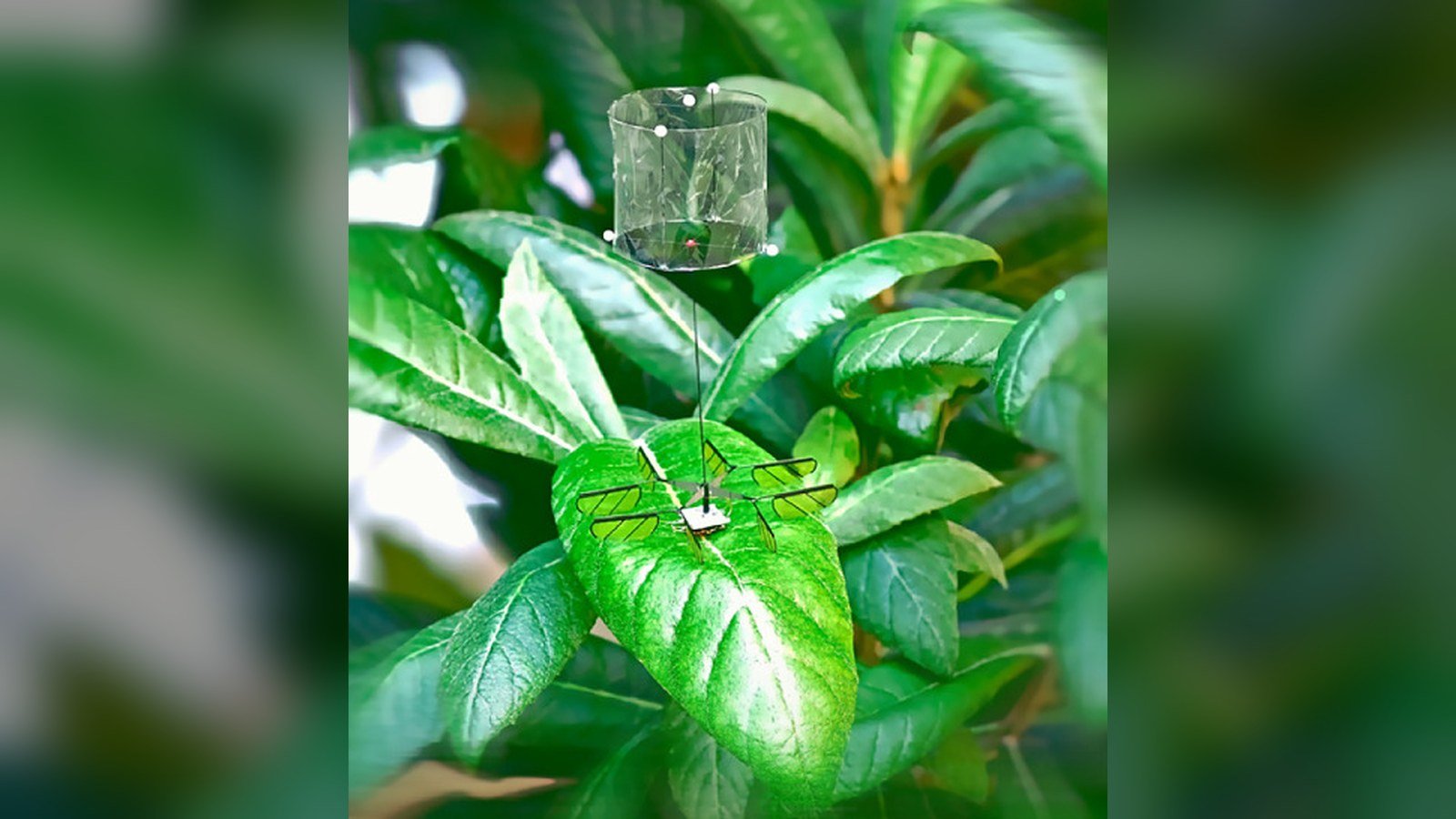
Image: the FVW-Fly flapping-wing robot perched on a leaf, from Fig. 1e of Lu Xiang et al., “An untethered sub-gram flapping-wing flight system achieves sustained self-stabilizing and altitude-controlled flight,” Nature Communications (2026), licensed CC BY 4.0; cropped from the figure and padded to 16:9 with a blurred background. It is the Chinese team’s robot, not MIT’s.