China’s biggest humanoid maker wants the industry to stop bragging about how many robots it builds and start counting how much work they do. At its Innovation Day in Shanghai on Thursday, AGIBOT proposed a new unit for that, the “Worken,” then launched a heavy-lifting factory robot, a new robot brain and an open-source robot operating system to go with it.
Key points
- AGIBOT proposed the “Worken,” a productivity unit that multiplies active robots by autonomous working hours and an output efficiency ratio.
- AGIBOT published no Worken score of its own and hasn’t said who sets the reference benchmark or whether anyone audits the hours.
- Its new G2 Max is a wheeled, dual-arm industrial robot rated by AGIBOT for 40 kg with both arms, with no price or delivery date announced.
- AGIBOT’s GO-3 Preview benchmark wins are self-reported, and the company says its Link-U OS will be fully open source by the end of 2026.
It’s a clever pitch from a company that has shipped more humanoids than almost anyone. It’s also a measuring stick designed by the company that would like to be measured by it, and AGIBOT didn’t publish a single Worken score of its own. Here’s what was announced, and what we’d want to see before anyone starts quoting robot productivity in Workens.
Worken, explained
According to AGIBOT’s English release (also on PR Newswire), Worken mashes together “Work” and “Token,” a nod to the way AI companies now count output in tokens. AGIBOT describes it as “Effective Intelligent Work Hours” and gives a formula:
Worken = Number of Active Robots × Autonomous Working Hours × Output Efficiency Ratio
- Active robots counts machines actually doing tasks in real environments, not units built or sitting in inventory.
- Autonomous working hours counts time spent working without help, not total powered-on time.
- Output efficiency ratio compares the robot’s acceptable output on a defined task against a reference, such as what a human worker completes under established operating standards.
Co-founder, president and CTO Peng Zhihui framed it as a reality check for the whole sector: “As robots begin working in factories, warehouses and service environments, we need to answer a more practical question: how much productive work are they actually delivering?” He added that AGIBOT wants “to move beyond measuring how many robots are built or delivered and begin measuring how effectively they can perform useful work.”
The company calls Worken “an evolving framework” that it will refine with deployment data and task-specific benchmarks. It also appears in a new “2026 Embodied Intelligence Industry Innovation Report,” compiled by China Economic Information Service and the Shanghai Industrial Innovation Center of the China Academy of Information and Communications Technology (CAICT), which uses AGIBOT’s deployments as examples.
Why this metric, and why now
Humanoid makers have spent 2026 announcing production milestones. AGIBOT says its 20,000th robot rolled off the line in September. Rivals post their own counts, and the stunts keep coming: on Oct. 24, AGIBOT itself got 110 of its Expedition A3 humanoids into a Guinness record for synchronized dancing in Jinan. Impressive coordination, zero boxes moved.
Production counts say little about paid work. Counterpoint Research estimates that more than 60% of humanoid shipments in the first half of 2026 went to entertainment, data collection and research, not to factories or warehouses. A metric that discounts idle, demo and teleoperated hours would expose that gap, which is exactly why it’s interesting that a market leader is the one proposing it.
Our read: Worken is a decent idea with an obvious weak point. The output efficiency ratio depends on a “reference benchmark,” and AGIBOT hasn’t said who sets it, how human baselines are measured, or whether anyone outside the company audits the hours. A robot that does 30% of a human’s output for 20 hours a day could post a healthy number while still losing money for its owner. Until there are shared task definitions and independent checks, Worken is a marketing unit with a formula attached.
The new hardware: G2 Max and AHA3
The most concrete launch was G2 Max, a wheeled, dual-arm industrial robot rather than a walking humanoid. AGIBOT’s release lists 21 degrees of freedom, dual-arm handling of up to 40 kg and an adjustable working height from 0.1 to 2.5 meters. A Chinese-language launch post from Oct. 26 adds the detail factory buyers actually ask for:
- Each arm handles 20 kg; both together are rated at 40 kg, with a 50 kg peak. Repeatability is listed at ±0.5 mm or better.
- AGIBOT says the payload covers more than 95% of industrial totes, using 7-degree-of-freedom force-controlled arms.
- Horizontal reach is 1.2 meters, so it can palletize from one side without the usual 1.5-meter clearance.
- In an e-commerce warehouse, AGIBOT claims a success rate above 99%, about 80 cases an hour depalletizing and 75 an hour palletizing.
- Dual hot-swappable batteries plus automatic recharging are meant to allow 24/7 operation, with 2D and 3D lidar, ultrasonic sensors, a bumper and an emergency stop for 360-degree safety.
The best detail is a little recursive. At a robot factory run by Hu Guang (沪光股份), a G2 Max carries limb-joint parts such as shoulder housings and hip assemblies to the final-assembly stations for a humanoid called the Qiyuan T1, keeping pace with a line that finishes one robot every 2.5 minutes. Factory head Zhou Ye described the takt curve as “almost a straight line,” according to the Chinese post. Robots building robots is the dream; robots carrying parts to the people building robots is the honest current version.
AGIBOT also introduced AHA3, its third-generation humanoid hardware architecture. It bundles motor drives, onboard computing and Wi-Fi 6 and 5G connectivity, plus joint liquid cooling for continuous operation and IP67-rated joints for dusty or wet sites. A new hand family spans OmniHand 3 Lite, OmniHand 3 and OmniHand 3 Ultra, along with an OmniPicker 3 tactile gripper.
Here’s what AGIBOT’s G2 line looks like at work
AGIBOT hasn’t posted a G2 Max video yet. This clip from its official YouTube channel, published in September, shows what the company says a deployment of more than 300 robots looks like in practice.
The software: GO-3 Preview, WITA-Omni and Link-U OS
On the AI side, AGIBOT debuted GO-3 Preview, a foundation model built on what it calls WRAM, a “World Reasoning Action Model” that combines reasoning, prediction and action so a robot can anticipate the consequences of what it’s about to do. The company demonstrated zero-shot and few-shot tasks and said GO-3 Preview ranked first on RoboDojo, achieved the top overall score on RoboTwin and placed first on RoboColiseum.
It also showed WITA-Omni, a model that fuses vision, speech, full-duplex conversation, facial expressions and body movement for robots that deal with the public, and claims it ranks first on several embodied-interaction benchmarks, including Daily-Omni. Its AGILE motion framework gained a “self-evolving agent” that’s meant to let robots probe their physical limits and improve through experience.
The catch: all of those benchmark wins are self-reported, presented on AGIBOT’s own stage. Humanoids Daily notes the results haven’t been independently verified. Robot benchmarks are also far less settled than language-model leaderboards, so “first on RoboDojo” tells you less than “first on SWE-bench” would.
The most consequential software news may be the least flashy. AGIBOT released Link-U OS 1.0, which it bills as the first operating system built for embodied intelligence, with a hardware abstraction layer between robot bodies and the apps that run on them. Selected partners are trialing it now, AGIBOT says it will be fully open source by the end of 2026, and the company is donating the project to China’s OpenAtom Foundation, where it has become a Platinum sponsor. AGIBOT says its ecosystem spans 255 universities, 511 companies and more than 80,000 developers.
If Link-U OS catches on, AGIBOT gets to shape the plumbing of Chinese robotics the way Android shaped phones. That’s a bigger strategic play than any single robot.
Where the robots are working
AGIBOT pointed to deployments in tablet production at contract manufacturer Longcheer, where its G2 robots handle line-side materials and are judged on cycle time, sustained operation and task completion. It also listed semiconductor packaging and testing, CNC machine tending, logistics, service robots at Guangzhou Metro and the Chimelong tourism complex. Those are real sites, but the release gives no hours, fleet sizes or output figures for any of them. You’d think a company launching a productivity metric would lead with its own.
Business context matters too. Humanoids Daily reports AGIBOT booked 1.05 billion yuan in 2025 revenue and began its Hong Kong IPO process on July 24, 2026. A company heading toward public markets has every reason to change the conversation from units shipped to value delivered, especially if investors start asking how many of those 20,000 robots are doing paid work. The Robot Report has more on the full slate of announcements.
What it means
In our ranking of the most advanced robots last week, the recurring theme was the gap between what robots can do in demos and what they do on paid shifts. Worken is the first serious attempt by a big manufacturer to put a number on that gap. If competitors, customers and auditors adopt something like it, robotics gets a much more honest scoreboard. If it stays an AGIBOT-only metric, it’s just a nicer-sounding way to present AGIBOT’s numbers.
What to watch next
- A published Worken score. Fleet size, autonomous hours and output ratio for at least one named customer site.
- Third-party benchmarks. Independent runs of GO-3 Preview on RoboTwin or similar suites.
- Link-U OS source code. Whether the full open-source release actually lands by the end of 2026, and under what license.
- G2 Max orders and pricing. AGIBOT hasn’t announced a price or delivery dates.
- The Hong Kong IPO filing, which would force far more detailed disclosure of deployments and revenue than a launch event does.
The takeaway
AGIBOT asked the right question this week: how much useful work are all these robots actually doing? It then answered with a formula, a heavy-duty robot and an open-source OS, and no numbers. Worken could become a useful industry yardstick, but only once someone other than AGIBOT holds the ruler.
Hype in. Signal out.
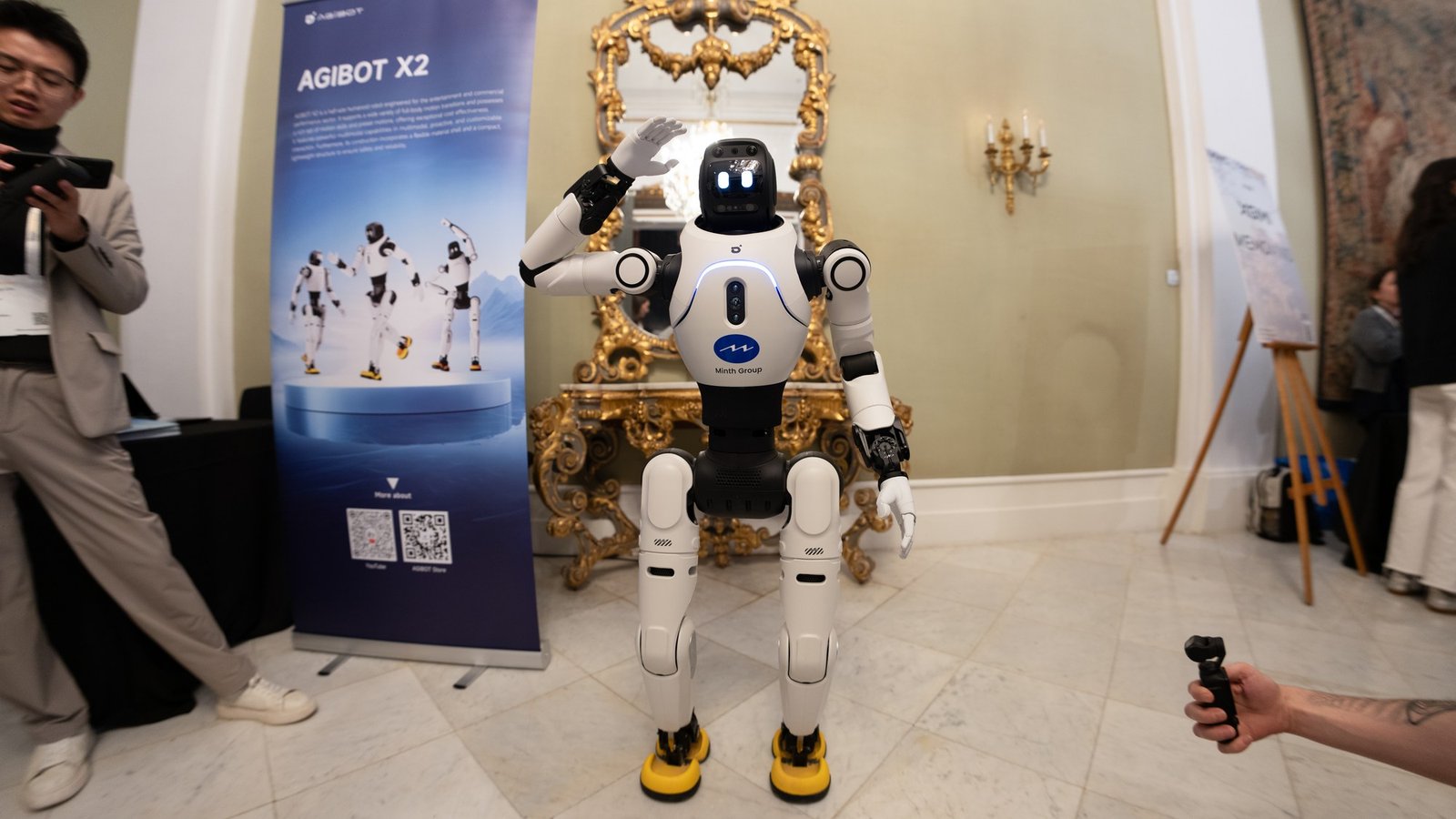
Image: An AGIBOT X2 humanoid on display during MWC 2026 in Barcelona. Photo by JJxFile / Wikimedia Commons, CC BY 4.0; cropped to 16:9.