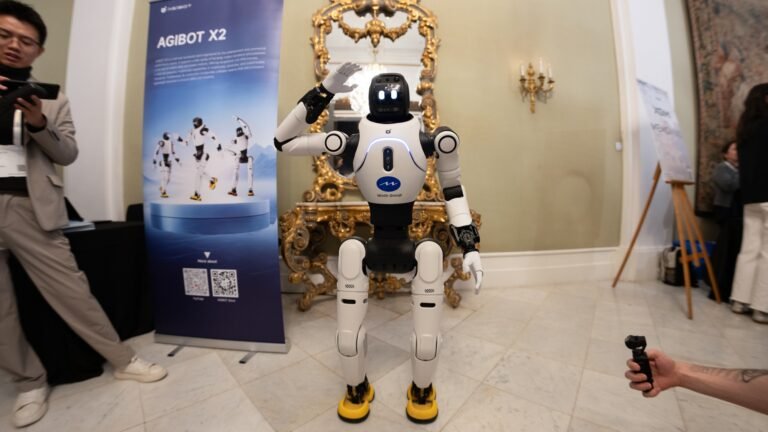
In Shanghai on Thursday, AGIBOT spent a good chunk of its annual Innovation Day talking about robot joints. Its new humanoid architecture, AHA3, comes with liquid-cooled joints sealed to IP67, and a new family of hands that runs from the OmniHand 3 Lite up to the OmniHand 3 Ultra, according to the company. Five days earlier in Jinan, 110 of its Expedition A3 humanoids danced in formation for more than five minutes with no one steering them in real time, a stunt Guinness logged as a world record, China Daily reports.
Key points
- AGIBOT unveiled liquid-cooled, IP67-sealed joints and a new OmniHand 3 family this week, while a Zhejiang University team and Xiaomi each showed 21-joint robot hands.
- By the count most often cited in biomechanics the human body has about 244 degrees of freedom, and on big single joints like knees and waists some robots already exceed the human range, per company specs.
- The gap is touch and durability: the Torch-Hand preprint completed all 33 standard human grasp types but has no touch sensing, and its tasks were teleoperated or replayed.
- Timelines vary widely: Musk expects outside Optimus deliveries around the end of 2027, while a Bristol robotics professor told the BBC human-level dexterity may be about 10 years away.
That was the end of a busy week for robot knuckles. On Tuesday, a Zhejiang University team posted a preprint describing a 21-joint hand that lifted a 40 kg dumbbell and hit every one of the 33 standard human grasp types. The same day, Xiaomi showed its own 21-joint hand, packed with 1,500 touch points, per 42HOW. A week before that, on Tesla’s earnings call, Elon Musk named the hand as Optimus’s main problem.
Put it together and the shift is easy to see. The humanoid industry has mostly stopped arguing about whether robots can walk. Now the fight is over wrists, thumbs, spines and ankles: how many ways a machine can bend, and how close that gets to a person. So we went and counted. Here is how far robots really are from moving like us, joint by joint, and how long the people building them think the rest will take.
Your body has about 244 ways to move
Engineers describe motion in degrees of freedom, or DOF: each independent way a joint can rotate or slide. An elbow hinge is roughly one. A shoulder is three. By the count most often cited in biomechanics, from Vladimir Zatsiorsky’s Kinematics of Human Motion, the whole human body has 244 kinematic degrees of freedom. Counts run higher if you model joints differently, and the exact number matters less than its shape. Those 244 are spread everywhere: through the fingers, the shoulder blades, the ribs, the feet and a long, segmented spine.
The same paper makes a point robot builders tend to skip. Humans have more muscles than degrees of freedom. Several muscles pull on most joints, which looks wasteful on paper and turns out to be the trick. It lets you stiffen a wrist before you catch a ball, or go floppy when you trip.
The hand alone accounts for about 27 degrees of freedom: four in each finger, five in the thumb and six in the wrist. The spine is built from 33 vertebrae, and while the lower ones fuse, the rest let you twist, curl and absorb a landing in small increments that add up. No production humanoid has anything like it. The best have two or three joints where your torso has dozens.
Range of motion has hard numbers too. A CDC study of normal joint range of motion (Soucie et al., 2011) measured healthy people and found adults aged 20 to 44 averaged about 172 degrees of shoulder flexion for women and 169 for men. Knee flexion averaged about 142 and 138 degrees. Ankles are surprisingly stiff: roughly 13 to 14 degrees of upward bend and 55 to 62 degrees pointing down.
Then there is the part no spec sheet captures. Roboticist Rodney Brooks, who co-founded iRobot and Rethink Robotics, notes in a long essay on dexterity that the smooth skin of a human hand holds about 17,000 mechanoreceptors, roughly 1,000 of them in each fingertip. Joints are only half of moving like a human. The other half is feeling what the joints are doing.

Where today’s robots actually stand
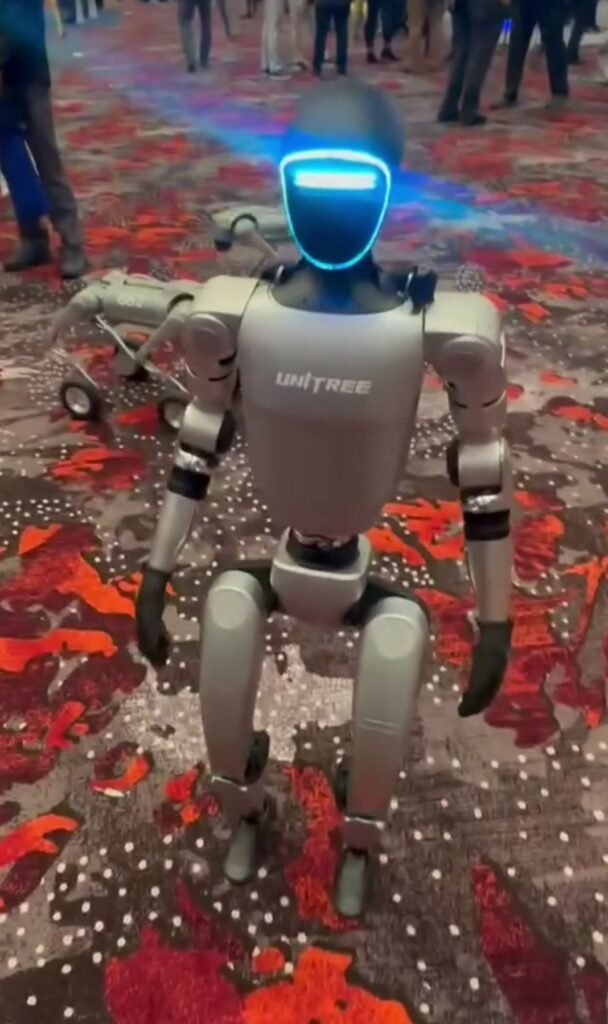
Here is the surprise in the numbers: on many single joints, robots already beat you. Unitree lists the knee of its small G1 humanoid as bending from 0 to 165 degrees, against roughly 140 for a human, and its waist as turning 155 degrees each way, per its spec page. Boston Dynamics’ production Atlas lists its range of motion simply as “continuous” on its product page. Many of its 56 degrees of freedom can keep turning where a human joint would hit a stop, which lets Atlas swivel its head, torso and limbs in ways no person can.
We pulled the published numbers for a handful of robots and set them against the human baseline. All robot figures are company specs unless noted.
| Machine | Total DOF | Hands | Torso/spine | Source |
|---|---|---|---|---|
| Human body | ~244 | ~27 per hand incl. wrist | 33 vertebrae, many small joints | Zatsiorsky via PMC; PMC |
| Boston Dynamics Atlas | 56 | New hand: 13 | Continuous rotation | Boston Dynamics |
| 1X NEO | 75 (our sum) | 22 each | 2 spine | 1X |
| Unitree G1 | 23 to 43 | Optional dexterous hands | Up to 3 waist | Unitree |
| Unitree H2-X | 31 | Not listed | Not listed | SpecsLib (secondary) |
| LimX Oli | 31 to 43 | Varies by configuration | 3 waist, 2 neck | LimX |
| AGIBOT G2 Max | 21 (dual-arm) | Not listed | Not listed | AGIBOT |
| Tesla Optimus hand (patent filing) | n/a | 22 finger DOF, plus 2 wrist | n/a | Supracite |
| Joint | Human average (CDC, ages 20 to 44) | Robot spec |
|---|---|---|
| Shoulder flexion | 169° (men) to 172° (women) | LimX Oli shoulder pitch: ±160° |
| Knee flexion | 138° (men) to 142° (women) | Unitree G1: 0 to 165°; LimX Oli: 5 to 148° |
| Ankle, up and down | ~13° up, 55° to 62° down | LimX Oli ankle pitch: −35° to 58° |
| Waist twist | Spread across many vertebrae | Unitree G1: ±155°; LimX Oli: ±150° |
Read the second table and a pattern jumps out. Big joints are not the bottleneck. A robot knee that folds 165 degrees or a waist that swings 300 degrees in total already exceeds the human envelope. The gap is in distribution. People spread motion across many small joints, while robots pile theirs into the limbs and treat the torso like a box. The 1X NEO has two spine joints. LimX’s Oli has three at the waist. Humanoid feet are mostly a rigid plate on a two-axis ankle, as Oli’s ankle spec of pitch plus roll shows.
The 1X NEO is the clearest case of a company spending its joint budget on hands. Of its 75 degrees of freedom, 44 sit in the hands, and the company says its tendon drive offers 95% backdrivability, meaning the robot gives way when you push it. Unitree went the other way with the H2-X, a 1.8 m, 70 kg machine with 31 degrees of freedom and joints that can put out 360 N·m, per SpecsLib. That is enough torque to backflip, and it turned out to be enough to break itself: a day after launch, an H2-X lost its lower leg landing a side flip on stage.
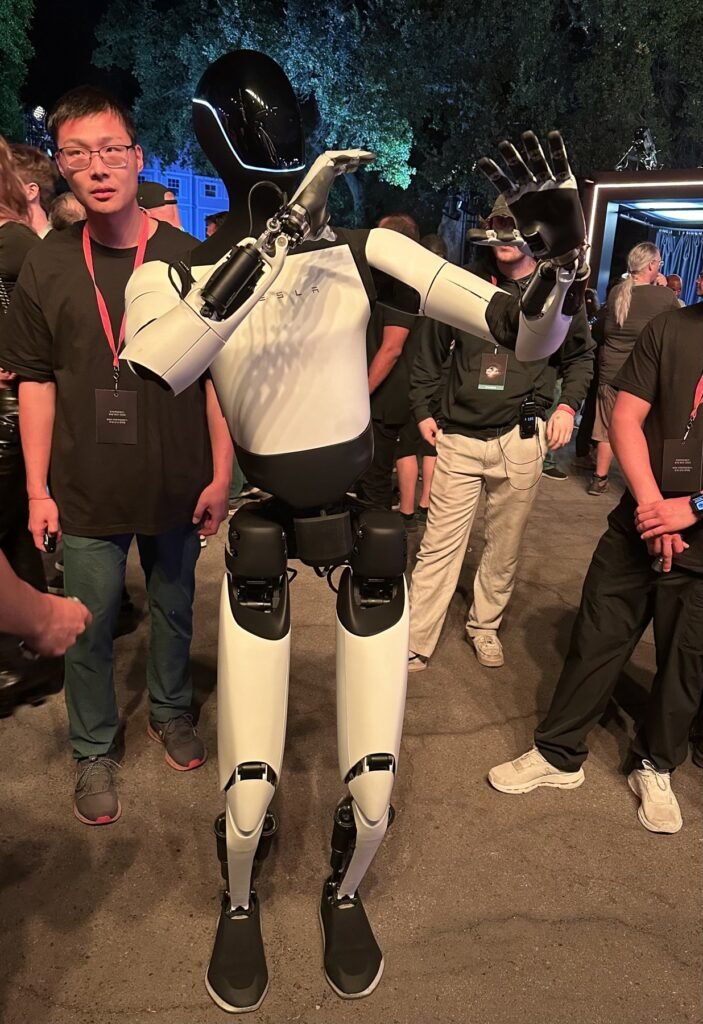
Tesla has said less in public, but a patent filing tells part of the story. Tesla’s WIPO application WO2026080701A1, summarized by Supracite, describes a hand with 22 finger degrees of freedom and two at the wrist, driven by linear actuators in the forearm that pull tendons. One embodiment shows 25 actuators in the forearm. That is a human-like layout: your fingers also get most of their strength from muscles in your forearm. The official Tesla clip below shows the Gen 2 robot from late 2023, with an earlier hand design.
Figure’s Figure 03, introduced a year ago, and 1X’s NEO are both pitched at homes, where the bar for safe, soft motion is higher than on a factory floor.
Muscles, motors and tendons
Every joint needs something to move it, and the choice of actuator decides a lot about how human the result can feel. Most humanoids today use electric motors with gearboxes at each joint. They are precise, cheap to control and easy to build at scale. They also run hot, and heat caps how long a joint can push hard. That explains AGIBOT’s emphasis on liquid cooling. Trade outlet eefocus reports that AGIBOT’s PowerFlow joint cuts continuous operating temperature by 20% with liquid cooling and reaches a peak torque density of 350 N·m per kilogram. Those figures come from secondary reporting; we could not confirm them in AGIBOT’s own release.
Hydraulics are the strongest option for their size. The old Atlas ran on them. Sanctuary AI still does, in its hands: the Canadian company says miniaturized valves give it an order of magnitude more power density than cable-driven or electromechanical designs, and that those valves have been tested past two billion cycles, per its announcement. The video below shows those hands turning objects between the fingers, the kind of in-hand manipulation most robot grippers can’t attempt.
Then there are the companies trying to copy the body directly. Poland-based Clone builds what it calls Myofibers, water-powered artificial muscles that the company says contract more than 30% in under 50 milliseconds, with a 3 g fiber pulling at least a kilogram, per Clone. Its Protoclone is described in Clone’s own video as a faceless, anatomically accurate android with more than 200 degrees of freedom and over 1,000 Myofibers. If those claims hold up, that is the closest any machine has come to the human joint count. It is also a twitching torso on a frame, not a robot doing a job.
Tendons are the middle path. Put the motors in the forearm and run cables to the fingers, and you get a light, slim hand. 1X does this, Tesla’s patent does it, and Xiaomi uses a hybrid: mostly tendons, with five directly driven joints, which lets it keep the palm to 324 g, 42HOW reports. The Zhejiang Torch-Hand goes the opposite way, packing the motors into the palm and driving the fingers through screw linkages. Tendons stretch and fray; linkages are stiff and durable but bulky. Nobody has settled the trade.
Power matters too. On Wednesday, XPENG said the solid-state battery for its IRON humanoid entered pilot production, claiming it is 30% lighter with 30% more capacity, per EnergyTrend. The robot itself is still pre-production. XPENG’s video explaining why IRON looks so human leans heavily on its soft, realistic synthetic skin.
Hands are the hardest problem
Boston Dynamics made the most interesting bet this month by going backward. Its new Atlas hand has 13 degrees of freedom, up from 7, but only three fingers and a thumb. The pinky is gone. Each joint is directly driven and backdrivable, and some fingers splay past what a human hand can do. The design aims at reinforcement learning, not mimicry. “With reinforcement learning, we can discover uses for these superhuman extra motions and exploit them,” Boston Dynamics’ Alberto Rodriguez said, per IEEE Spectrum.
Xiaomi went the other way and copied the human more closely, but used data to decide how closely. According to 42HOW and IT之家, Xiaomi analyzed 2,579 standard operating procedures across 16 factory workstations and built the design around 1,827 of them, covering more than 70.8% of manual operations. Xiaomi says hands with 17 to 21 degrees of freedom achieved 15% to 38% higher stable grasp success than hands with 6 to 15, and that the gains flatten out past 23. It also built in 1,500 tactile sensing points, at 1 mm resolution on the fingers. Xiaomi gave no production date or price.
The Torch-Hand preprint is the most direct attempt yet to match human hand anatomy. The Zhejiang team gives it 21 degrees of freedom: four per finger and a five-joint thumb with a three-axis base, like ours. The paper lists finger knuckles that bend 90 degrees and a thumb base that rotates 85 degrees. It reports fingertip forces of 52.65 to 64.69 N, about three times the 19.5 N of the open-source LEAP hand it compares against, plus grip strength above 100 N and repeatability to about 0.03 mm. It completed all 33 grasps in a standard human taxonomy and every position on the Kapandji thumb test, a clinical exam for thumb mobility.
Read the fine print, though. The tasks were teleoperated or replayed from a data glove, not done autonomously. The hand has no touch sensing. The paper gives no weight, no cost and no durability testing. It is a preprint, not yet peer reviewed. As a skeleton, it is close to human. As a hand, it can’t feel what it’s holding.
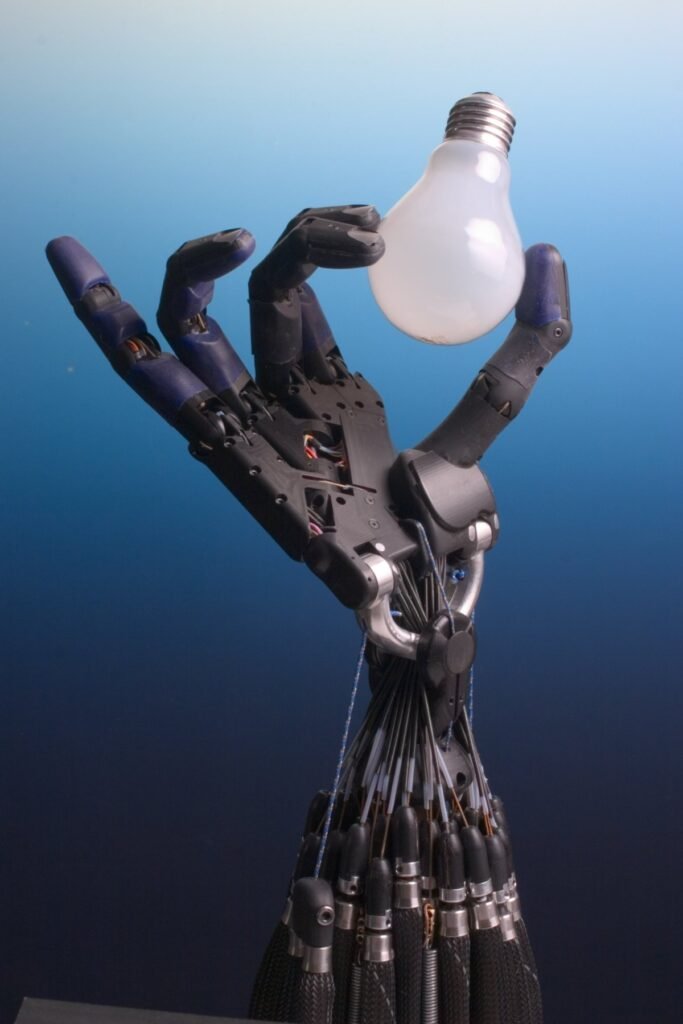
That gap is the whole story of robot hands. The UK’s Shadow Robot Company has sold a 24-joint hand with 20 actuated degrees of freedom for years, per Shadow. It weighs 4.3 kg. In a BBC report in February, Bren Pierce, founder of Bristol robotics start-up Kinisi, said that when you ask labs how long their best touch sensors last, “They say ‘six months’,” while industry wants a robot that works for 10 years. Kinisi’s prototype hand cost around £4,000 to make, the BBC reported, 10 times the £400 pincer the firm uses now. Human-level kinematics are now achievable. Human-level skin, at a price a factory will pay, isn’t.
Tesla’s experience lines up. On the Q3 call, Musk said the hand was the main issue for Optimus, because fingers have to be soft enough for delicate work and tough enough to survive it, Electrek reports. Figure CEO Brett Adcock said at the company’s October 22 all-hands that its fourth-generation hand is “approaching human parity,” according to Humanoids Daily. Figure did not publish a benchmark to back that up.
AGIBOT, for its part, likes to measure hands with contests. Its official channel shows the company’s hands at the World Humanoid Robot Games in August, building blocks, weighing powder and picking up beans with tweezers.
Balance is the quiet win
If hands are the hardest problem, whole-body balance is the one robots have quietly started to solve. Older humanoids walked by carefully keeping their center of pressure inside their footprint, which is why they shuffled. Newer ones learn balance in simulation and treat the whole body as one system. AGIBOT’s 110-robot dance in Jinan, five-plus minutes of synchronized motion without real-time human control per Xinhua, would have been unthinkable a few years ago. So would a robot falling, rolling and standing back up without help.
Agility’s Digit 5, introduced in September, pushes the other half of balance: being safe while you do it. Agility calls it its first humanoid engineered for cooperatively safe work, meaning people can work nearby without safety fences. Its own video adds the standard caveat that safety features do not eliminate all operational risk.
That caveat matters. Brooks advises staying three meters away from any full-size walking humanoid, in his essay, because a full-size walking machine that falls carries a lot of energy. Unitree’s own H2-X launch video asks viewers to keep two to three meters back. The H2-X leg failure showed why. A robot can be very good at generating force for a jump and still be poor at absorbing it on landing. Human legs soak up impact through tendons, cartilage and dozens of small joint motions. Robot legs mostly route it into one knee.
The software is doing more of the work
The biggest change of the last two years is not a joint. It is how joints are controlled. Boston Dynamics now trains Atlas’s movements with reinforcement learning, using human motion capture and animation as reference, and trains those policies in simulation before they touch real hardware. Its new hand was designed specifically for that sim-to-real pipeline: direct drive and backdrivability make the real hand behave like its simulated twin.
AGIBOT’s Thursday announcements were heavy on this layer, per Humanoids Daily: a motion framework called AGILE with what it describes as a self-evolving agent, a GO-3 model, the MEgo Glove to capture fingertip and palm forces from human workers, and a Link-U OS it says it will open-source by the end of 2026. We looked at AGIBOT’s new productivity unit, the worken, earlier today. The benchmark claims are AGIBOT’s own and have not been independently tested.
Google DeepMind is attacking the same layer from the AI side, working with Apptronik to put its Gemini Robotics models into Apollo humanoids.
Here is the catch Brooks keeps raising. Video teaches a model what a hand looks like doing something. It does not teach what the fingertips felt. He describes a classic experiment where a person with anesthetized fingertips fumbles a simple task that takes seconds with normal touch. Until robots collect touch data at scale, he argues, learned dexterity will hit a wall. That is why AGIBOT’s force-sensing glove and Xiaomi’s 1,500 tactile points may matter more than either company’s joint counts.
For a reality check on autonomy, Figure is useful because it published a number. Its Helix 2.5 model succeeded in 237 of 420 trials across 30 homes, about 56%, Humanoids Daily reports. That is real progress, and it is also a robot that fails almost half the time in someone’s kitchen.
How long, according to the people building them
Timelines depend heavily on who is talking and what they are selling. Musk said on the Q3 call that Tesla expects to start delivering Optimus to outside customers around the end of 2027, per Electrek. That is a company forecast, and Tesla’s robot timelines have slipped before; we covered its Fremont production start last week. Figure says its Figure 04 has reached design lock and Adcock teased Helix 3.0, its next AI model, as “baby AGI.”
The researchers are more cautious. Nathan Lepora, professor of robotics and AI at Bristol University, told the BBC that human-level robot dexterity “won’t happen in two years, but we might be talking about 10 years.” Brooks is bleaker. He wrote that we are “more than ten years away from the first profitable deployment of humanoid robots even with minimal dexterity,” and predicted that in 15 years successful humanoids will look like neither today’s designs nor us.
Even in China, where the hardware is moving fastest, executives disagree. At the Boao Forum in March, CNA reported, SenseTime co-founder Wang Xiaogang said robotics’ ChatGPT moment could come in about two years. Vivo’s Shao Hao put it closer to a decade. Baidu’s Shen Dou said stability, durability and dexterity still face “relatively large challenges.”
Our read: the kinematics race is nearly over. Lab hands now match the human joint layout, and big robot joints already move further than ours. A robot with human-like skeletal freedom from head to foot is a few years of engineering away, mostly in spines and feet. A robot that moves like a person, soft when it should be soft, aware of what it touches and able to take a hit without snapping, is at least a decade out on the evidence so far. The joint count was never the hard part. Skin, durability and judgment are.
What to watch next
Several near-term checkpoints will show whether this week’s hand news holds up. The Torch-Hand team still has to show its 21 joints survive thousands of hours of use, and what the hand weighs and costs. Xiaomi has given no ship date for its hand, and its grasp-success data is self-reported. AGIBOT has promised to open-source Link-U OS by the end of the year, which would let outsiders test its motion claims. XPENG’s IRON is still in pre-production, per EnergyTrend, so watch whether the battery pilot turns into a robot customers can buy. Tesla’s AI5 chip, which Musk tied to Optimus, is due around April 2027.
The most telling number, though, may come from Boston Dynamics. If a 13-joint, four-finger hand trained in simulation beats 21-joint human copies at real factory work, the industry will have its answer: humanlike was never the goal. Useful was. For the full field, see our ranking of the 10 most advanced robots.
Hype in. Signal out.
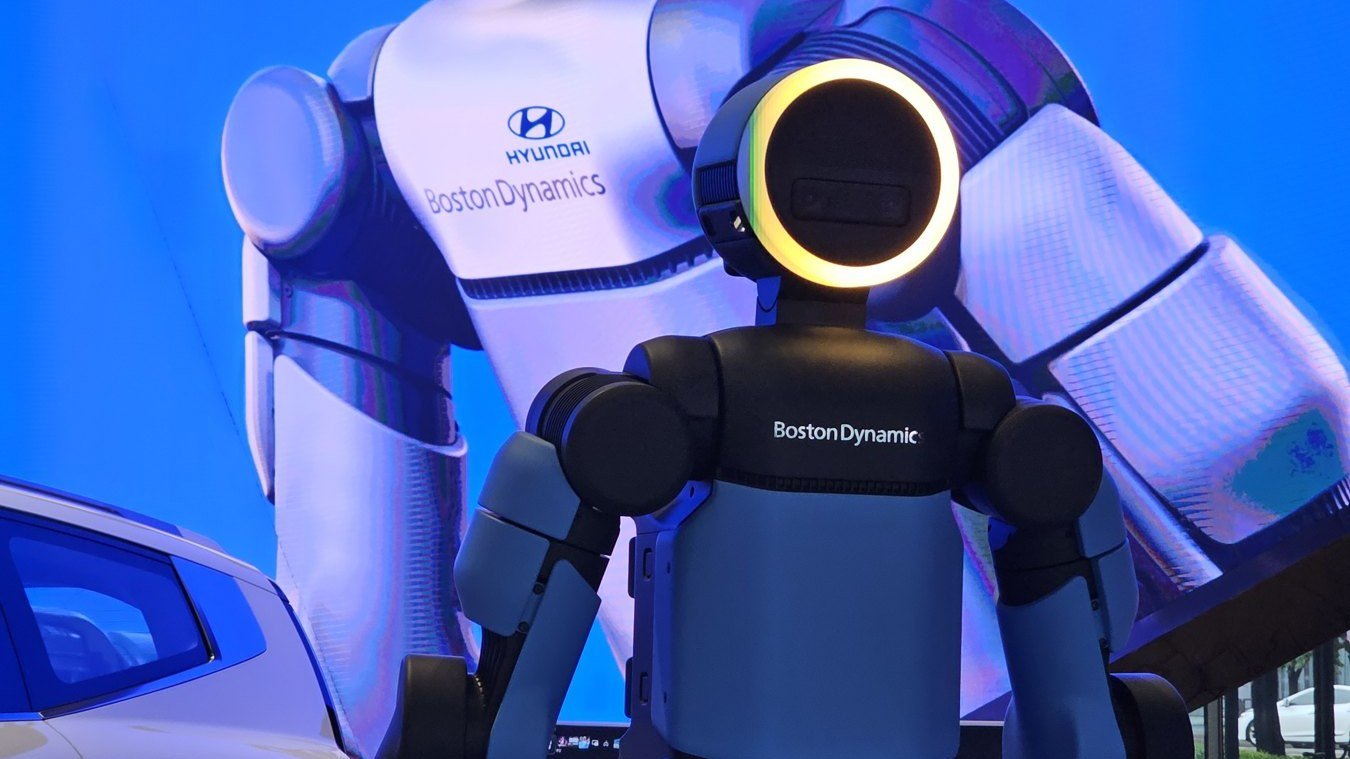
Top image: Boston Dynamics’ Atlas at Hyundai Motorstudio Goyang, South Korea. Photo by Damian B Oh / Wikimedia Commons, CC BY-SA 4.0; cropped to 16:9.