


Pebble’s Index 01 is a $75 ring that does one thing: hold its button, talk, and the Pebble app on your phone turns what you said into a note, a reminder, a shopping-list item or a question for an AI agent. It has no screen, no health sensors and no charging port. The battery is sealed in, and Pebble says it lasts 2 to 3 years on average before you’re asked to mail the ring back for recycling. This week, reviews from Engadget and BGR landed, and both liked it more than its one-trick design suggests.
Key points
- Pebble’s Index 01 is a $75 stainless steel ring with one button and a close-range microphone that records only while the button is held, then sends the audio to the Pebble app on your phone.
- The battery can’t be recharged; Pebble says it lasts 2 to 3 years on average, then asks owners to send the ring back for recycling.
- Engadget rated it 8 out of 10 and BGR recommended it to habitual note-takers, while both flagged limits, from an AI agent that gave Engadget an outdated answer to crackly recordings made away from the phone in BGR’s tests.
- Pebble lists it as in stock with no subscription and no returns, and says the price is “going up soon” to $99, a rise it first said would follow the start of shipping in March.
What you get for $75
Pebble’s spec sheet lists a 316 stainless steel band 2.95 mm thick and 6.6 mm wide, weighing 4.7 grams in size 10. It comes in US sizes 6 to 13 (size 6 in gold only), in Polished Gold, Matte Black or Brushed Silver. Inside are one “clicky” button, a close-range microphone and Bluetooth. Pebble rates it water resistant to 1 meter: showers and dishes yes, swimming no.
It works with iPhones on iOS 15.6 or later and Android 8.0 or later, and there’s no subscription. Pebble says the ring can store 5 minutes of audio when your phone is out of range, and that it’s built for short thoughts of 2 minutes or less, not meetings. Its July production post says the mic is designed to pick up audio 5 to 20 cm away, that recordings take about 3 to 10 seconds to reach the phone, and that you must sign in with a Google, Apple or GitHub account.
The brains live in the app. Pebble describes the system as local-first: speech-to-text and the AI model can run on your phone with no internet, and cloud processing is optional. Recordings can also be routed to ChatGPT, Claude, Notion, Obsidian, Todoist and others, or to your own server through webhooks and MCP (Model Context Protocol, a standard way for AI agents to call outside tools). The Pebble mobile app is open source.
What the reviewers found
Engadget’s Daniel Cooper gave it an 8 out of 10, listing “simple,” “affordable” and “easy to use” as pros and “single use,” “Pebble’s AI isn’t perfect” and the non-rechargeable battery as cons. He went in thinking it was a feature, not a product, and came out calling it “useful enough to easily justify if you want one.” He praised the button’s “wonderfully satisfying click,” which he says he triggered by accident only once, and said notes, reminders and shopping-list items “worked flawlessly so far.”
The AI agent was shakier. Cooper found it more reliable for questions about his schedule than for web lookups, and when he asked who managed a Premier League club, it named Ruben Amorim, who he notes was fired on Jan. 5, 2026, and has had two successors since. He also says Pebble is “Android-first”: on Android, a double click can trigger music playback, a triple click skips tracks, and the ring can send messages through Beeper. He described the app as lacking polish.
BGR’s Jorge Jimenez wore it for a couple of weeks with an iPhone 15 Pro Max, averaging 10 to 15 recordings a day. He used it most for grocery lists and says it made fewer typos than Siri when he compared them. Recordings made away from his phone all synced later, but some sounded “crackly and hard to hear.” On privacy, he tried recording with the ring in his pocket in a busy cafe and on the subway and says nearby conversations came through “faintly” and were “mostly inaudible,” so it’s a poor spy mic. He still reached for his phone for calendar appointments.
The battery math, and a price rise that slipped
Pebble’s numbers on battery life have moved. Its December 2025 announcement said the ring held “roughly 12 to 15 hours of recording,” or “up to 2 years” for the CEO’s own use. By July, Pebble said testers averaged about a minute a day, which it said works out to around 3 years. The product page now says 2 to 3 years. Our math: 12 to 15 hours at one minute a day is 720 to 900 days, or roughly 2 to 2.5 years. Heavier talkers will burn through it faster, and BGR notes longer recordings cut the total.
Spread over that life, $75 is about $25 to $37.50 a year. For comparison, Amazon’s Bee Frontier also costs $74.99 but recharges over USB-C and pushes its unlimited summaries and integrations into an $11.99-a-month Bee Pro plan. Pebble’s pitch is the opposite trade: nothing to charge and nothing to subscribe to, but a ring with an expiration date.
The schedule slipped too. Pebble said in December 2025 that worldwide shipping would begin in March 2026, after which the price would “go up to $99.” In May, it said it had built more than 700 rings, with 11,000 more to make for pre-orders, and was “a bit behind schedule.” On July 24, its mass-production post said the first orders would ship the following week. In November it’s still $75, the order page says “Going up soon to $99,” and Pebble says more than 12,000 have shipped and new orders go out within 48 business hours.
The fine print
- No returns: Pebble says that because it ships to more than 100 countries at $75, it offers no returns, exchanges or refunds once an order ships. You get a 30-day warranty against defects.
- Sizing is on you: Pebble sells a $10 sizing kit and warned pre-order customers in July that the ring may feel slightly smaller than its sizers. Sizes 14 and 15 are waitlist-only.
- Not the final price: Pebble’s cart has a slot for a separate “US import tariff” charge, and Pebble says shipping, taxes and duties are calculated at checkout. We didn’t complete a checkout, so we can’t say what the total adds up to.
- Wear and tear: Pebble itself says the ring will get scratched, the silicone button will wear down over time, and creams or gels can clog the mic hole.
Who should buy it, and who should skip it
Buy it if you lose thoughts between the moment you have them and the moment you find your phone, and you live in lists. That’s BGR’s pitch: “habitual note-takers, the person whose desk is covered in Post-it notes.” Engadget’s point is the price: at $75, it’s a cheap experiment. Tinkerers with Android phones, webhooks or their own AI agent get the most out of it.
Skip it if you want health or sleep tracking; Pebble’s own page tells those buyers to get an Oura, which Engadget lists at $399. Skip it for meetings or long recordings; Engadget notes Plaud’s NotePin ($159) can record up to 20 hours. Skip it if you hate the idea of a gadget built to be thrown away, if you’re between sizes and can’t risk a no-returns order, or if you want a web-answering AI you can trust: the agent got a basic sports question wrong in Engadget’s test. Engadget’s other comparisons: the Wizpr Ring ($139 on Indiegogo, $199 at retail), Vocci’s $299 ring with a subscription and Aina’s $399 ring due early next year.
The takeaway
The Index 01 is a $75 bet that a physical button beats a wake word. Reviewers say it mostly delivers on the one job it’s built for, with the AI agent and the app still rough. Our read: the real cost isn’t the $75, it’s a ring that stops working in a few years and a company you’ll need around to replace it. The open-source app is the hedge. Watch for when the $99 price lands, whether the app and agent get the polish Pebble promised, and how close real batteries get to 2 to 3 years once early buyers start hitting the end of theirs.
Hype in. Signal out.
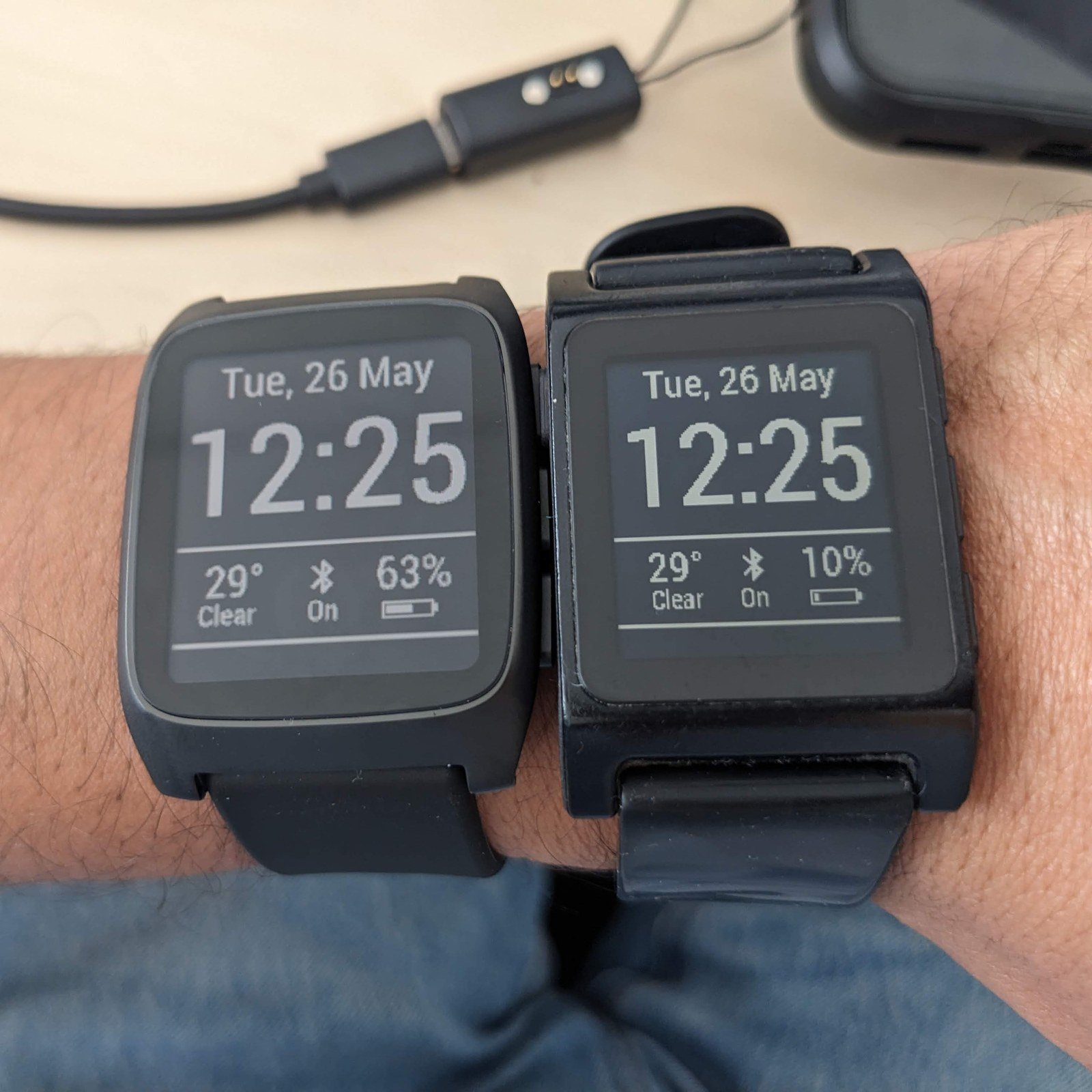
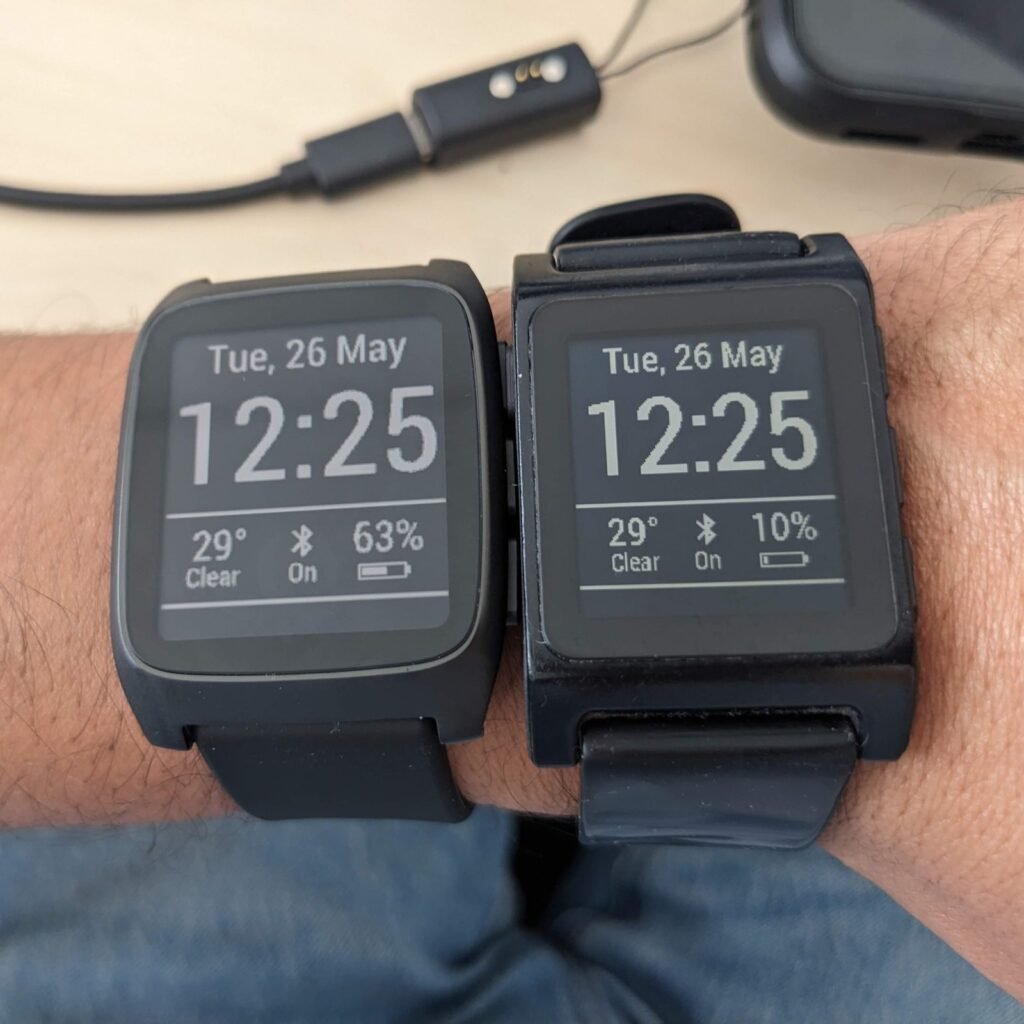
Lead image: a Pebble Time 2 (left) and an older Pebble 2 smartwatch (right), not the Index 01 ring; no freely licensed photo of the ring was available. Photo by Waldyrious via Wikimedia Commons, licensed CC BY-SA 4.0; resized.