




Nature ran a news feature and an editorial on Wednesday with a message the HIV field has not been able to say with a straight face in a long time: a vaccine is “closer than ever before.” The case rests on a strategy called germline targeting, which this year got monkeys to make the rare, broadly neutralizing antibodies that people almost never produce on their own.
That is a real scientific milestone. It is also a prediction about the future, in a field with 40 years of failed predictions. And the same editorial that says a vaccine is “on the horizon” says getting there “could take more than a decade.” Here is what is new, who is predicting what, and what would have to go right.
Key points
- Nature said on Nov. 25 that an HIV vaccine is “finally within reach,” pointing to germline-targeting shots that got monkeys to make broadly neutralizing antibodies.
- In the strongest single result, serum broadly neutralizing activity showed up in 44% of vaccinated rhesus macaques, and the team did not test whether the animals were protected from infection.
- Nature’s own editorial says turning those results into an effective vaccine could take more than a decade, and the three large HIV vaccine efficacy trials NIH reported on from 2020 to 2023 all failed to protect.
- Nature’s editorial says U.S. funding cuts ended an NIH preclinical vaccine program and forced a South African vaccine trial to be postponed and scaled back.
What Nature actually said
The feature, by Nature reporter Ewen Callaway, is headlined “A powerful HIV vaccine is finally within reach — thanks to these super antibodies.” The editorial, titled “The world has a golden chance to improve HIV prevention: don’t squander it,” argues that funders should “ramp up investment, not cut it back.”
The optimism comes from researchers, and Nature quotes them by name. “We have a line of sight to an efficacious vaccine,” Mark Feinberg, president and chief executive of the International AIDS Vaccine Initiative (IAVI), told the magazine. “The scientific promise is greater than it’s ever been.” Rogier Sanders of Amsterdam University Medical Centre called the monkey results “a very important milestone,” adding: “No one has achieved that before.”
Feinberg also told Nature that success “is by no means guaranteed.” Hold on to that line. It is the most important one in the piece.
Germline targeting, explained without the immunology degree
HIV’s surface protein, called envelope, is the obvious vaccine target. The trouble is that the virus mutates so fast that “there are millions of strains circulating simultaneously,” as Scripps Research immunologist Richard Wyatt put it to Nature. A vaccine that teaches the body to block one strain does almost nothing.
A small number of people living with HIV eventually make broadly neutralizing antibodies, or bnAbs, which latch onto parts of the virus that barely change and can shut down a wide range of strains. One South African woman known in the literature as CAP256 made some of the strongest ever found. But those antibodies take years of evolution inside an infected body, through what virologist Penny Moore called a “cat and mouse game” between the virus and the immune system.
Germline targeting tries to fake that process in an uninfected person, in steps. A first “priming” shot wakes up the rare immature B cells (the cells that make antibodies) that have the right genetic starting point. Later booster shots, each a slightly different version of the envelope protein, “shape” and then “polish” those antibodies toward the elite form. Sanders compares it to scouting youth football players: “We’re scouting the talented B cells.” The La Jolla Institute for Immunology describes it as walking a B cell from its naive state to a broadly neutralizing one.
The three monkey studies behind the headline
The feature builds on three papers Nature published this year, which an August News & Views commentary called “an important preclinical advance.” All three are in rhesus macaques. None tested whether vaccinated animals were protected from infection.
| Study | Published | What the authors report |
|---|---|---|
| Steichen et al. | June 30, 2026 | 24 macaques in four groups of six. bnAb lineages in at least 50% of animals; serum bnAb activity in 44%; in one animal, levels the authors say would be expected to protect against diverse HIV strains. |
| Marchitto et al. | June 30, 2026 | A redesigned envelope based on CAP256’s virus primed bnAb precursors 30 to 400 times more efficiently than unmodified versions, and the authors report neutralization breadth in over 90% of macaques. The team used three delivery methods, one of which was infecting animals with a lab-made simian-human virus. |
| Guenaga et al. | April 29, 2026 | Envelope proteins attached to fat bubbles (liposomes) produced cross-neutralizing serum antibodies in all immunized animals; antibodies from four macaques bound the virus much like a known human bnAb. |
The Steichen paper’s own abstract is the clearest statement of what changed. Before it, germline targeting “has not succeeded in generating bnAbs in humans or non-transgenic animals.” The authors call their result “proof of principle.” The La Jolla Institute’s release notes the plain caveat: “The team didn’t test whether these antibodies could prevent infection.”
Humans have only gone partway down the path so far. According to Nature, in small trials of a priming shot called eOD-GT8, delivered as protein or mRNA, nearly all participants made bnAb “precursors,” antibodies with the right blueprint but not yet the mutations that make them elite. A booster pushed some of them further. “It worked beautifully,” said William Schief of Scripps Research, who is also vice-president for protein design at Moderna.
The predictions, and who is making them
Strip out the adjectives and three forecasts are on the table:
- Researchers predict a vaccine is reachable. Feinberg’s “line of sight” and Nature’s “within reach” are forecasts by people inside the field, based on animal data and partial human data.
- Nature’s editors predict it will take a while. The editorial says it “could take more than a decade” to translate the germline-targeting results into an effective vaccine, and that “the current strategy might encounter more hurdles.”
- One lead scientist predicts humans may do better than monkeys. La Jolla’s Shane Crotty said in the institute’s release: “We believe this vaccine approach is even more likely to succeed in humans, because of the immunogenetics.” The Steichen paper reports that the precursor B cells its vaccine targets are roughly eightfold rarer in rhesus macaques than in people, which is consistent with that bet. It is still a prediction, not a result.
Forty years of “soon”
Skepticism here is not cynicism. It is the historical record. HIV vaccine forecasts have been wrong for four decades, and big efficacy trials have repeatedly failed:
| Year | Prediction or trial | What happened |
|---|---|---|
| 1984 | HHS Secretary Margaret Heckler suggested a vaccine would be available within two years, as PBS Frontline summarized it. | She later told Frontline: “That turned out to be totally incorrect.” |
| 1997 | President Bill Clinton: “let us commit ourselves to developing an AIDS vaccine within the next decade.” | No licensed vaccine by 2007, or since. |
| 2009 | The RV144 trial in Thailand. | Modest signs of protection, per Nature; efforts to replicate them failed. |
| 2020 | HVTN 702, an RV144-based regimen in 5,407 South African volunteers. | Stopped after an interim review found it did not prevent HIV. |
| 2021 | Imbokodo, 2,637 women in five African countries. | Efficacy of 25.2%, with a confidence interval running from -10.5% to 49.3%: not sufficient protection, NIH said. |
| 2023 | Mosaico, 3,900 volunteers in Europe and the Americas. | Safe but did not protect; discontinued. |
What is different this time, according to the researchers Nature spoke to, is the method. Older vaccines were, in Scripps immunologist Dennis Burton’s words, “a shot in the dark,” because nobody knew what an effective immune response should look like until a huge trial ended. Germline targeting aims at a specific, measurable antibody target. That makes failures easier to diagnose early. It does not make success automatic.
What would have to happen for the prediction to come true
Reading the papers and Nature’s reporting together, the road from monkey to market has at least four checkpoints, and none has been passed yet:
- Full bnAbs in people. Human trials so far report precursors and partial maturation. The next step is showing a complete prime-and-boost series produces broadly neutralizing antibodies in humans, not just in macaques.
- Enough of them, in enough people. Serum bnAb activity showed up in 44% of animals in the strongest study, and reached the level the authors associate with protection in one animal. A vaccine needs high, lasting levels in most recipients.
- A workable efficacy trial. Nature notes that effective prevention drugs such as lenacapavir “might make it difficult to test how well a vaccine works,” . Trial volunteers are offered proven prevention, and fewer infections in a trial means slower answers.
- Money. Nature’s editorial says the NIH ended its preclinical HIV-vaccine program last year and that U.S. cuts forced the postponement and scaling back of an HIV vaccine trial in South Africa. “We’re in a better position than we’ve ever been, and just at this time, we’ve seen the funding streams cut off,” Burton told the magazine.
The drug that changes the math
The vaccine story is landing in the same month as a big step for HIV prevention drugs. On Oct. 30, the FDA granted tentative approval to Dr. Reddy’s Laboratories’ generic version of lenacapavir, a twice-yearly injection, under the PEPFAR program. Nature’s editorial describes it as an approval; the FDA letter is more careful, saying the application “is not approved and will not be approved until FDA issues an approval letter.”
Dr. Reddy’s says the injection will cost $40 per person per year across 120 countries covered by Gilead’s voluntary licence, with first supplies expected by the end of 2026. Nature’s editorial cites trial data showing the original Gilead drug was more than 95% effective at preventing HIV acquisition.
So why keep chasing a vaccine? Nature lists the drug’s limits: it is hard to identify who needs it most, it has to be taken for years, and even $40 a year is out of reach for the poorest. Sanders gave the shortest answer: “A vaccine makes you independent from access to drugs.”
What to watch next
- IAVI G004 results. This Phase 1 trial in South Africa is testing three mRNA-encoded immunogens, including eOD-GT8 and N332-GT5, the priming design behind the Steichen monkey work. ClinicalTrials.gov lists an estimated 96 participants, primary completion on Nov. 2, 2026, and study completion estimated for March 31, 2027. Its results are one place to look for whether multi-shot designs push human antibodies past the precursor stage.
- A full-regimen human study. La Jolla says IAVI, Scripps Research, the HIV Vaccine Trials Network and partners are “advancing plans” to test the complete immunization series in people. No date is given.
- Protection data in animals. None of the three monkey papers challenged vaccinated animals with the virus. A challenge study would show whether these antibody levels actually block infection.
- Funding decisions. Whether the postponed South African trial gets back on schedule is a direct test of Nature’s warning about money.
The takeaway
By its researchers’ account, a vaccine has for the first time taught ordinary, non-engineered animals to make the antibodies HIV researchers have chased for 30 years. That is new, it is published, and it is worth the excitement. “Within reach” is still a forecast from people who have earned some optimism but not a pass on history. Nature’s own editorial says the trip could take more than a decade, and the next real clue arrives with the human trial data.
Last checked: Nov 26, 2026
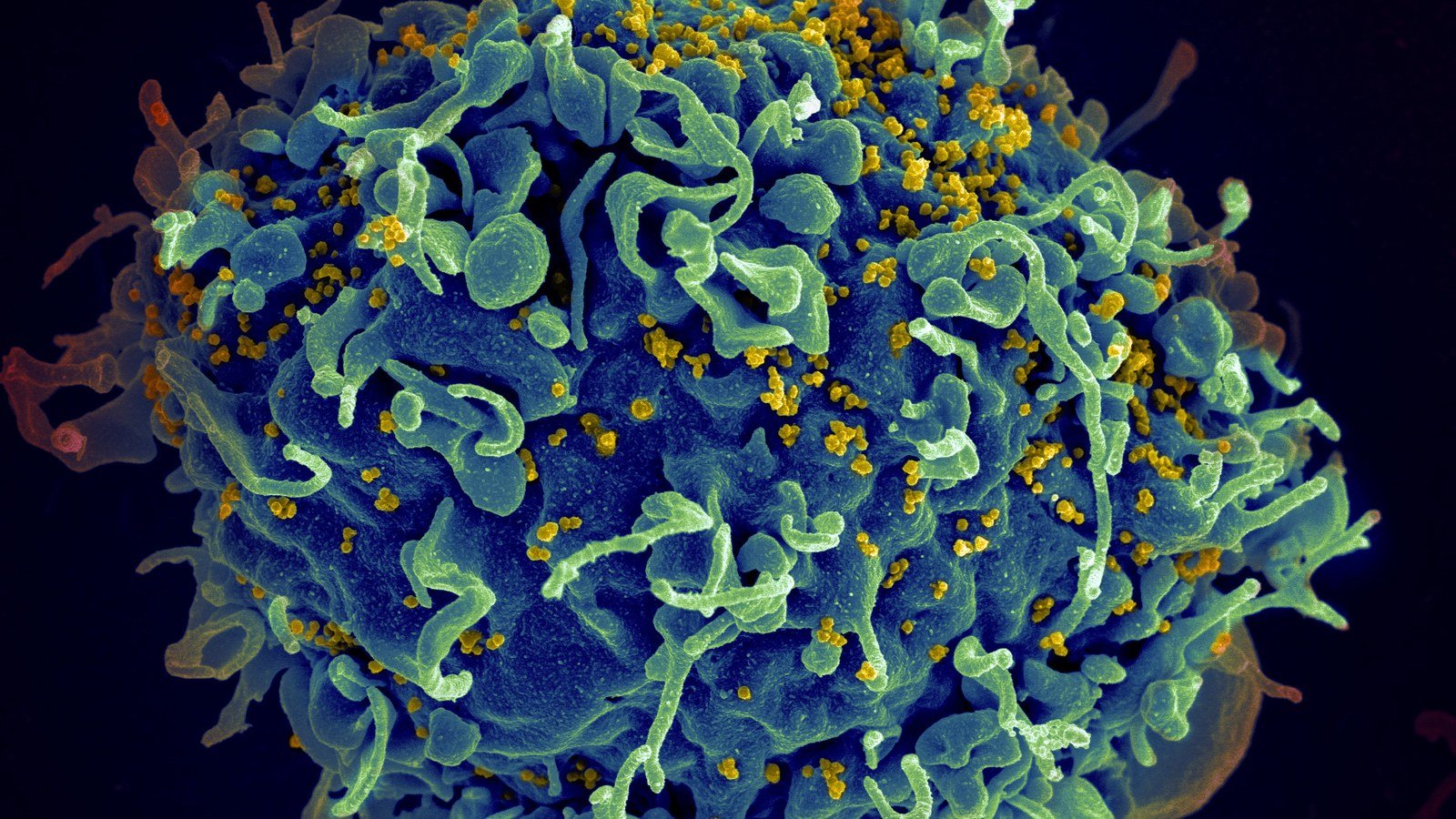
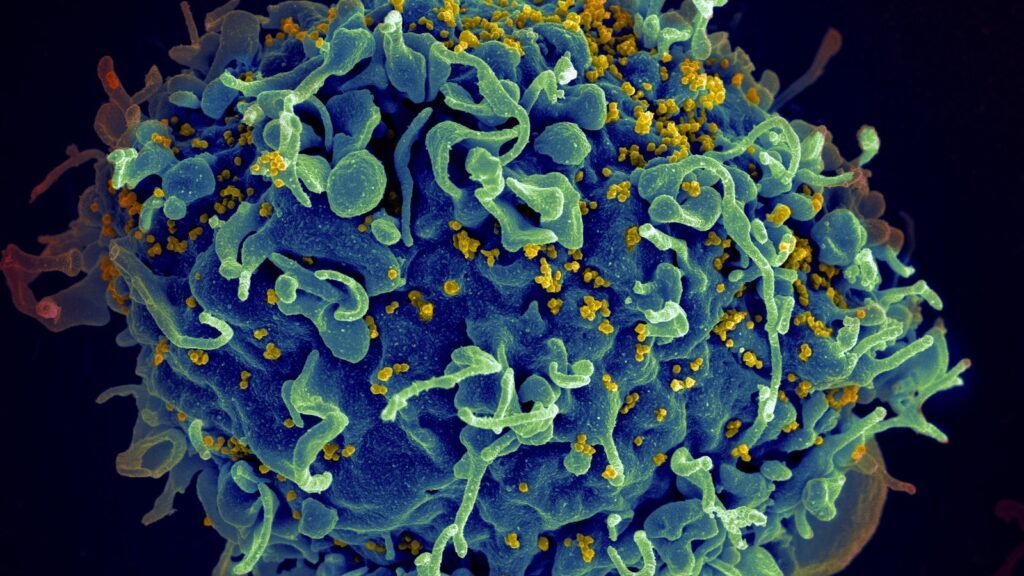
Lead image: Scanning electron micrograph of a human H9 T cell infected with HIV by NIAID, licensed CC BY 2.0 via Wikimedia Commons. It shows HIV infection, not any vaccine in this story. Cropped to 16:9 and resized.
This story is not medical advice.
Hype in. Signal out.