


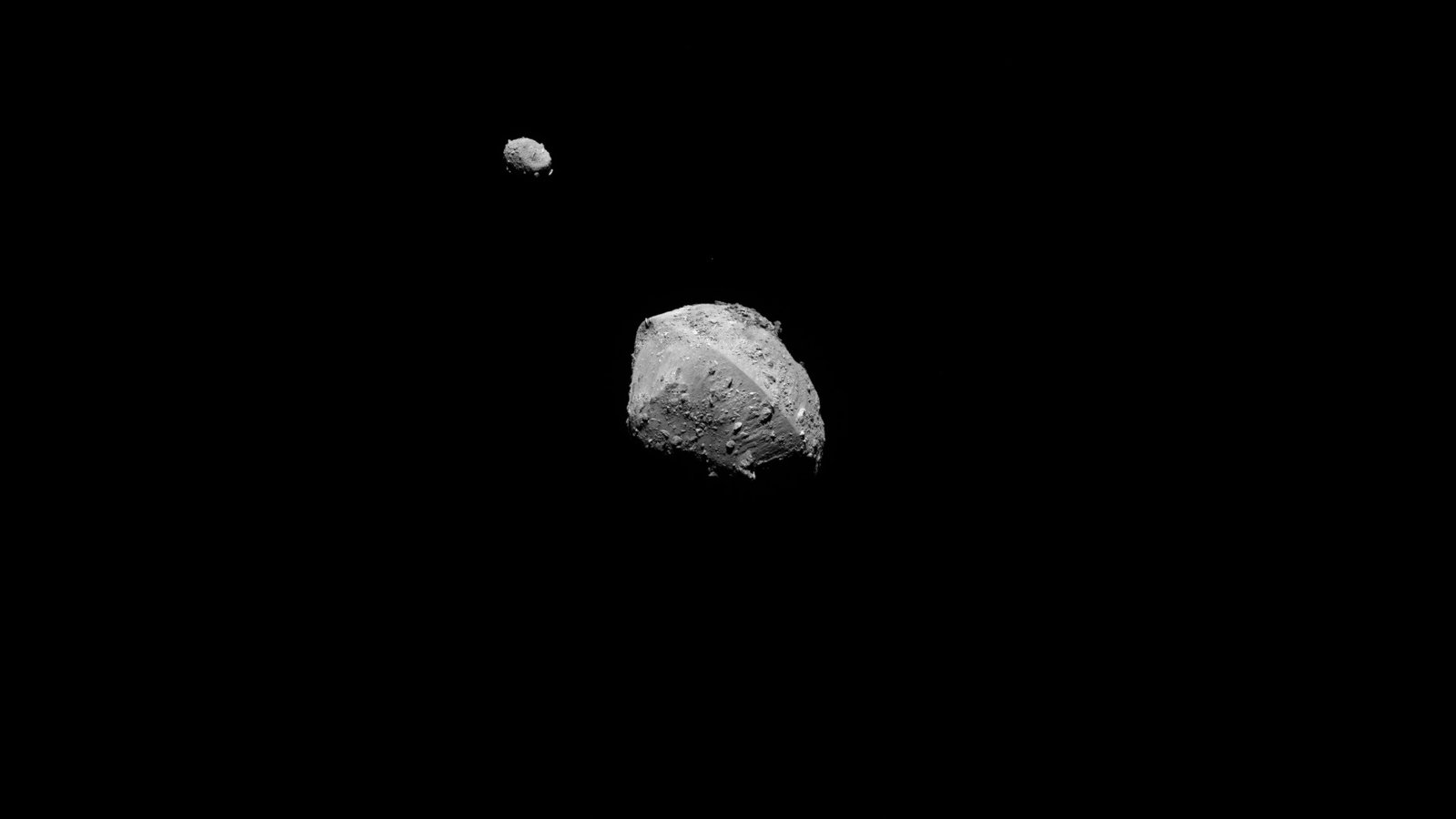
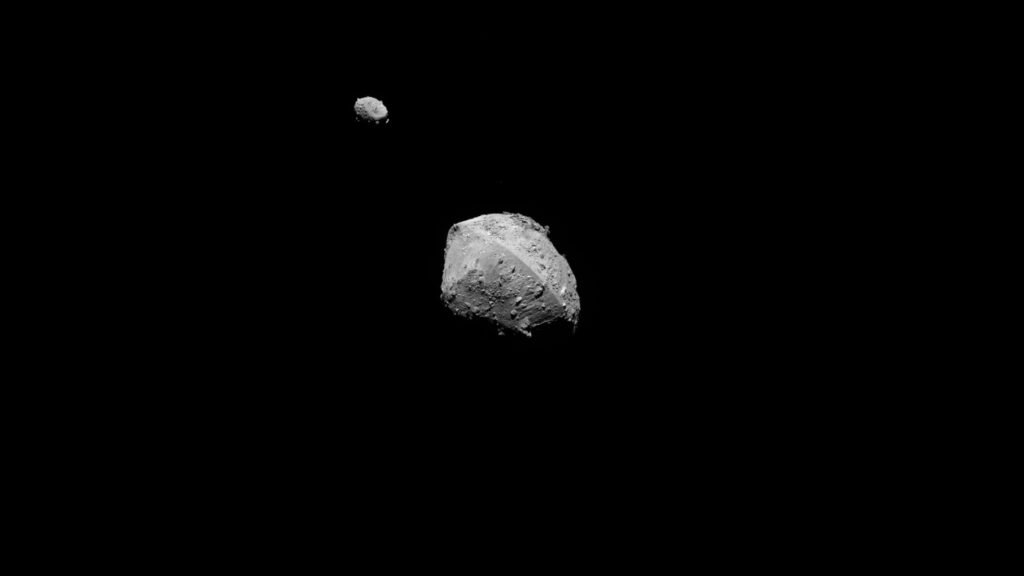
NASA’s DART spacecraft didn’t just nudge the asteroid Dimorphos in 2022. It flattened the whole face it hit into a crater as wide as the asteroid itself and left the moonlet tumbling, according to the first close-up images from the European Space Agency’s Hera mission, released Wednesday at a media briefing in Berlin.
Hera also found hundreds of previously unknown boulders, ESA said, a few meters across, circling the asteroid pair. That’s a surprise for the scientists and a traffic problem for the spacecraft that has to fly through them. And it lands on a 2024 forecast by one of Hera’s own scientists, who wrote that the mission “may find a reshaped asteroid rather than a well-defined crater.”
Key points
- ESA says Hera’s images show DART flattened the face of 151-meter Dimorphos it struck into a “stadium-sized” crater that “extends across the asteroid’s entire width.”
- Dimorphos is now “tumbling wildly” in its orbit, ESA’s mission scientist says, while the rest of its surface looks as it did in DART’s 2022 images.
- Hera spotted hundreds of orbiting boulders a few meters across; Hubble had counted 37 in 2023, and ESA says the swarm complicates the closer passes ahead.
- The number planetary defense needs most, the mass of Dimorphos, isn’t in yet; Hera moves to about 13 km in December and releases two CubeSats in January.
What Hera saw
Hera, which launched on a SpaceX Falcon 9 on Oct. 7, 2024, has been in its “early characterisation phase,” flying 25 to 30 km from the asteroids on what ESA calls “rectangular orbits” at an average speed of 12 cm per second. That’s slower than a slow walk. Three instruments did the early work: the black-and-white Asteroid Framing Camera, the 25-color Hyperscout H and JAXA’s Thermal Infrared Imager, which measures surface temperatures.
The framing camera’s lead image, taken Nov. 7 from 29 km away at 2.7 meters per pixel, shows Dimorphos with one side cut flat. ESA describes “some weird structures inside” the crater, “including an apparent cigar-shaped structure at its centre.” Dimorphos is 151 meters across and orbits the 730-meter Didymos about 1 km away, per ESA. The pair is now about 193.5 million km from Earth.
“Scientists debated whether Dimorphos had sustained an impact crater, changed its shape or stayed the same,” Hera principal investigator Patrick Michel of CNRS and the Observatoire de la Côte d’Azur said in ESA’s release. “Much to our surprise the answer turns out to be all three at once!”
“The crater is almost as large as the body itself, which is really, really spectacular,” Hera team member Sabina Raducan told the BBC. “As a crater person, I can also say it’s beautiful.”
A barrel thrown down the stairs
The other change is motion. Before the impact, Dimorphos kept one face toward Didymos, the way our Moon does with Earth. “Now it’s very, very chaotic,” Raducan told the BBC. “Imagine a barrel that you throw down the stairs.” ESA mission scientist Michael Kueppers said the impact “has left Dimorphos tumbling wildly in its orbit.”
This was predicted as a possibility. A 2021 Icarus paper led by Harrison Agrusa modeled how DART could kick Dimorphos into “attitude instability” and chaotic tumbling, especially rotation about its long axis, and said Hera could confirm it. Michel was a coauthor. Hera is now showing that it happened. ESA’s animation of one full orbit, with a frame every 2 minutes, makes the wobble easy to see because the flattened crater face keeps turning to new angles.
Our read: the tumble isn’t just a curiosity. A rocking, reshaped moonlet changes how its orbit evolves, so teams have to separate what the impact did to the orbit from what the new shape and spin are doing to it now.
How the forecasts did
DART hit Dimorphos on Sept. 26, 2022, at about 6.1 km per second. A 2023 Nature paper measured the orbit change at 33.0 minutes, plus or minus 1 minute. A perfectly inelastic hit, with no debris thrown off, would have shortened the orbit by about 7 minutes. The rest came from the recoil of the ejecta, and the four-years-later images are the first close look at the hole that ejecta came out of.
| Question | What earlier work said | What Hera reported Nov. 25 |
|---|---|---|
| Crater or reshaping? | Raducan et al., Nature Astronomy 2024: impact likely caused “global deformation”; Hera “may find a reshaped asteroid rather than a well-defined crater” | A crater across the struck face; the rest of Dimorphos looks unchanged (ESA) |
| Crater size | David Jewitt, from Hubble boulder data: material could have come from a circle “about 160 feet across” (about 50 m) (NASA, 2023) | “Extends across the asteroid’s entire width,” about 151 m (ESA); no measured diameter released yet |
| Spin | Agrusa et al., 2021: impact could trigger chaotic tumbling | “Tumbling wildly” (Kueppers, ESA) |
| Boulders | Hubble counted 37 boulders, about 3 to 22 feet (1 to 6.7 m) across (NASA) | “Hundreds” of orbiting boulders “just a few metres in size” (ESA) |
Our read: the forecasts weren’t wrong so much as each one got a piece. Raducan’s simulations called Dimorphos a weak rubble pile with a cohesive strength “less than a few pascals,” and nothing in the new images contradicts that. What she expected to see, a body reshaped so thoroughly it had no clean crater, turned out to be a clean, flat-faced crater on an otherwise intact body. Michel’s “all three at once” is the honest scorecard.
Our math: if the crater really spans Dimorphos’s 151-meter width, it’s about three times wider than the roughly 50-meter circle Jewitt estimated from Hubble’s boulders. That comparison uses ESA’s description, not a measurement. The team hasn’t published a crater diameter, depth or shape model yet.
Hundreds of boulders, and a traffic problem
“Another big surprise is that Hera is showing that the asteroids are surrounded by hundreds of orbiting boulders, just a few metres in size,” Kueppers said. Hyperscout H caught them in long exposures with the asteroids’ light subtracted, leaving trails of dots, the Planetary Society explained. The BBC reported their sizes as ranging from tens of centimeters to meters.
NASA’s 2023 Hubble release found 37 boulders drifting away at “a little more than a half-mile per hour,” with a total mass of about 0.1% of Dimorphos. Jewitt said then that “the boulder cloud will still be dispersing when Hera arrives.” It was, and there’s more of it than Hubble could see. Kueppers said the team “will have to take account of these objects in the coming weeks as the mission moves in closer.”
Hera has also mapped Didymos. “The smallest details that we can make out in these images are about 3m in size,” Hera team member Naomi Murdoch told the BBC, describing “boulders the size of cars and buses sitting on a world with almost no gravity.” Surface gravity on Didymos is about 40,000 times weaker than Earth’s, she said.
Why it matters
DART proved a spacecraft can move an asteroid. It didn’t tell anyone exactly how efficiently, because nobody knew Dimorphos’s mass. The 2023 momentum study in Nature put the momentum enhancement factor, called beta (how much extra push the ejecta added on top of the spacecraft’s own momentum), at 3.61 if Dimorphos is as dense as Didymos. Across the plausible density range of 1,500 to 3,300 kg per cubic meter, beta ran from 2.2 to 4.9.
That’s more than a factor of two of uncertainty in how hard a kinetic impactor actually shoves a rubble pile. A future deflection mission against a real threat would have to size its spacecraft and its warning time around that number. “We [could] measure its properties and say: ‘Well, we need this mass of spacecraft, travelling at this speed, this early, in order to deflect it enough,’” Hera scientist Simon Green told the BBC.
Hera’s mission manager Ian Carnelli made the pitch from the dinosaur hall of Berlin’s Museum für Naturkunde. “NASA’s DART mission demonstrated that we can change an asteroid’s orbit,” he said. “Hera is now revealing what happened to the asteroid itself.”
The catch
- These are first looks, not results. ESA released images and descriptions. No crater diameter, shape model, mass or new beta value has been published, and none of it is peer reviewed yet.
- “Stadium-sized” is a description. ESA hasn’t given the crater in meters. “Entire width” implies about 151 m, but treat that as an upper-bound reading of ESA’s words.
- The resolution is still coarse. At 2.7 meters per pixel, Dimorphos is only about 56 pixels across in the lead image (our math). The “weird structures” in the crater are a few pixels each.
- One rubble pile isn’t every asteroid. A weak, low-cohesion body like Dimorphos may respond differently from a solid one. What worked here won’t automatically transfer to the next target.
- The boulders add risk. ESA says the swarm has to be accounted for as Hera closes in, and the BBC reported it will make flying the spacecraft and CubeSats “especially challenging.”
The takeaway
Humanity’s first asteroid-deflection test left a bigger mark than the leading simulation expected and set its target spinning out of control. That’s good news for the deflection itself and a harder problem for whoever has to model the next one. What to watch: Hera’s approach to about 13 km in December, which ESA says will return “progressively higher-resolution” images (if the camera’s resolution scales with distance, roughly 1.2 meters per pixel, our estimate); the January 2027 release of the Juventas radar CubeSat, which will probe an asteroid’s interior for the first time, and the Milani CubeSat; the first mass measurement for Dimorphos; and the first peer-reviewed crater numbers. The full briefing replay runs 1 hour 16 minutes. ESA’s next planetary-defense mission, Ramses, is being developed with JAXA to study asteroid Apophis during its close but safe Earth flyby on April 13, 2029.
Last checked: Nov 26, 2026, 8:07 PM PST. ESA had not released crater measurements, a shape model or a mass estimate for Dimorphos.
Lead image: Didymos and Dimorphos with DART impact site visible (Hera Asteroid Framing Camera, Nov. 7, 2026). Image: ESA. Used for editorial purposes under the ESA terms of use for images and videos (not a Creative Commons license); black margins added to fit 16:9.
Hype in. Signal out.