


For 65 years, the dream of a tiny machine small enough to swim through the bloodstream and fix the body from the inside has been science fiction’s favorite medical fantasy. Caltech’s latest paper does not deliver that machine. But it does report something concrete: a 250-nanometer nanorobot that, switched on by a beam of light, ferried roughly five times more chemotherapy across the blood-brain barrier of mice with brain cancer than the same drug given on its own.
The device, nicknamed the BrainBot, is described in a paper published Nov. 25 in Science Robotics by a team led by Caltech medical engineer Wei Gao. The university says the light-activated bots “successfully cross the BBB to deliver lifesaving therapeutics.” That is a company-style claim about a mouse study, so hold it at arm’s length: this is an early animal result, not a treatment, and the researchers say so themselves.
Key points
- Caltech researchers report a 250-nanometer, light-propelled nanorobot that delivered about 5.2x more of the chemo drug doxorubicin into the brains of glioblastoma-bearing mice than free drug, according to their Nov. 25 Science Robotics paper.
- The team says the treatment slowed tumor growth and lengthened median survival in mice while cutting the whole-body toxicity of the chemo; it did not cure or eliminate tumors.
- The robots are switched on by near-infrared light aimed through the skull; the authors say scaling the light trick to a human-sized head is an unsolved problem.
- Past nanomedicine timelines have slipped for decades, and the lead researcher says human studies are still some way off.
What a BrainBot actually is
Strip away the name and a BrainBot is a hollow, asymmetric silica shell about 250 nanometers wide, or hundreds of times thinner than a human hair, per Caltech. Inside sits a gas-generating fuel (ammonium bicarbonate) and a light-absorbing dye (indocyanine green), sealed behind a waxy gate made of lauric acid. The outside is coated with polyethylene glycol and studded with a 40-nucleotide DNA aptamer the authors call hBS01, a molecular grappling hook that recognizes the cells lining the brain’s blood vessels.
Here is the sequence the paper describes. The particle circulates inertly until near-infrared light hits it. The dye converts that light into heat; above about 43 degrees Celsius the wax gate melts and the fuel decomposes into gas, turning a passive nanoparticle into a self-propelled one. That burst of propulsion shoves the aptamer-tipped shell against the vessel wall, where the cells take it up and carry it across into the brain. Once inside, the shell degrades and releases its drug. In this study that drug was doxorubicin, a standard but harsh chemotherapy.
The key design idea is that the propulsion stays “dormant until they reach the BBB,” as the authors put it, because the heat-sensitive gate keeps the fuel locked up during the trip through the bloodstream. It is less a tiny submarine with a motor than a drug capsule that lies still until a light switch tells it to wriggle.
What the mouse numbers say, and what they don’t
The headline figure is a 5.2-fold increase. The researchers measured doxorubicin in brain tissue eight hours after injection and found that light-activated BrainBots reached 2.30% of the injected dose per gram of brain, a 5.2-fold increase over the same bots left un-illuminated. That is a relative number, and it is relative to a weak baseline: even the best group delivered just over 2% of the dose to a gram of tissue. For context, a widely cited 2016 analysis in Nature Reviews Materials found that across hundreds of studies, a median of only 0.7% of an injected nanoparticle dose ever reaches a solid tumor. Nanoparticle delivery is a game of small fractions, and this is still a small fraction.
The therapy results are more tangible. In mice with implanted U87MG human glioblastoma cells, tumors in the untreated group grew roughly sevenfold over 12 days. Free doxorubicin and un-illuminated bots roughly halved that growth; light-activated BrainBots held it to about twofold, the paper reports. The illuminated group also lived longest: the authors report a statistically significant extension of median survival versus every other group, including free drug (log-rank p-values from 0.0014 to 0.035, with six mice per group).
Two caveats the authors are candid about. First, the bots “did not eliminate established tumors” — this slowed cancer, it did not beat it. Second, the real selling point may be safety rather than potency: free doxorubicin caused about 9% weight loss and signs of liver injury, while the BrainBot group released the drug slowly and avoided that toxicity. In other words, the clearest win here is giving a nasty drug more gently, not a dramatic new cure.
Here is the claim laid out against its limits:
| What Caltech reports | The fine print |
|---|---|
| ~5.2x more drug in the brain with light | Relative to un-illuminated bots; absolute delivery was ~2.3% of dose per gram |
| Tumor growth cut to ~2x vs ~7x untreated | Tumors were suppressed, not eliminated; n=4 for tumor volume |
| Longest median survival of any group | 6 mice per group; a mouse glioblastoma model, not humans |
| Lower systemic toxicity than free chemo | Main demonstrated advantage; driven by slow, local release |
| No detectable damage to the barrier or brain | Short-term; authors call for long-term safety studies |
The catch nobody can switch off yet: light
Every BrainBot advantage depends on getting near-infrared light to the right spot. In a mouse, that is doable: the authors confirmed that 808-nanometer light passes through a mouse’s scalp and skull, and head-surface temperatures stayed around 43 to 44 degrees Celsius with a pulsed on-off beam. A mouse skull is a fraction of a millimeter thick. A human skull is not.
The authors flag this directly as a limitation: translation to “larger tissues will likely require light-delivery strategies that preserve a safe activation window while reducing the effective optical path length.” Plainly, near-infrared light does not travel far through human bone and brain, so lighting up a tumor deep in a person’s head is a genuinely unsolved engineering problem, not a detail. It is the difference between a demo and a therapy.
A 65-year-old promise, scored
The idea traces to Richard Feynman’s 1959 Caltech lecture “There’s Plenty of Room at the Bottom,” where he relayed a friend’s “wild idea” that “it would be interesting in surgery if you could swallow the surgeon.” The modern version is louder. Futurist Ray Kurzweil wrote in his 2024 book The Singularity Is Nearer that medical nanorobots would enter our bodies in the 2030s to repair us cell by cell and push lifespans past 120. That is a prediction, and a sweeping one; nothing in the BrainBot paper speaks to it.
The nearer-term forecasts have a mixed record. Gao’s own lab has walked this road before: a February 2026 Nature Nanotechnology paper reported “bubble bots” that homed in on bladder tumors in mice, following earlier magnetically guided microrobots. Progress is real, but it has stayed in mice. Elsewhere, Barcelona’s Nanobots Therapeutics reported in 2024 that urease-powered nanobots shrank mouse bladder tumors by up to 90%, and founder Samuel Sanchez said he hoped to test patients in two to three years; the company now lists first-in-human trials as “planned for 2028”. India’s Theranautilus has said it aims to start the first human trial of magnetically steered dental nanorobots in late 2026, pending regulator sign-off. None of these has published a completed human trial yet.
What would have to go right
For BrainBots to matter beyond a mouse cage, several things have to happen in roughly this order:
- A light-delivery answer for human heads. Either a way to pipe near-infrared light deep into the brain safely, or a different trigger (magnetic, ultrasound) that works at human scale. Until then the mechanism simply does not transfer.
- Long-term safety data. The authors measured silicon clearing from the brain within three weeks in mice, but call for studies of repeated dosing and chronic effects. Silica in the brain is not something regulators wave through.
- A challenge that beats the alternatives. Rivals are further along. A focused-ultrasound trial published in The Lancet Oncology (BT008NA) already opened the barrier in 34 human glioblastoma patients and reported a median overall survival of 31.3 months versus 19.3 in matched controls, though the authors stress a randomized trial is still needed. BrainBots will have to prove they add something that approach doesn’t.
- Manufacturing and dosing at scale. Getting a precise, aptamer-coated, fuel-loaded nanoshell made reproducibly and cheaply enough for clinics is its own mountain.
Who it affects
If it ever works in people, the first beneficiaries would be patients with glioblastoma, among the deadliest cancers, where median survival has sat below 18 months for years and the barrier blocks most drugs from reaching the tumor. Gao also points past cancer, telling Caltech the platform is “not limited to brain delivery” and naming Parkinson’s as a hope. Outside experts were encouraging but careful: Aston University biotechnologist Roslyn Bill told The Independent the mouse results are “encouraging” but “there is still a considerable way to go before we know whether this approach will translate into patients.”
What to watch
- A non-rodent model. The next real signal is whether the light trick survives a jump to a larger animal with a thicker skull, where the optical-path problem bites.
- A published safety read on repeated dosing. The authors named this as the open question; watch for it rather than another efficacy headline.
- Whether anyone files for a human trial. Gao says human studies need more work first. A registered trial, from this group or a rival, is the milestone that turns “nanorobot” from a lab word into a clinical one.
- How it stacks up against focused ultrasound. That rival is already in human trials. The honest test is a head-to-head, not a press release.
The takeaway
A light-steered nanorobot that pushes five times more chemo into a mouse brain, and does it more gently than a syringe of the raw drug, is a legitimate step. It is also a mouse, a relative number against a low bar, and a mechanism that leans entirely on a light beam that cannot yet reach a human tumor. The science fiction version swallows the surgeon. The 2026 version delivers a bit more chemo to a rodent and is honest that the hard parts are still ahead. That honesty is the best thing about it.
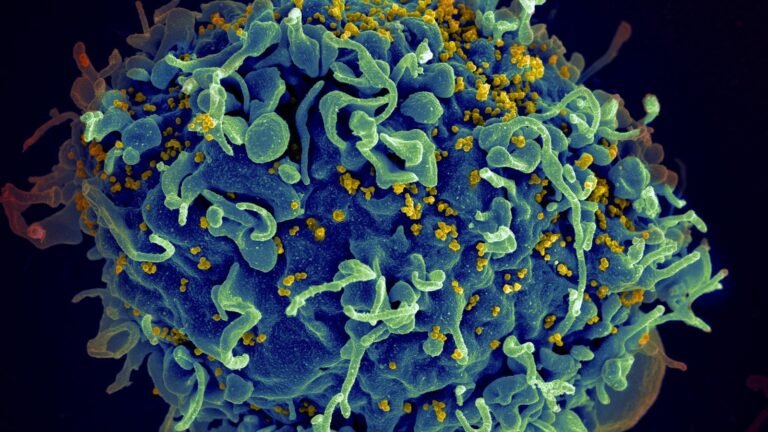
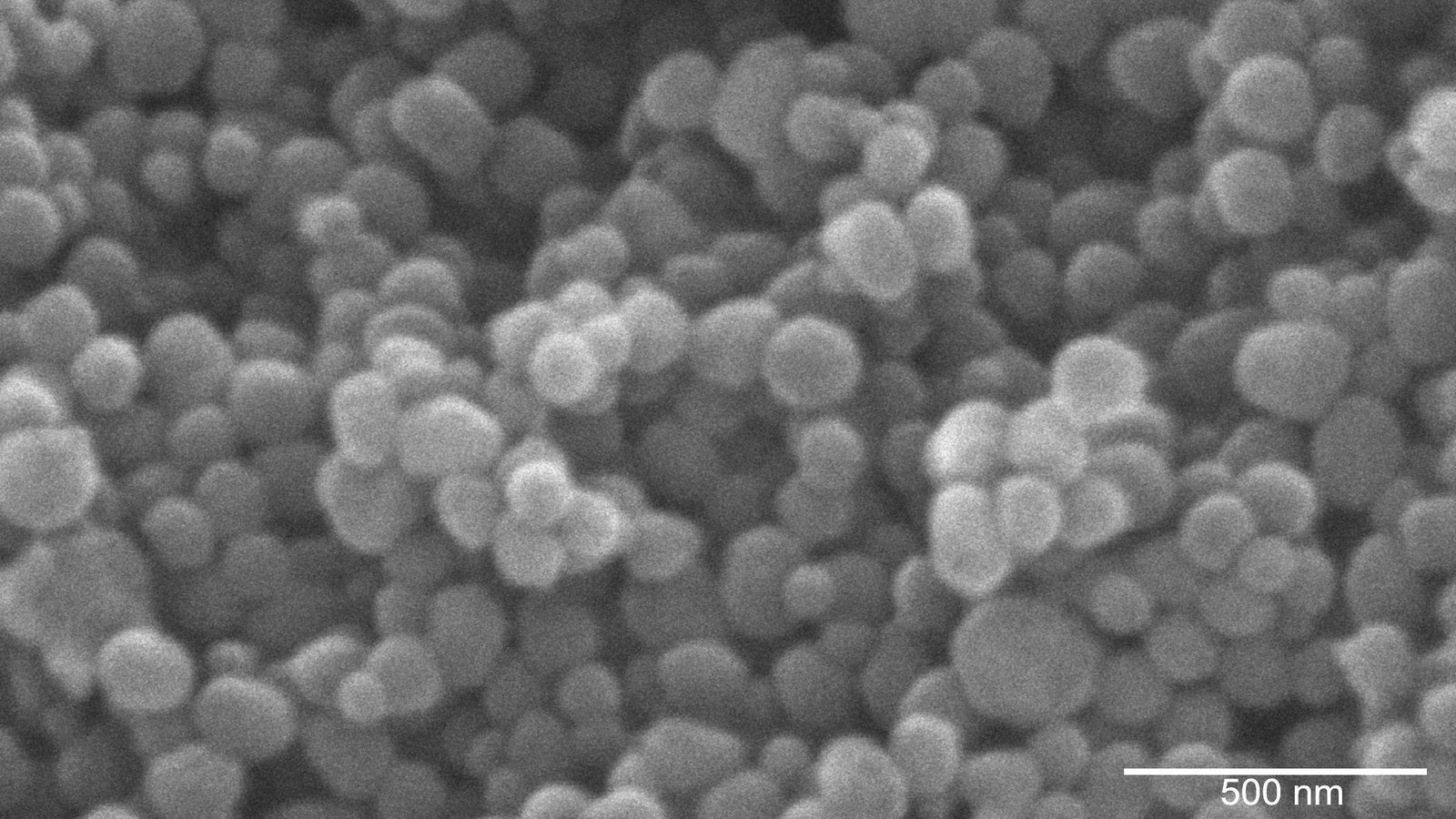
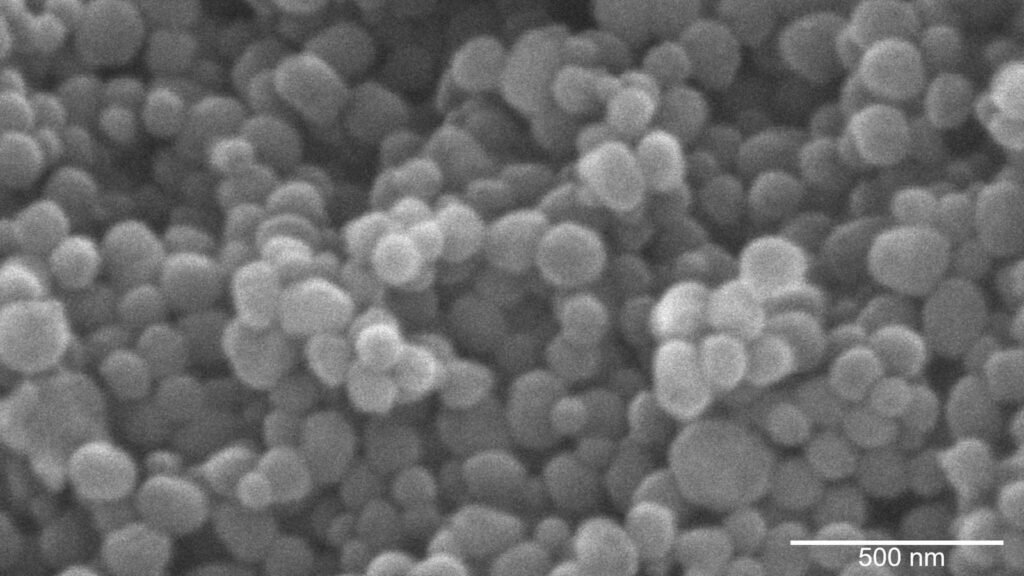
Image: a scanning electron microscope view of silica nanoparticles, the material class used to build BrainBots, by the Dr. Victor Lin group/Iowa State University, released to the public domain. It is a generic image of silica nanoparticles, not the Caltech robots in this study; cropped to 16:9 and resized.
This story is not medical advice.
Hype in. Signal out.