


Waymo has recalled the self-driving software in 4,488 robotaxis because its cars kept driving into closed freeway lanes, according to a safety recall report the Alphabet-owned company filed with the National Highway Traffic Safety Administration on Nov. 19. It is the second time this year Waymo has recalled its freeway software over lane closures, and this time it has no software fix to offer yet: the report says “the final remedy is currently under development.”
Last checked: Nov 27, 2026. This is a developing story; Waymo’s freeway rides remain paused and California’s restriction remains in place as of this writing.
Key points
- Waymo filed two recalls with NHTSA on Nov. 19, and each covers the same 4,488 driverless-capable fifth- and sixth-generation self-driving systems.
- Waymo’s filing logs 11 instances of its vehicles entering closed freeway lanes between Oct. 1 and Nov. 9, with no collisions or injuries, and says the final software fix is still under development.
- The second recall covers software that could lose track of a police officer’s stop gesture; Waymo links it to one collision on May 8 and says every affected vehicle was updated by Nov. 6.
- California’s DMV barred Waymo’s driverless vehicles from all state freeways on Nov. 11, and Waymo has paused commercial freeway rides in every market where it offered them.
What Waymo told regulators
The recall, NHTSA campaign 26E086, says a Waymo “may enter and continue driving in a closed freeway lane due to improperly recognizing and failing to avoid a closed lane.” NHTSA’s acknowledgment letter, dated Nov. 23, adds the part that matters most: the car can “continue driving at speed.”
The chronology in the filing reads like a slow-motion argument with traffic cones:
- Oct. 1 to Nov. 6: eight Waymo vehicles entered freeway lanes that were closed by cones, highway patrol vehicles running a traffic break, and/or construction vehicles.
- Nov. 6: Waymo narrowed its “approved scope of operation” to reduce exposure to closed freeway lanes.
- Nov. 9: three more Waymos entered freeway lanes marked with cones as closed for construction. That is three days after the first restriction, a gap CNBC highlighted in its report on the filing.
- Nov. 10 and 11: Waymo restricted autonomous driving at times and places where it was more likely to meet a closed freeway lane, including “temporarily restricting planned commercial freeway trips.”
- Nov. 12: Waymo’s Safety Board decided to file a voluntary software recall.
Waymo says none of these events involved a collision or injury. The “remedy” in place today is not a software update at all. It is routing changes and map edits that steer cars away from freeway construction and lane closures. Waymo owns every affected vehicle, so there are no owners to notify and no dealers to visit.
A traffic break, for the uninitiated, is when highway patrol cruisers weave across all lanes to slow the traffic behind them, for example ahead of a hazard. Citing video of a Nov. 6 incident on Interstate 280, The Verge reports that a driverless Waymo tried to overtake two California Highway Patrol cruisers doing exactly that.
Recall No. 2: the cop it couldn’t see
Waymo filed a second recall the same day, 26E087, covering the same 4,488 systems. This one has nothing to do with freeways. On May 8, a Waymo approached an intersection where police were directing traffic by hand. An officer signaled it to stop, and it did. Then passing cross-traffic blocked the car’s view of the officer, the car decided the intersection “appeared clear,” drove in and collided with a vehicle that emerged from behind “a large occlusion,” according to the filing.
In plain terms, the software forgot the stop command once it couldn’t see the person who gave it. Waymo says the fix “better tracks and maintains gesture commands,” that it engineered and validated that update between May and July, and that it rolled the update out to driverless vehicles between Sept. 17 and Nov. 6. Waymo says the May 8 crash is the only known collision tied to the problem.
The timing is legal, and still worth noticing. Federal rules require a recall report within five working days after a company determines a defect is safety related. Waymo’s Safety Board made that determination on Nov. 18, after every car already had the fix, and Waymo filed the next day. So the public record of a defect that caused a crash in May arrived in November, as a recall of software that was no longer running.
One more thing for anyone adding up the headlines: it’s two recalls of the same 4,488 systems, not 8,976 cars.
This is the second freeway recall since June
Waymo has been here before. In June it filed recall 26E035 for 3,871 fifth-generation systems after its cars “did not recognize and drove past ramp closure signs” into planned freeway construction zones in Phoenix (one event on April 11 and five on April 19) and after seven Waymos drove between cones into active construction lanes in the San Francisco Bay Area on May 18. The amended report filed July 2 says Waymo began updating software on June 16, began resuming freeway operations June 25, and had the fix on every driverless-capable vehicle by June 29.
That fix was supposed to improve recognition of freeway construction zones, rank them above other freeway hazards, slow the car when it might be in one, and improve its “response to authorized emergency vehicles” in those zones. The new recall lists 26E035 as a related recall, and describes lanes closed by cones, highway patrol traffic breaks and construction vehicles.
| June recall (26E035) | November recall (26E086) | |
|---|---|---|
| Filed | June (report dated June 12); amended July 2 | Nov. 19 |
| Systems covered | 3,871 fifth-gen systems capable of driverless freeway operation | 4,488 fifth- and sixth-gen systems capable of driverless operation |
| Events cited | 6 in Phoenix (Apr. 11, 19); 7 in the Bay Area (May 18) | 8 (Oct. 1 to Nov. 6); 3 more (Nov. 9) |
| What the cars did | Drove past ramp closure signs; drove between cones into construction lanes | Entered lanes closed by cones, highway patrol traffic breaks and/or construction vehicles |
| Fix at filing | Software update, rolled out June 16 to 29 | Operating restrictions only; final fix “under development” |
| Collisions or injuries reported | None mentioned in the filing | None, per Waymo |
Our read: the populations aren’t defined the same way, so don’t treat 3,871 to 4,488 as a precise measure of fleet growth. The June recall counted systems that could drive freeways without a human; November’s counts every system that can drive without a human at all, including the newer sixth generation.
California pulled the plug first
The recall filing describes Waymo’s Nov. 11 freeway pullback as “voluntary scope constraints.” It doesn’t mention that the California Department of Motor Vehicles issued restrictions that same day barring Waymo from operating or testing driverless vehicles on every freeway in the state. The DMV said Waymo’s driverless freeway operations “pose an imminent hazard to public safety due to recurring incursions by its vehicles into active construction zones where construction workers, vehicles and equipment are present,” according to a statement published by CBS San Francisco and KQED.
The DMV cited three Waymos entering an active construction closure on U.S. 101 near Burlingame and an incident with CHP vehicles on Highway 280 in San Francisco, and noted that this happened “despite a prior restriction and corrective actions” after the May 18 incidents. The DMV didn’t give a date for the Burlingame event, and Waymo’s filing doesn’t give locations, so we can’t confirm that it is the same Nov. 9 event in the recall, though the count matches.
The restriction stays until Waymo shows the DMV “effective corrective actions,” including evidence its cars can detect and respond to construction zones and emergency vehicles, The Robot Report reported. Waymo says it has paused commercial freeway rides in all its markets, is still testing on freeways with “trained autonomous specialists” behind the wheel, and that its service “continues to operate safely on surface streets, serving over half a million trips each week,” a company figure.
The calendar is not kind. Waymo opened freeway rides in Phoenix, Los Angeles and the San Francisco Bay Area on Nov. 12, 2025, pitching trips to Sky Harbor and San Jose’s airport. California banned it from freeways on Nov. 11, 2026, and its Safety Board voted to recall on Nov. 12, exactly one year after launch. In between, CBS reports, freeway service had expanded to Miami in May and Austin in September.
A pattern regulators are now tracking
Freeways aren’t Waymo’s only open file. On Nov. 6, NHTSA opened a recall query into whether Waymo’s December 2025 school-bus recall actually worked, saying most of the reported incidents of Waymos passing stopped school buses happened after that fix was installed, TechCrunch reported. Waymo told TechCrunch it has “received no citations since March 2026.” CBS also reports Waymo paused service in Georgia and Texas in May because its cars were entering flooded streets.
Phil Koopman, an emeritus Carnegie Mellon professor who studies autonomous-vehicle safety, told The Verge: “They issue a recall, it doesn’t fix the problem, but they keep scaling up anyway.” He argues Waymo is using recalls as “Band-Aids,” for example routing around known trouble spots, rather than fixing the underlying perception and reasoning. That is his interpretation, not something the filings say, but the filings do show the same pattern twice: an incident cluster, an operating restriction, a recall, and a return to service, followed by more incidents of the same kind.
The case for Waymo is real too. Waymo says none of the freeway lane incursions it reported caused a crash or injury, it paused freeway rides in other states without being ordered to, and it told regulators about all of this in writing. The catch is speed. At city speeds a confused robotaxi can stop. At freeway speed next to a road crew, the margin for “it couldn’t tell the lane was closed” is close to zero.
Who this affects
- Riders: freeway trips, including airport runs, are back to longer surface-street routes until Waymo resumes freeway service. Waymo hasn’t given a date.
- Road crews and highway patrol: they are the people standing in the closed lanes. The DMV’s restriction was explicitly about workers, vehicles and equipment in active construction zones.
- Regulators: California’s DMV, which calls its updated autonomous-vehicle rules (enacted April 28, 2026) “the strongest in the nation,” now has to decide what proof of a fix is enough. Other states will be watching that call.
- Rivals: every robotaxi company planning freeway service now has a public record of exactly which edge cases tripped up the market leader: cones, traffic breaks and an officer’s hand.
What we still don’t know
- The final fix. Waymo amended its June recall with rollout dates about two weeks after filing. Watch for an amended 26E086 report saying what changed and when it shipped.
- The rate. The filings count incidents, not miles. Without freeway mileage for the same period, nobody outside Waymo can say whether 11 incursions in about six weeks is rare or routine.
- What the DMV accepts as proof. The restriction requires “effective corrective actions,” but the agency hasn’t said publicly what specific evidence or testing would satisfy it, or whether it will publish its decision.
- Whether other states follow. Waymo’s freeway pause in Arizona, Florida and Texas is voluntary. We haven’t seen a regulator outside California order one.
- The school-bus query. If NHTSA finds the December 2025 remedy inadequate, it would be a federal finding that a Waymo software recall didn’t do its job, the exact charge critics are making about freeways.
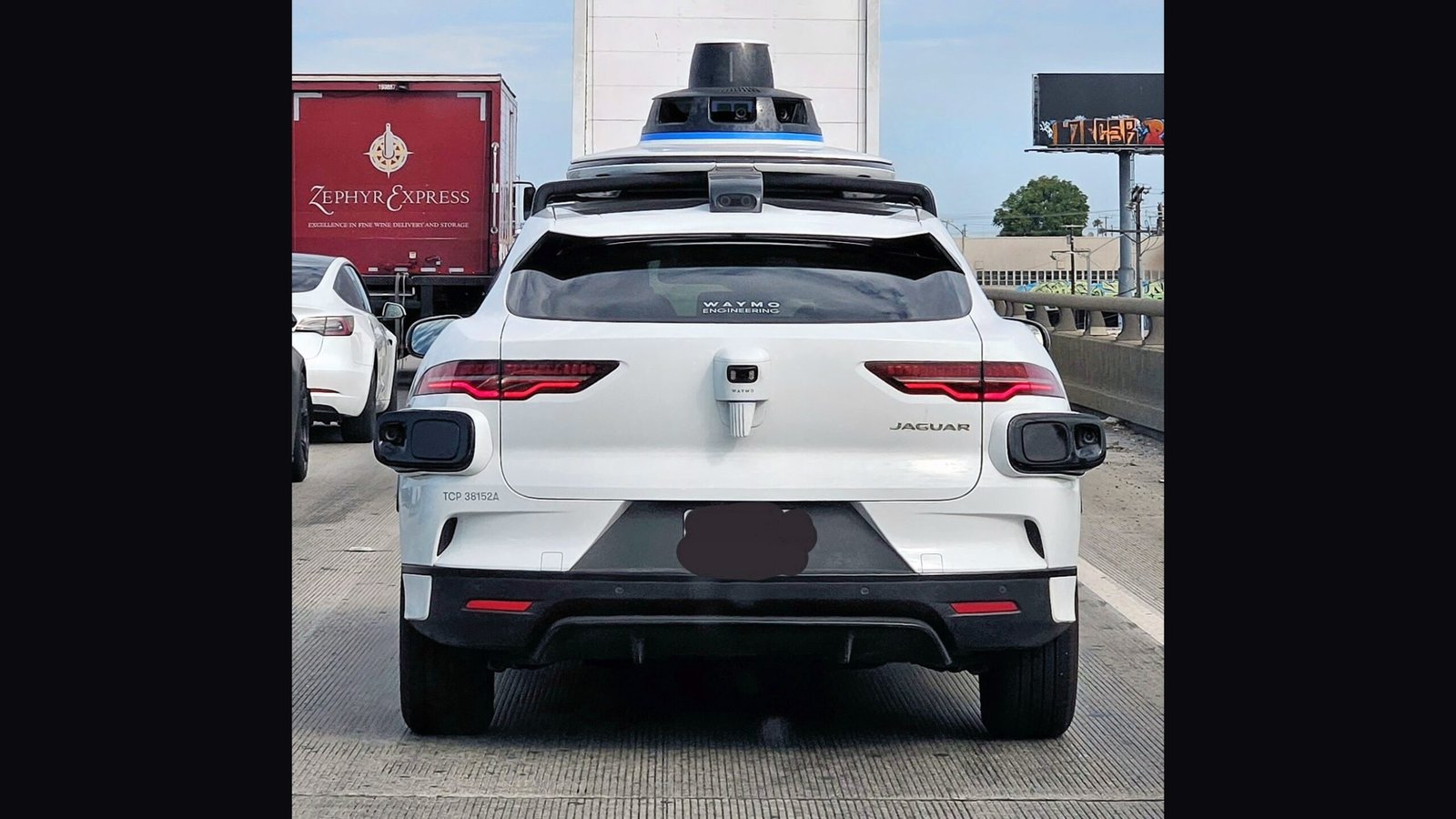
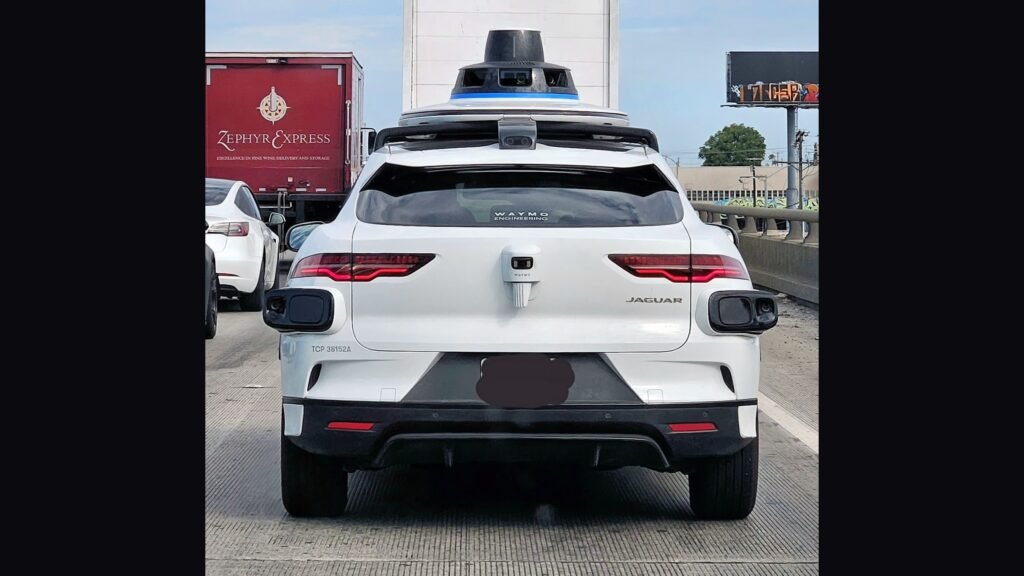
Lead image: a Waymo Jaguar I-Pace marked “Waymo Engineering” on Interstate 10 in downtown Los Angeles in August 2023, before Waymo offered public freeway rides. It is not one of the vehicles in the recalled incidents. Photo by Eric Polk via Wikimedia Commons, CC BY-SA 4.0; padded to 16:9.
Hype in. Signal out.