




Hackers have broken into Cloud One, the U.S. Air Force’s flagship cloud computing platform, three people familiar with the matter told Reuters on Friday. One source said the intruders reached the platform’s control plane, the layer that runs everything else. The Air Force won’t confirm or deny it, and nobody has said who did it or what, if anything, they took.
Key points
- Hackers breached Cloud One, the Air Force’s main multi-cloud computing platform, three people familiar with the matter told Reuters; the Air Force declined to confirm or deny it.
- One source told Reuters the intruders used a software flaw to reach the platform’s control plane, but nobody has said who did it, how long they were in, or whether any data was taken.
- Reuters’ sources say the Air Force paused migrations to Cloud One, blocked updates to apps already on it and revoked some users’ administrator rights.
- In a 2023 article, the Cloud One team claimed a “100% success rate” against 10 million attempts a year to break into the platform.
Last checked: Nov 27, 2026. This is a developing story based mostly on anonymous sources; the Air Force has not confirmed the breach.
What was reported, and by whom
The scoop comes from Reuters reporters Mike Stone and Raphael Satter, citing five people who spoke on condition of anonymity (we read the full Reuters text as syndicated by Military Times). Three said Cloud One had been breached. Two said the intrusion was found “within the past month or so” during work to upgrade the system, and that the discovery “has led to disruption across the platform.”
According to those sources:
- The way in: one source said the intruders “exploited a software vulnerability to reach the control plane.” Reuters could not identify the vulnerability.
- The damage: unknown. Reuters “could not establish the identity of the hackers, the full scope of the intrusion or whether any data had been stolen.”
- The response: investigators called in U.S. Cyber Command to assess the damage, one source said. Cyber Command did not respond to Reuters.
- The fallout: two sources plus a fourth person said efforts to migrate back-office applications onto Cloud One were paused; updates to applications already on it were blocked; a fifth source said some users lost their administrator rights.
Other outlets added a little. NBC News cited “a U.S. official” saying hackers penetrated the platform in a breach that “could have exposed sensitive military information.” Federal News Network said one person familiar with the incident confirmed some of Reuters’ details, and that remediation “disrupted some Cloud One functions, including those requiring administrative access.”
The Air Force’s on-record position is a careful non-answer. It told Reuters it “does not comment on the security posture, vulnerabilities or operational status of specific networks and systems,” and that it continuously takes “prudent measures” to protect its systems. A spokesperson told CBS News that “ensuring the security, resilience and availability of our most critical war fighting assets remains a top priority.”
What Cloud One actually is
Cloud One started in late 2017 under the name Cloud Computing Environment, according to a 2023 article credited to the Cloud One team. The idea was a one-stop shop: Air Force units plug their applications into one of four commercial clouds (Amazon Web Services, Microsoft Azure, Google Cloud and Oracle Cloud) and inherit security controls and accreditation instead of building their own. Federal News Network reports it now hosts big chunks of Air Force and Space Force IT, including personnel actions and payroll, logistics and maintenance.
How big is it? A Department of the Air Force slide deck from its 2026 DAFITC IT conference says the Cloud One program office “continuously supports 750K warfighters” and lists “Fully Accredited Cybersecurity Guardrails” and “24/7 Operations and Maintenance” among its services. The 2023 article put the count at 97 applications plus the handful it described in detail. Two of Reuters’ sources called it one of the military’s biggest cloud platforms. “A breach here is a big deal,” one said.
Reuters singled out two tenants that explain why people are nervous:
- The Theater Integrated Combat Munitions System (TICMS). The Cloud One team’s 2023 article says it tracks “all on and off aircraft actions for Air Force munitions assets and components across 210 worldwide locations,” and moved onto Cloud One in 2020.
- Cloud-Based Command and Control (CBC2). An Air Force release from January 2023 says it runs on Cloud One computing environments and “ingests over 750 radar feeds,” fusing them into one screen for North American air defense. It is a joint program with Canada.
Being hosted on a platform is not the same as being exposed by a breach of it. No report so far places the intruders inside either system, and Reuters’ source framed the risk as what the access could allow “in theory.”
Why “control plane” is the scary phrase
Plain-English version: a cloud has a data plane (the apps and databases doing the work) and a control plane (the machinery that creates accounts, grants permissions, spins up servers, changes network rules and pushes software). Getting into one application gets you that application. Getting into the control plane can get you the keys that manage many applications at once.
The Reuters source likened it to “a universal remote,” saying intruders “in theory could leverage their access to check the operational status of military aircraft or the movement of spare parts, though it was unclear whether the hackers did so in this case.”
The catch: that is the most alarming detail in the story, and it rests on one anonymous source. The reported response does fit it, though. Revoking administrator rights and freezing updates is what you do when you no longer trust your own admin tooling, not when one app has a bad password.
The patch freeze, by the numbers
The most concrete harm reported so far isn’t stolen data. It’s that, per Reuters’ sources, Air Force teams can’t push fixes to applications on Cloud One “just as a new batch of serious software vulnerabilities has been disclosed across the technology industry.”
How bad is the timing? We pulled CISA’s Known Exploited Vulnerabilities catalog (data feed, release of Nov. 27), the government’s list of flaws confirmed to be under active attack:
| Measure | Nov. 2025 | Nov. 2026 |
|---|---|---|
| Flaws added Nov. 1 to Nov. 27 | 10 | 42 |
| Typical (median) days CISA gives agencies to fix each one | 21 | 3 |
| Added in the last five days (Nov. 23 to 27) | n/a | 18 |
The three-day window is new this year: the median deadline was 21 days through February, 14 days from March through May and three days every month since June, by our count of the same catalog. Friday’s additions included two GeoServer flaws and a Drupal core flaw, all due Nov. 30.
Two caveats. CISA’s binding deadlines under Binding Operational Directive 22-01 apply to federal civilian agencies, not the Defense Department, which runs its own patching rules. And none of the reporting says which, if any, of these flaws affect software on Cloud One. The table is context for the squeeze, not evidence of a specific hole.
Two contractors, one platform, and a timeline that doesn’t quite agree
Cloud One has changed hands at the top recently. Leidos launched it as prime contractor in 2017 and lost it to SAIC in 2020, Federal News Network reports. On Dec. 10, 2025, the Pentagon’s contract announcements listed a task order to Leidos for “Cloud One Architecture and common shared services” with a ceiling of $454,954,000, running through Oct. 10, 2031, with about $28.7 million obligated at award; 11 offers were received. A ceiling is a maximum, not money spent.
SAIC protested in the Court of Federal Claims and withdrew the complaint in late January, and Leidos formally took over in May, according to Federal News Network. In a March 11 announcement, Leidos said its improvements “are designed to boost security, increase automation and simplify day-to-day operations.” Leidos referred reporters’ questions to the Air Force; SAIC did not respond to Reuters or Federal News Network.
The reports don’t line up on everything:
| Question | What’s been reported |
|---|---|
| When was it found? | Reuters: “within the past month or so,” during upgrade work. Federal News Network’s source: “earlier this year,” while patching a vulnerability. |
| When did Leidos take over? | Federal News Network and CBS: May. Reuters’ copy said SAIC was prime “until 2025” in the version Military Times ran; CNBC’s updated copy says 2026. |
| Who did it? | Nobody has said. Reuters could not identify the hackers. |
| Was data stolen? | Unknown. The Air Force declined to say what intruders accessed. |
Those gaps matter. If the intrusion was found months ago, the question becomes why it surfaced through leaks on Thanksgiving weekend. If it was found during the transition, the handoff between contractors is part of the story. Neither company has commented on the breach itself.
The “100% success rate” problem
Reuters dug up a line worth quoting. In the 2023 article, the Cloud One team wrote: “There is no room for error when it comes to security,” and claimed “a 100% success rate against a staggering 10 million adversarial attempts per year to penetrate the cloud.”
That number was always a claim about attempts that were noticed and stopped. A perfect defensive record is a statement about what you’ve detected, and the intrusions that matter are the ones you haven’t detected yet. This one, per Reuters, turned up during upgrade work.
Nicolas Chaillan, who founded Cloud One as the Air Force’s first chief software officer and left that job in 2021, told Federal News Network the service had “failed to keep up with my vision and requirements” and alleged that users can reach Cloud One through a less-secure method than he recommended. “Attackers move at machine speed while defenders patch by hand, or right now, not at all,” he said. The Air Force declined to respond to his claims, and Federal News Network’s report does not tie the access method he criticized to this breach.
Part of a pattern, or a pile of coincidences?
Reuters notes the government is already dealing with at least six other recently disclosed incidents, including two at the FBI, a previous hack of Pentagon data, a leak of Homeland Security personnel data, a breach affecting at least two spy agencies and a hack at the Treasury Department. BleepingComputer adds that the CIA and intelligence-community breach was reportedly carried out with ARTEX, an open-source AI-driven penetration-testing tool, but that it’s unknown whether ARTEX or similar tools were used against the Air Force.
NBC and BleepingComputer both say it’s unclear whether any of these breaches are related. Not every bad week is one campaign: officials blamed a router swap, not an attacker, for the outage that grounded U.S. flights earlier this month. But AI-assisted intrusion is no longer hypothetical; we’ve covered the EU Commission’s confirmed AI-tool attack, and cloud control planes are exactly the kind of wide surface that automated scanning rewards.
Our read
Take the reporting seriously and the specifics carefully. Five sources, a U.S. official speaking to NBC and a second outlet’s confirmation make “Cloud One was breached” solid. The juicier claims (control-plane access, munitions and radar exposure) are either single-sourced or framed as theoretical.
The clearest damage today is operational: a platform built to make the Air Force faster now can’t take updates, can’t onboard new apps and has fewer trusted admins, while CISA’s list of actively exploited flaws grows at one of its fastest clips of the year. That is an awkward place for a “one-stop shop” to be.
It also tests the core bet behind Cloud One: that putting hundreds of applications behind one set of accredited guardrails is safer than letting every unit run its own. Usually it is. But the same consolidation that cuts duplicated work also concentrates the blast radius when the shared layer is what gets hit.
What to watch
- Which vulnerability. If the flaw is in commercial software rather than custom Air Force code, other customers may be exposed, and a CISA catalog entry or vendor advisory would be the tell.
- Whether TICMS or CBC2 were touched. Those are the two systems Reuters named; the Air Force has declined to say what intruders accessed.
- Leidos and SAIC disclosures. Both are public companies. SEC rules adopted in 2023 require a Form 8-K within four business days if a company decides a cyber incident is material to it; a breach of a customer’s platform may never cross that line, so silence would not mean much either way.
- When updates and migrations resume. Lifting the patch freeze is the first public sign the Air Force thinks it has evicted the intruders.
- Congress. Armed Services committee members will want to know when the Air Force found this and why it reached the public through anonymous sources.
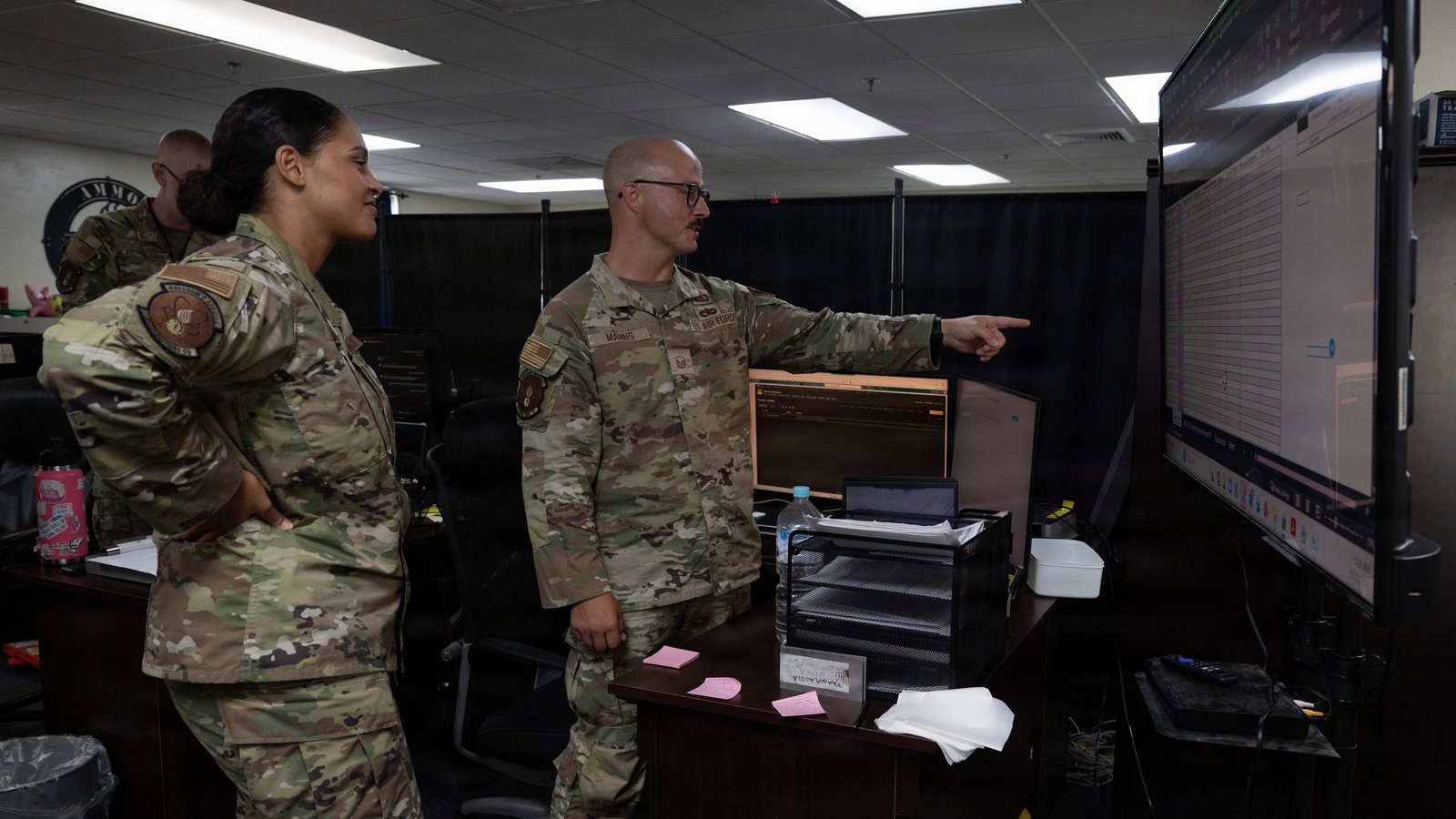
Lead image: Master Sgt. Dustin Manns, 18th Munitions Squadron munitions accountable systems officer, talks with Tech. Sgt. Kristen Minus at Kadena Air Base, Japan, during a munitions inventory in September 2026. It shows munitions accountability work, not Cloud One or the breach; we don’t know what system is on the screen. U.S. Air Force photo by Senior Airman Greydon Furstenau via Wikimedia Commons, public domain (U.S. government work); cropped to 16:9.
Hype in. Signal out.