Figure’s Figure 03 is the most advanced robot you can point to right now, Boston Dynamics’ Atlas has the best body, and the robot doing the most unsupervised work on Earth doesn’t have legs at all. That’s our late-October 2026 ranking of the ten machines that matter, built from company test reports, earnings calls and shipment data rather than highlight reels.
Key points
- Our ranking puts Figure 03 first, largely because Figure published a 56% full-task success rate in its own test across 30 homes it had never collected data in.
- Boston Dynamics’ Atlas ranks second for the strongest humanoid body we can assess, but it has no public work record yet.
- Waymo’s driverless fleet, at more than 500,000 paid rides a week by the company’s count, beats every humanoid on unsupervised real-world work.
- Nearly every big milestone on the list, from Digit 5 general availability to Tesla’s first Optimus customer shipments, is a company promise for 2027.
The other headline: almost everything exciting on this list is scheduled for 2027. Deliveries, factories, new models, new cities. We split each entry into what the robot does today and what its maker has promised for next year, because those are two very different things.
How we ranked them
“Most advanced” has no shared benchmark. The last serious side-by-side humanoid test was the DARPA Robotics Challenge more than a decade ago, and every company now picks its own exam, as NewMarketPitch points out in its tracker. So we weighed four things:
- Autonomy: long tasks in places the robot hasn’t seen, with stated rules about human help.
- Body and hands: strength, reach, balance and useful manipulation.
- Real work: hours, cycles, rides or procedures logged outside a lab.
- Scale: units actually built or deployed, not factory capacity on a slide.
Videos counted for very little. Plans, capacity targets and order backlogs are labeled as plans. We included non-humanoids where they beat humanoids on real-world autonomy or reliability, because a robot is a robot.
There are no numerical scores. The order is our judgment from the evidence above. Most of the performance and deployment figures are reported by the companies themselves and haven’t been independently tested, and where a company hasn’t disclosed something, we treat it as unknown rather than zero.
1. Figure 03 (Figure AI)
What it does today: In September, Figure tested its Helix 2.5 model in 30 Bay Area homes it had never collected data in, using one frozen checkpoint per job, each adapted from a single pretrained model. Three jobs: tidy a living room, fold towels, make a bed. In Figure’s own report, full-task success was 56%, versus 9% for a model trained without Figure’s new Index dataset. No partial credit, and any safety intervention counted as a failure.
Figure says it built its 1,000th Figure 03 in July at a rate of about one robot per hour, and the model is back at BMW’s Spartanburg plant on a sequencing job, according to NewMarketPitch. Its predecessor, Figure 02, logged more than 1,250 hours at BMW and loaded more than 90,000 sheet-metal parts before Figure retired that fleet in September.
Why it ranks first: No rival has published a comparable unseen-environment test with stated rules. Figure also has the largest disclosed Western humanoid fleet. Figure itself is careful here: “The point is not that general humanoid robotics is solved,” its Helix 2.5 report says. A 56% success rate also means failing in a stranger’s house nearly half the time.
Announced for 2027: Figure has said the design of Figure 04 was completed in May, and CEO Brett Adcock has floated home deployment as soon as 2027, per Technology Ripple. Treat the home timeline as ambition. The compute is more concrete: Figure’s deal with Nscale for up to 100,000 GPUs is reported to add capacity from the second half of 2027. Figure’s stated goal of 100,000 robots in four years is a target, not a forecast anyone can check.
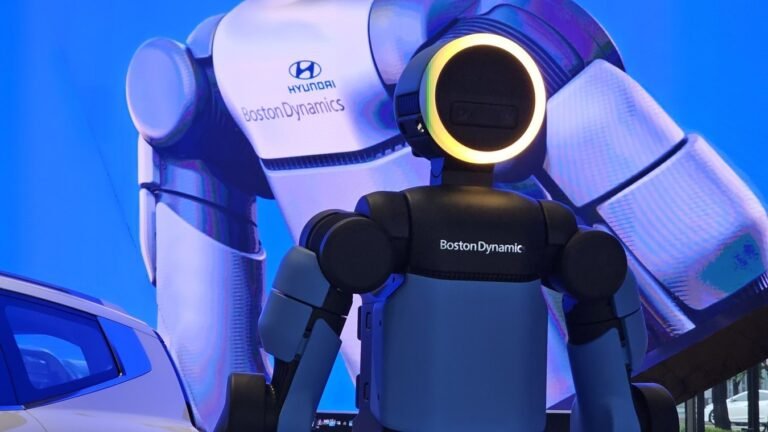
2. Atlas (Boston Dynamics / Hyundai)
What it does today: The production Atlas, unveiled at CES in January, has 56 degrees of freedom, a 2.3-meter reach, lifts up to 50 kg and swaps its own batteries when it runs low. In September, Boston Dynamics opened its Robotics Metaplant Application Center inside Hyundai’s Georgia plant near Savannah, where Atlas is training on real automotive work like sequencing parts into assembly order. This month it showed a new four-finger, 13-degree-of-freedom hand built to run triggered tools like drills, grinders and nail guns. There’s no pinky: engineers taped their pinky and ring fingers together for a day and decided the extra finger wasn’t worth three more actuators.
Why it ranks second: Atlas is the strongest, toughest humanoid body we can assess. What it lacks is a public work record. Boston Dynamics hasn’t released anything like Figure’s BMW hours or Agility’s tote counts.
Announced for 2027: All 2026 Atlas units were committed to Hyundai and Google DeepMind, and Boston Dynamics plans to add other customers in early 2027. The Georgia training center is slated to move to a building roughly ten times larger next year. The bigger numbers sit further out: per the RMAC announcement, Hyundai plans 25,000 Atlas robots across its plants “over the next few years,” parts sequencing on the real line from 2028 and component assembly by 2030.
3. Waymo Driver (Waymo)
What it does today: Waymo’s fleet completes more than 500,000 paid rides per week across more than 15 US cities and has passed 20 million cumulative paid rides, the company said this month in its Madrid announcement. It cites safety data from more than 400 million km of driverless operation showing 95% fewer serious-injury crashes than human drivers. That’s Waymo’s own analysis, but it is also the largest public record of any robot on this list.
Why it ranks third: No humanoid comes close to the Waymo Driver on unsupervised hours in an unstructured, public environment full of humans. It loses to Figure and Atlas only on generality: it does one job, very well. It isn’t flawless: Waymo paused service in five cities in May over flooded roads.
Announced for 2027: Fully driverless service in Madrid and, pending regulatory approval, Tokyo with Nihon Kotsu and GO, per Reuters. Toronto follows in 2028. Semafor has reported Waymo plans to grow from about 4,000 vehicles to 20,000 by the end of 2027, as summarized by The Next Web. Waymo hasn’t confirmed that figure publicly.
4. Digit (Agility Robotics)
What it does today: Digit has the cleanest paid-work record of any humanoid. It moved more than 100,000 totes at GXO’s Flowery Branch, Georgia site at about 98% accuracy, and the Digit 4 fleet has logged more than 65,000 hours across GXO, Schaeffler and Toyota’s Canadian plant, according to Agility. The new Digit 5, unveiled in September, lifts 50 lb repeatedly, runs on a 90-minute battery that recharges in nine minutes, and is designed to work near people without safety fences.
Why it ranks fourth: Proven work beats potential, but Digit’s hands and task range are narrower than Figure’s or Atlas’s. The business is also tiny. Agility’s merger filings showed $1.78 million in 2025 sales, about $174,000 in the first half of 2026 and a going-concern warning, per NewMarketPitch‘s review. The $300 million in Digit 5 orders is tied to milestones.
Announced for 2027: Digit 5 early access in the first half of 2027, general availability by the end of 2027, with CE marking planned for Europe and the UK. GXO plans to put Digit to work at sites in North Carolina and Tennessee starting early next year. Shareholders vote on Agility’s $2.5 billion SPAC deal in November.
5. da Vinci 5 (Intuitive)
What it does today: Intuitive placed 546 da Vinci systems last quarter, 315 of them da Vinci 5, and has more than 2,000 da Vinci 5 units installed worldwide, used by more than 18,000 surgeons, the company said on its Q3 earnings call on Oct. 20. Across all da Vinci models, surgeons perform more than 10,000 procedures per day. The da Vinci 5’s Force Feedback instruments let surgeons feel tissue resistance; about 8% of da Vinci 5 cases used them last quarter.
Why it ranks fifth: This robot is not autonomous; a surgeon drives every movement. It ranks on reliability at a scale no humanoid approaches, in the highest-stakes room there is. Intuitive’s CEO Dave Rosa said AI-controlled motion in surgery “must earn the confidence of regulators, surgeons, care teams and patients before we deploy it at scale.”
Announced for 2027: Longer-lasting instruments and volume pricing roll out from the first half of 2027, which Intuitive says will cut instrument revenue per procedure by 3% to 5% to widen access. Expansion into more countries is planned. Telesurgery clearances are expected in the first half of 2028.
6. Unitree H2 and G1 (Unitree Robotics)
What it does today: Unitree sells capable humanoids to anyone, at prices nobody else matches, and builds them at scale. It shipped more than 7,000 humanoids in the first half of 2026, per Counterpoint, and says it has built about 18,000 bipedal humanoids, per NewMarketPitch. The 1.82-meter H2 has 31 degrees of freedom and lists at $29,900; the stronger G1+ launched at $15,000. Unitree listed on Shanghai’s STAR Market in August.
Why it ranks sixth: Unitree leads on agility, price and volume, but has weak public evidence of sustained useful work. CEO Wang Xingxing said in August that the company was holding back on factory deployment because its robots still work slower than people. Last week its new H2-X “Kung Fu Legend Guardian” lost its lower leg landing a side flip at Unitree’s own conference. We cover that separately.
Announced for 2027: Wang told CCTV a physical-AI breakthrough is “most likely within the next one to two years, or two to three years,” and suggested a “ChatGPT moment” could come as early as next year, per the Global Times. Unitree has also announced an annual World Physical AI Competition with $10 million in funding.
7. AgiBot G2 and A3 (AgiBot)
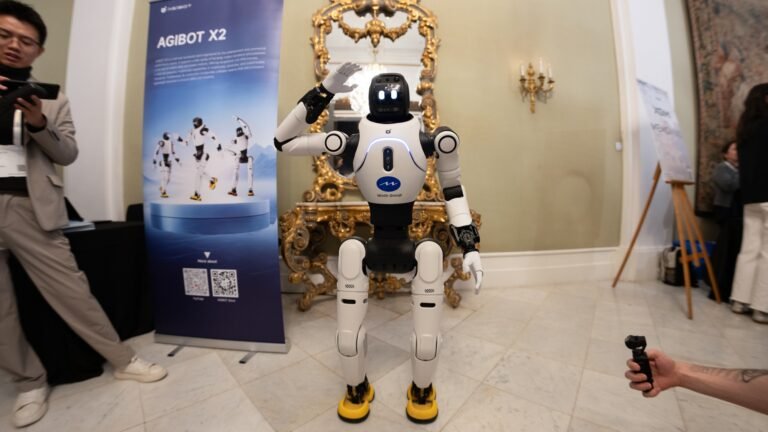
What it does today: AgiBot is the world’s highest-volume humanoid maker. It shipped about 9,700 humanoids in the first half of 2026, more than 43% of the global total, according to Counterpoint; IDC counts more than 8,600, about 35%. AgiBot says it passed 20,000 cumulative robots produced in September and is running more than 300 robots at Chimelong Spaceship Park in Hengqin plus 100 X2 humanoids in ASD retail stores, per Robotics and Automation News. Its wheeled G2 is deployed in electronics manufacturing.
Why it ranks seventh: Volume is real, but most global humanoid shipments still go to entertainment, data collection and research rather than factory work. Counterpoint puts that share above 60%.
Announced for 2027: AgiBot is targeting revenue above 10 billion yuan in 2027. A Hong Kong IPO has slipped into 2027 after a new funding round at a reported 50 billion yuan valuation, per 36Kr.
8. Walker S2 (UBTech)
What it does today: Walker S2 is China’s most factory-focused humanoid and swaps its own battery in about three minutes. UBTech sold 921 full-size humanoids in the first half of 2026, up from 45 a year earlier, and in September opened a Liuzhou plant designed for more than 10,000 robots a year, about one every ten minutes, per Fliegerfaust. Walker S2 is in validation on a Hitachi Elevator production floor and in ROSSMANN logistics in Europe.
Why it ranks eighth: Industrial access and capacity, with thin performance data. UBTech’s own filing reports a 75% lab success rate on loading and unloading, and earlier said Walker S2 hit 30% to 50% of human productivity on selected tasks. Airbus, which bought Walker S2 units for trials, has published no results.
Announced for 2027: UBTech has disclosed a fourth-generation industrial humanoid that is more than 15% lighter with a two-minute battery swap, but hasn’t named it or set a launch date. Industry reporting puts its 2027 goal at 10,000 units of annual industrial humanoid capacity.
9. NEO (1X)
What it does today: NEO is the clearest consumer home humanoid: soft-bodied, $20,000 to buy or $499 a month, with new 25-degree-of-freedom tendon-driven hands shown in July. 1X’s Hayward, California factory began production this year. The catch is that early units ship with “basic autonomy,” and a remote 1X operator can take over for unfamiliar tasks. We could not confirm how many have reached customers, and neither could NewMarketPitch.
Why it ranks ninth: Best home product design, weak independent autonomy. Figure has shown more household skill without a human on the other end.
Announced for 2027: Deliveries outside the US start in 2027, according to 1X. SoftBank was reported in August to be negotiating a majority stake at about $6 billion; no deal has been confirmed.
10. Optimus (Tesla)
What it does today: Tesla says it has begun “early production” of Optimus at Fremont, on a line it says can eventually build a million robots a year, Manufacturing Dive reported Oct. 27. Tesla has published no unit count, task-success rates or external customers, and as of mid-October hadn’t publicly shown Optimus V3. The Information has reported Fremont building several hundred a week, mostly for internal testing; Tesla hasn’t confirmed that.
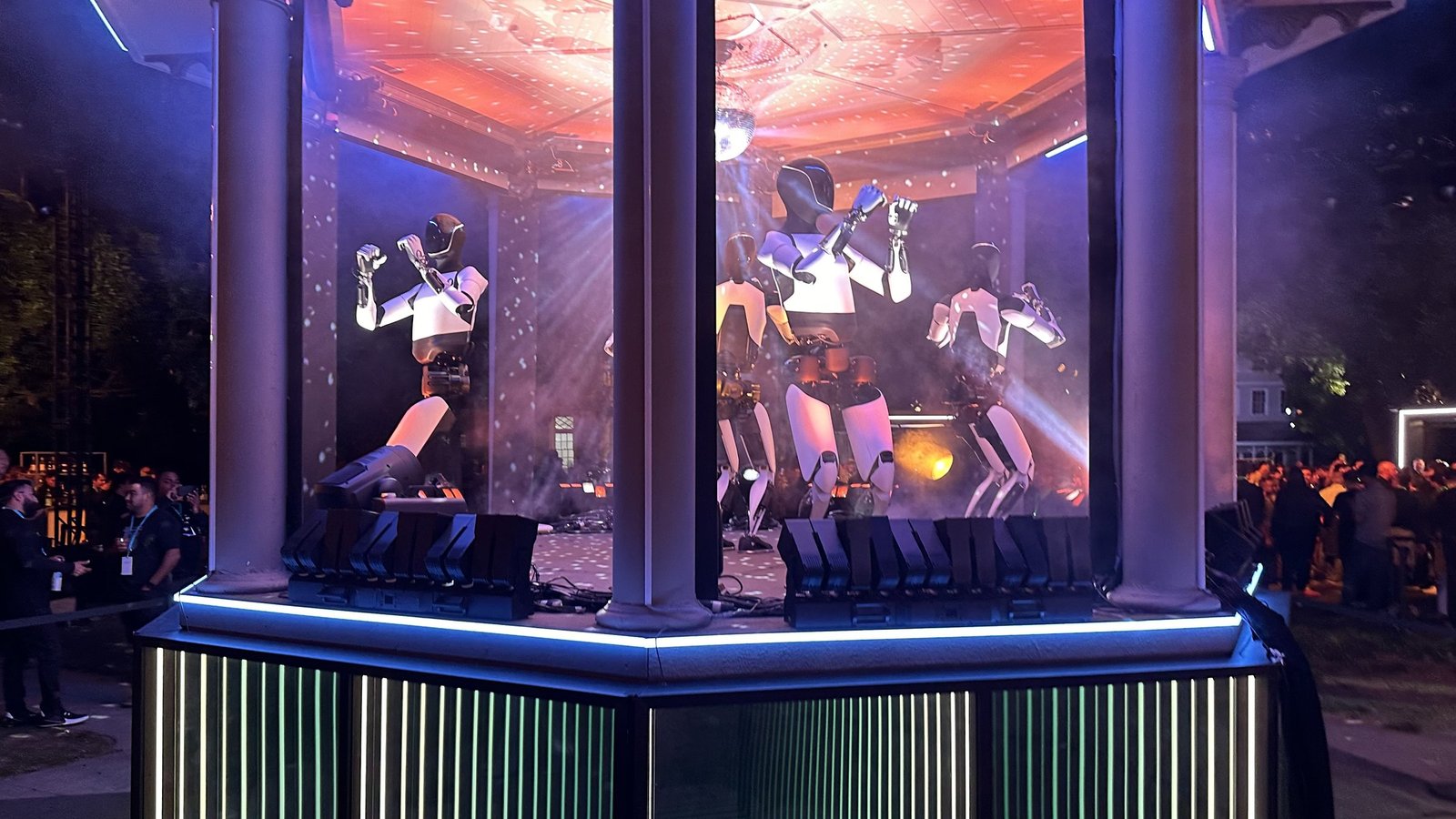
Why it ranks tenth: Tesla has the manufacturing machine. The robot’s capabilities are mostly undisclosed. Our featured image shows Optimus units at Tesla’s October 2024 event; the photographer, investor Steve Jurvetson, noted on the photo that they were clearly teleoperated.
Announced for 2027: Customer shipments are “likely to be towards the end of next year,” per Tesla, and reaching the full production rate could take “a year, maybe longer.” Tesla also describes an internal “Optimus Academy” of 10,000 to 20,000 robots for training. A marketing video is promised “in the coming weeks.”
Honorable mentions
- Apptronik Apollo: a key Google DeepMind hardware partner with more than $935 million raised. Apollo 3, its first true product, is expected in 2027, per NewMarketPitch.
- Xpeng IRON: mass production by the end of 2026, deliveries from the first half of 2027 starting in Xpeng’s own stores, and a European push in the second half, per TechNode.
What’s coming in 2027
Next year is when the promises come due. Here’s the calendar the industry has handed us:
- Early 2027: Atlas opens to customers beyond Hyundai and DeepMind. GXO adds Digit at new sites.
- First half: Digit 5 early access. Xpeng IRON deliveries. Waymo pushes toward Madrid and Tokyo. Intuitive’s new instrument pricing begins.
- Second half: Figure’s new GPU capacity is reported to start arriving. 1X expands beyond the US. Xpeng goes to Europe.
- Late 2027: Digit 5 general availability. Tesla’s first Optimus customer shipments, if the schedule holds.
Our read: 2026 was the year humanoid makers proved they could build robots by the thousand. Counterpoint counts more than 22,000 humanoids shipped worldwide in the first half alone. 2027 has to show those robots doing paid work at a rate that beats a person or a cheaper machine.
The catch: Nearly every 2027 date above comes from the company selling the robot. Tesla’s Optimus timeline has already slipped repeatedly, and Agility’s revenue shows how small paid humanoid work still is.
The takeaway
Figure has the best all-around robot, Atlas has the best body, and Waymo has the best record of robots working unsupervised among people. What to watch: whether Figure publishes customer throughput for Figure 03, whether Boston Dynamics releases any Atlas work numbers from Georgia, and whether Tesla ships a single Optimus to a paying customer in 2027.
Hype in. Signal out.
Correction (Oct 29, 2026): this story earlier said Figure ran “one fixed version” of Helix 2.5 across its home test. Figure’s report says it used one frozen checkpoint per job (three in all), each adapted from a single pretrained model. We also added a note on how the ranking was made and labeled Figure’s results as company-reported.
Image: Tesla Optimus robots on display at Tesla’s Oct. 10, 2024 robotaxi event at Warner Bros. Studios; the photographer noted they were teleoperated. Photo by Steve Jurvetson / Wikimedia Commons, CC BY 2.0; cropped to 16:9.