Unitree Robotics spent Oct. 21 selling its new H2-X humanoid as a “Kung Fu Legend Guardian” that can stand watch for eight hours and leap off a 4-meter platform. On Oct. 22, at Unitree’s own conference in Hangzhou, the robot landed a side flip, fell over, and its right lower leg came off at the joint, TechNode reports.
Key points
- An H2-X humanoid’s right lower leg came off at the joint after a side-flip landing at Unitree’s own Hangzhou conference on Oct. 22, TechNode reports.
- Unitree pitches the H2-X for security patrols and rescue, but there is no product page, price or spec sheet yet.
- Unitree’s shares rose 20% the next day, the Global Times reported, citing Beijing Daily.
- Unitree had not commented on the fall as of Oct. 25, the same week its CEO said a “ChatGPT moment” for robots could come as early as next year.
The next day, Unitree’s stock jumped 20%, according to Beijing Daily figures cited by the Global Times. Welcome to the humanoid market in late 2026.
A bodyguard robot with a stunt reel
The H2-X launched with a 61-second promo on Unitree’s official YouTube channel and X. The clip passed 8.4 million impressions on X, per Robotica Guide, which logged its on-screen captions. Among them: “Real Footage Throughout No Speed-Up,” “4 Meter High Platform” and “Standing for Approximately 8 Hours.”
The video stages the robot as a guard and rescuer. Some of those rescue scenes carry a caption reading “Real Footage of Props for Reference Only,” which is doing a lot of work.
The closing card is the strangest part. It tells viewers to keep “a safe distance of at least 2–3 meters or more,” warns “Extreme testing. No imitation!” and says the field is “in the early stages of exploration worldwide.” Buyers, it adds, should “thoroughly understand the limitations of humanoid robots before making a purchase,” per Robotica Guide.
There’s no product page, price or spec sheet for the H2-X yet. Unitree positions it for security patrols and emergency rescue, per TechNode. For reference, the standard Unitree H2 is a 1.82-meter, roughly 70 kg humanoid with 31 degrees of freedom that lists at $29,900.
What happened on stage
Unitree hosted its 2026 World Physical AI Conference and Partner Ecosystem Conference in Hangzhou, its first ecosystem conference in the company’s ten-year history, per 36Kr. During a live demo, an H2-X attempted a side flip. On landing it fell sideways onto a black cushioned mat, and its right mechanical lower leg detached at the joint, TechNode reported.
Some reports said the knee appeared to spark, according to TechWeb via Sina. The same piece notes H2-X joints can output up to 360 N·m of torque, and walks through an engineering explanation: a robot can be good at generating force (发力) for a jump while still being bad at absorbing it (卸力) on landing. A flip ends with a lot of energy dumped into one knee in a fraction of a second.
Unitree did not respond to the Global Times’ request for comment as of Sunday, Oct. 25, the paper reported. TechNode also said there was no official response. Reactions on Weibo were mixed, the paper said.
The same week, a much bigger pitch
The flip was a side show at an event built around a very large claim. In a talk titled “Believe, Trust AI as Much as Possible,” CEO Wang Xingxing presented what Unitree calls “Physical AI Robot Self-Evolution V1,” per 36Kr. The South China Morning Post described a related effort, “Unitree Rehearsal,” that Wang called the company’s “most important initiative of the year”: an AI that searches papers, writes code, tests skills in simulation and then runs them on real robots.
Wang also described experiments using GPT-6 Astra for tasks like painting and Go with “zero training,” and said the core challenge is aligning AI models’ inputs and outputs with real robot bodies, per 36Kr. He said Unitree’s G1 has reached cumulative sales of 10,000 to 20,000 units, and that he hopes robots will be in homes by the end of this year or next.
On CCTV, Wang put a breakthrough in physical AI “most likely within the next one to two years, or two to three years,” and said a “ChatGPT moment” for robots could come as early as next year, the Global Times reported. Unitree also announced a World Physical AI Competition with $10 million in annual funding across eight categories. Rules are still to be announced.
Then there was the roundtable with retired NBA star Yao Ming. “If you can’t even walk well or run, how can you expect such a robot to do practical work?” Yao said, per 36Kr. At the same event, Unitree argued that its robot fighting matches are a way to test reliability in collisions and falls. On Thursday, the test was live.
Wall Street shrugged. Make that Shanghai.
Unitree listed on Shanghai’s STAR Market in August. On Oct. 23, the day after the fall, its shares rose 20% to close at 624 yuan ($93.55), for a market value of about 252.38 billion yuan, the Global Times reported, citing Beijing Daily. We can’t say what drove the rally. We can say a broken leg on launch day didn’t stop it.
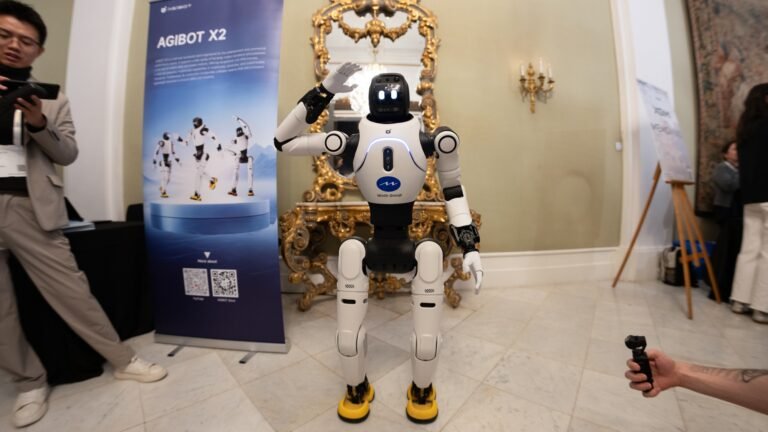
Why it matters: Unitree is one of the two companies shipping the most humanoids on Earth, alongside AgiBot. When its flagship guard robot breaks at its own launch event, it’s a public reminder that humanoid hardware is still fragile at the edges of its performance envelope, even as valuations price in a near future of robots in homes.
Our read: Robots fall, and testing at the edge is how engineers find limits. The weird part is the gap between messages: a promo shouting “Real Footage Throughout” and “8 hours,” a disclaimer telling buyers to understand the limitations, a CEO promising a ChatGPT moment, and a leg on the mat. All in the same 48 hours.
The catch: One failed landing tells us little about the H2-X’s reliability as a standing guard, which is the job Unitree is actually pitching. Unitree hasn’t published specs, failure data or what it changed afterward. Until it does, the stunt reel and the broken leg are both just footage.
The takeaway
Unitree’s H2-X is a security-and-rescue humanoid with no price, no spec sheet, a viral stunt video and one very public injury. What to watch: whether Unitree publishes H2-X specs and a failure explanation, how the $10 million competition’s rules handle falls and repairs, and whether “Unitree Rehearsal” shows measurable results outside a keynote. For where Unitree sits against Figure, Atlas and the rest, see our top 10 most advanced robots ranking.
Hype in. Signal out.
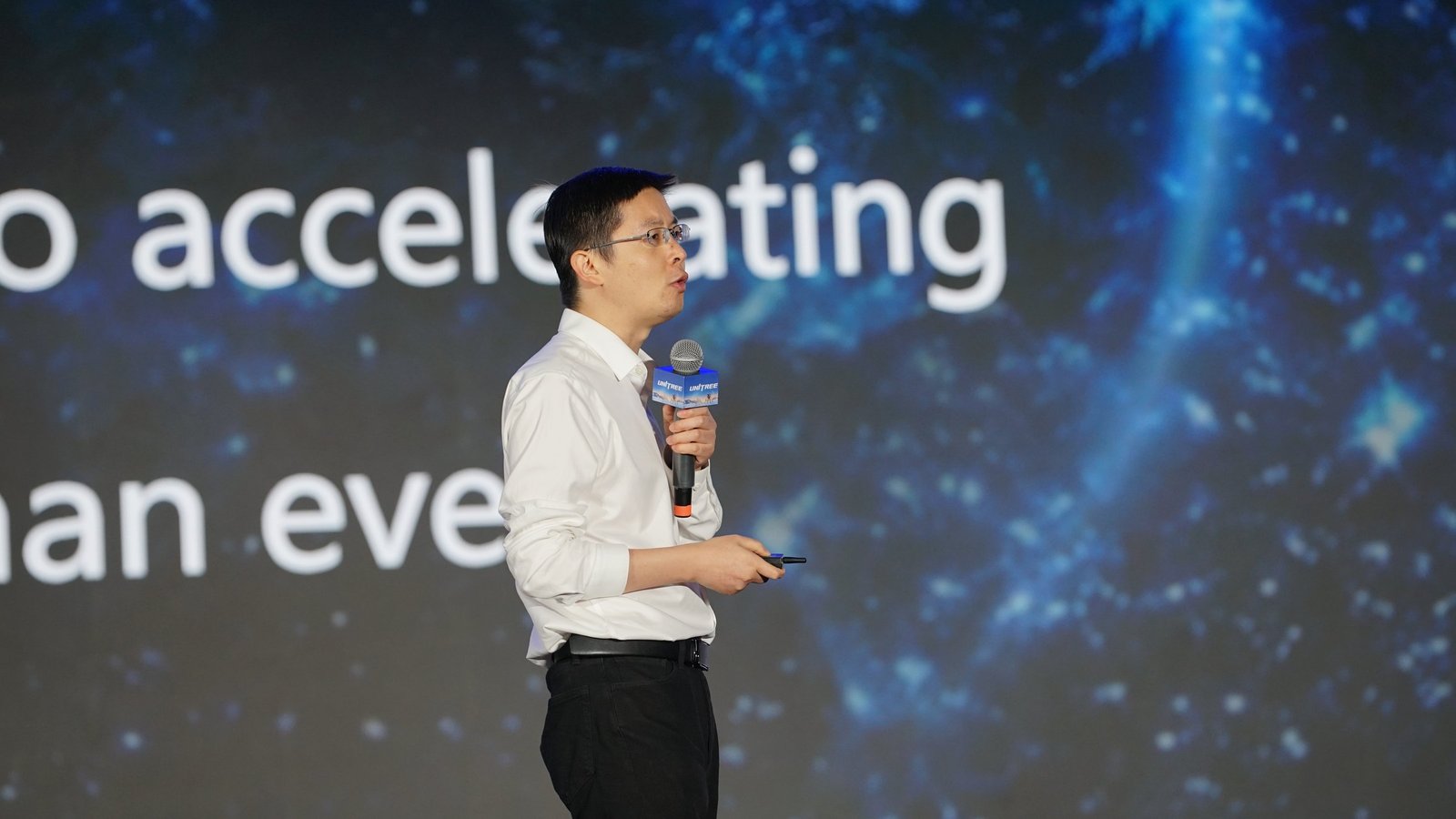
Image: Unitree CEO Wang Xingxing on stage at Unitree’s World Physical AI Conference in Hangzhou, October 2026. Photo by Xuthoria / Wikimedia Commons, CC BY-SA 4.0; resized.