


China’s foreign-investment security reviewers told SoftBank Group on Nov. 4 that it cannot buy ABB’s robotics business in China, SoftBank said two days later. ABB confirmed the same notice. The October 2025 agreement to sell the whole division for $5.375 billion is still on paper. The piece Beijing just pulled out is the division’s largest market.
Key points
- SoftBank said that on Nov. 4, 2026, China’s Office of the Working Mechanism for Foreign Investment Security Review prohibited its acquisition of ABB’s robotics business in China.
- The October 2025 deal values the whole ABB Robotics division at $5.375 billion. ABB said the unit had about 7,000 employees and $2.3 billion in 2024 revenue.
- China is ABB’s largest market for robotics deliveries, and more than 90% of ABB robots sold to Chinese customers are made locally, according to ABB as reported by China Daily in 2025.
- Bloomberg reported on Nov. 7 that SoftBank and ABB are studying a carve-out of the China business; people familiar with the talks said there is no certainty it will save the deal.
What the companies actually said
Read the statements closely, because a lot of the weekend headlines did not. SoftBank did not say China killed the global purchase agreement. It said it “received notification from the Office of the Working Mechanism for Foreign Investment Security Review in China that it had prohibited the acquisition of ABB’s robotics business in China.” ABB used the same wording and noted that SoftBank is managing the approval process.
That is a veto of the China operations, not a public shredding of the October contract. Both companies said they are “in close dialogue” and “working constructively on the transaction.” SoftBank added that it will announce any decisions that require disclosure. Neither company gave a reason for the prohibition, and China’s review office has not published one.
The distinction matters for the price. SoftBank agreed to buy a holding company that was supposed to contain the entire robotics division, China included. A division minus its largest market is a different asset. “Working constructively” is what companies say when they have not yet said whether they will reprice, restructure or walk away.
The $5.375 billion SoftBank thought it was buying
On Oct. 8, 2025, SoftBank announced a definitive agreement to acquire ABB’s robotics business for a total purchase price of $5.375 billion, about 818.7 billion yen at the exchange rate it disclosed that day. ABB’s matching release called the same figure an enterprise value. SoftBank said the price is subject to customary adjustments for net working capital and net debt at closing.
ABB had been preparing to spin the division off as a separately listed company. It said the SoftBank offer would create “immediate value” for shareholders, with expected cash proceeds, net of transaction costs, of about $5.3 billion and a non-operational pre-tax book gain of about $2.4 billion. It separately estimated about $200 million in separation costs and $400 million to $500 million in cash taxes on the local carve-out. Those are different kinds of money: hoped-for cash, an accounting gain, a split-out cost and a tax bill. They should not be added together, and they all assumed a deal that included China.
ABB said the division had about 7,000 employees and 2024 revenue of $2.3 billion, or about 7% of group revenue, with an Operational EBITA margin of 12.1%. SoftBank, using unaudited pro forma figures supplied by ABB, put 2024 revenue at $2.279 billion, down from $2.452 billion in 2023. Bloomberg later placed the unit among the four large industrial-robot makers, alongside FANUC, Yaskawa and Midea-owned KUKA, with plants in Sweden, the United States and China. The planned close was mid-to-late 2026. SoftBank listed required approvals “including in the European Union, China, and the United States.”
Masayoshi Son, SoftBank’s chairman and CEO, cast the purchase as more than a factory-automation bolt-on. “SoftBank’s next frontier is Physical AI,” he said in the October release. “Together with ABB Robotics, we will unite world-class technology and talent under our shared vision to fuse Artificial Super Intelligence and robotics.” SoftBank said the platform would sit alongside holdings that include SoftBank Robotics Group, Berkshire Grey, AutoStore, Agile Robots and Skild AI.
Why Beijing had a veto
China is not a side market that happened to sit inside the deal perimeter. In July 2025, China Daily reported, citing information released by ABB, that China is the company’s largest market for robotics deliveries and that over 90% of ABB robots for Chinese customers are manufactured locally. The same report said the share of ABB Robotics’ domestic suppliers in China was expected to reach around 80% that year. Marc Segura, president of ABB Robotics, described the approach as “local for local.”
The factory behind that claim is not a sales office with a showroom arm. In 2019 ABB announced a $150 million robotics plant of 67,000 square meters in Kangqiao, near Shanghai, billed as a site “where robots make robots.” It expected an early-2021 opening. The Financial Times, which first reported last week’s block, wrote that the Pudong mega-factory began operating in 2022 with help from Shanghai’s government, and put ABB’s China headcount across the whole company at about 12,700.
A Japanese buyer was asking to take control of a Swiss company’s robots, customer data and a government-backed Shanghai plant in the world’s largest industrial-robot market.
What the review reportedly looked at
The official record stops at the prohibition. The reporting does not. David Keohane of the Financial Times reported that SoftBank was informed the deal would be blocked by China’s National Development and Reform Commission, the state planner that handles supply-chain security. The companies named the Office of the Working Mechanism for Foreign Investment Security Review. Those can describe the same process; the notice SoftBank said it received uses the Office’s name.
According to people familiar with the matter, the Times reported, the deal cleared China’s competition review in February 2026 and then went into the security review. Until the week before the decision, people close to SoftBank and people briefed on the process had expected approval. The review included scrutiny of ABB’s Chinese supply chains and a demand to keep some manufacturing in China. People familiar with the matter also said the NDRC was concerned about robotics data being sent overseas to train AI models, including OpenAI’s. SoftBank is a major OpenAI investor.
People briefed on the regulators’ thinking told the Times that officials had also examined keeping some intellectual property in China, which could have meant spinning parts of the business to Chinese owners. People close to SoftBank were uncertain which conditions were being formally requested. The China operations were “a significant attraction for the deal,” they said. None of that is an official finding. The South China Morning Post called the prohibition China’s second major block of a tech deal this year, after Meta was ordered to unwind its acquisition of the AI startup Manus.
A carve-out, another buyer, or a long walk back
By Nov. 7, Bloomberg reported that SoftBank and ABB were looking at carving the Chinese operations out of the transaction, with SoftBank leading the push. A carve-out would mean a separately owned entity for the China unit. The same people said the effort may fail and that there is no certainty it will produce a deal.
ABB is also reviewing other options, including finding another buyer, one person told Bloomberg, adding that “the business” could be valued at $2 billion to $3 billion. The report did not say whether that range referred to a standalone China entity or a leftover global division, so it is not a new official price for either. A return to ABB’s original spin-off plan is also on the table, the people said, but looks complicated because the SoftBank agreement is already signed.
One detail sits awkwardly next to SoftBank’s own paperwork. A person told Bloomberg that Son had said he did not believe the transaction would need to involve the Chinese government. Whatever was said internally, the company’s Oct. 8, 2025, release listed China among the required approvals. The surprise, if there was one, was the outcome of a review SoftBank had already disclosed.
Bloomberg also reported that SoftBank’s shares slumped 11% in Tokyo on Friday, Nov. 6, in a broader slide in technology stocks, and that ABB’s losses for the week topped 5%. Those are market moves around the news, not a valuation of the remaining business.
The same robots, two security files
Zoom out and the veto is less of a one-off than it looks. Two weeks ago the White House issued a Section 232 proclamation that treats imported industrial robots and factory machinery as a threat to U.S. national security. It set no tariff. It started a 180-day clock to negotiate with trading partners, after which duties, tariffs or quotas could follow. ABB is one of the foreign suppliers that proclamation implicitly covers, alongside FANUC, Yaskawa and KUKA.
The same class of machine now sits in two governments’ security files, for opposite reasons. Washington is worrying about too many foreign robots coming in. Beijing just decided that this robot business, and the production data that comes with a Shanghai plant and a mostly local supply chain, should not go out under a Japanese owner with a large stake in an American AI lab.
Our read: this is what “Physical AI” looks like once it leaves the keynote. Son’s pitch was that ABB’s installed base plus SoftBank’s AI stack would produce a new kind of robotics company. Chinese reviewers, if the people talking to the Times are right, heard the same pitch and asked a narrower question: whose models get trained on data generated in Chinese plants? That is not a synergy slide. It is a jurisdiction fight.
The catch
A cleaned-up deal without China would not be a slightly smaller version of the one signed in October. SoftBank has not published a current China revenue split, and we are not going to invent one. The public record says China is the largest market, that most of the robots sold there are built there, and that SoftBank described the local footprint as part of the point. Take that out and the $5.375 billion headline describes a business that no longer exists in the form that was priced.
The other listed approvals are a blank. SoftBank named the European Union and the United States alongside China last October. Neither company has said where those reviews stand. A carve-out built to satisfy Beijing could raise new questions for the remaining reviewers, or for customers who find their supplier split along a border.
What to watch next
- The carve-out terms, if any. Who would own the Shanghai factory, the China customer contracts and the data those contracts generate is the entire negotiation.
- Whether $5.375 billion gets rewritten. That number bought a global division whose largest market is now off limits. A close at the original price, a marked-down close, or a walk-away are different outcomes, and only one of them matches the October announcement.
- The other approval clocks. SoftBank listed the EU and the United States as required jurisdictions. Any public decision from those reviews will show whether China was the only hard stop.
- An official reason. The companies and the review office have not stated why the China acquisition was prohibited. Until they do, the data-and-OpenAI account remains sourced to people familiar with a closed process, not to a government finding.
Industrial robots used to be capital goods with long sales cycles and unfashionable margins. This month they are something two governments put on the security ledger. SoftBank still wants a Physical AI platform. ABB still wants to sell a division it has already moved into discontinued operations. China still has the factory. Those three facts do not currently add up to a closing.
Hype in. Signal out.
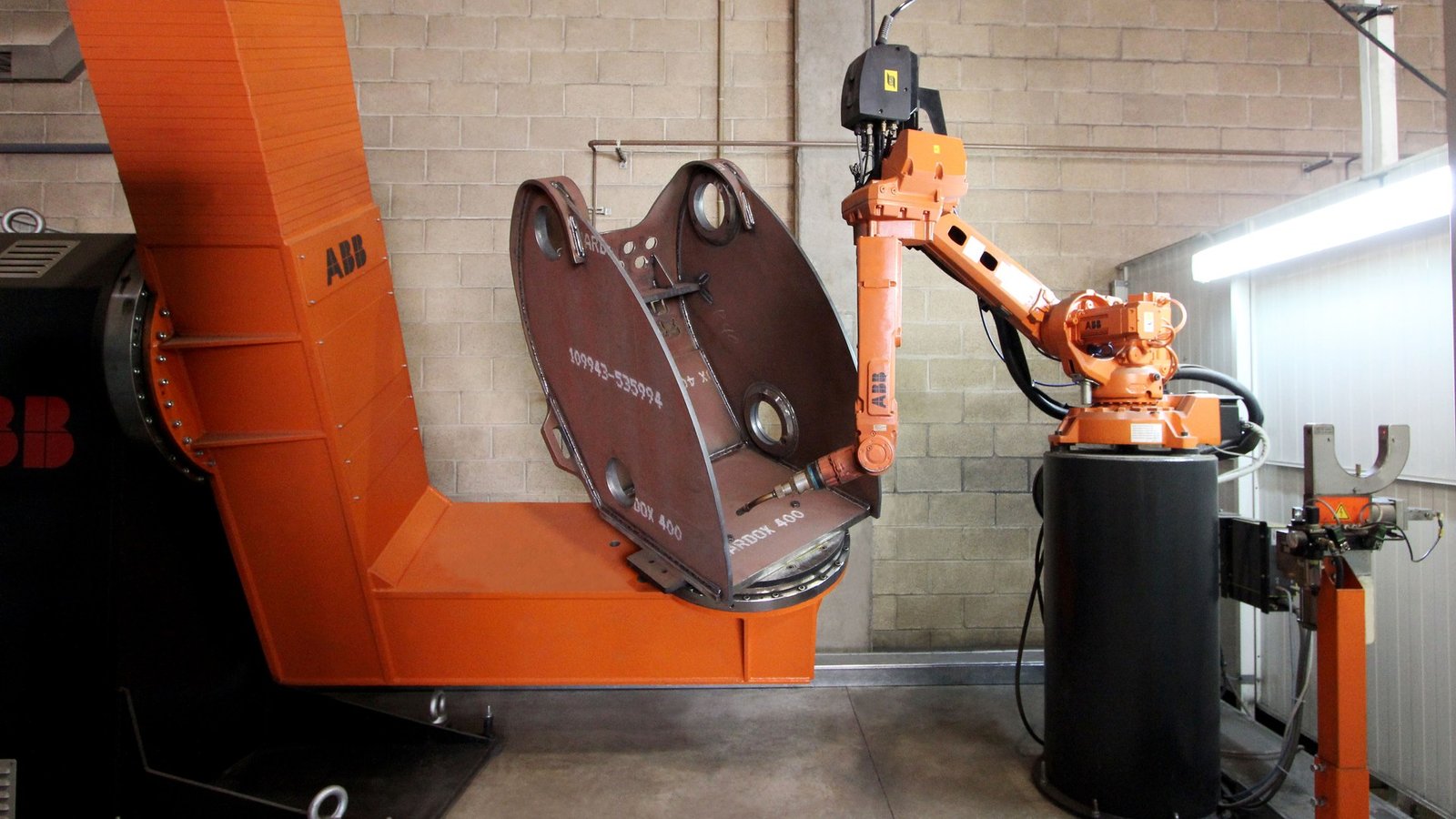
Featured image: An ABB welding robot working on a Xcentric Ripper housing, photographed June 17, 2014, at Parque Empresarial Jundiz. Photo by Ana 2016 via Wikimedia Commons, CC BY-SA 4.0. Cropped and resized for this post.