




J.P. Morgan predicts that humanoid robot production in the U.S. will reach 300,000 to 400,000 units a year by 2030 and about 1.5 million a year by 2035, according to a research note the bank released on Thursday, Nov. 12, as reported by Reuters. Reuters says the bank sees the industry shifting from demonstrations to commercial deployment. The note itself isn’t public, so everything below about it comes from Reuters’ summary.
Key points
- J.P. Morgan predicts U.S. humanoid robot production will reach 300,000 to 400,000 units a year by 2030 and about 1.5 million by 2035, according to Reuters’ summary of a note that isn’t public.
- Omdia estimates Figure AI, Agility Robotics and Tesla shipped about 150 humanoids each in 2025, so the forecast implies output growing roughly 3.7x to 3.9x a year.
- Past forecasts have been revised sharply: Goldman Sachs lifted its 2030 global estimate from 256,000 to 890,000, and Tesla’s 2025 Optimus goal fell far short.
- The work being forecast is factory and warehouse jobs, and the robotics trade group IFR says household helpers may not arrive in the near or medium term.
A prediction is only as interesting as the distance it has to travel. So we did the math the coverage skipped: where U.S. humanoid output actually stands, how fast it would have to grow to hit J.P. Morgan’s range, how the last round of robot forecasts aged, and what would have to go right in the next five years.
What J.P. Morgan is predicting
According to Reuters’ summary of the note, the bank expects humanoids to spread through manufacturing, logistics and warehousing, pushed by labor shortages, improving economics and new factory capacity. It names Tesla’s Optimus, Agility Robotics’ Digit, Boston Dynamics’ Atlas, Figure AI’s Figure robots and Apptronik’s Apollo as the key U.S. players.
The note includes three economic claims worth flagging as the bank’s estimates, not established facts:
- J.P. Morgan estimates humanoid costs are nearing parity with labor costs.
- It estimates that running humanoids across multiple shifts could save a customer about $100,000 a year. Reuters’ summary doesn’t give the robot price, wage rate or shift count behind that number.
- It expects the market for key parts (actuators, motors and vision systems) to approach $30 billion by 2035, and sees component suppliers as the biggest near-term opportunity.
It also says the quiet part plainly: “Near-term progress remains supply constrained, with a few binding bottlenecks: hands, actuators, the brain, and production capacity.”
One more thing readers should know. The bank names stocks it favors in the same note (Timken, Robotis, Leader Drive, Orbbec and Cognex), so the forecast is also part of an investment pitch. That doesn’t make it wrong. It does make it one bank’s view with assumptions we can’t inspect.
The starting line: about 450 robots
Here’s the number the forecast needs next to it. Research firm Omdia counted 13,317 humanoid robots shipped worldwide in 2025, and the three U.S. makers in its top 10, Figure AI, Agility Robotics and Tesla, shipped about 150 each, according to Forbes’ report on the Omdia data. That’s roughly 450 robots combined. Chinese makers dominated: AgiBot shipped an estimated 5,168 and Unitree 4,200. IDC, using different definitions, counted about 18,000 units globally.
Those are rough counts. Forbes noted the figures were “suspiciously rounded,” and Omdia’s “others” bucket (1,350 robots) includes makers it didn’t name, some of them American. Output has also grown this year. Figure said on April 29 that its BotQ plant had delivered more than 350 Figure 03 robots and raised its rate from one robot a day to one an hour. Tesla said in October that Optimus production had started in Fremont, but its shareholder update lists the line as “Early Ramp” with no capacity figure, TSN reports.
Our math: going from about 450 robots in 2025 to 300,000 a year in 2030 is a roughly 670x increase. Hitting 400,000 is about 890x. Spread over five years, that’s output growing about 3.7x to 3.9x every single year. If the real 2025 U.S. base was higher than Omdia’s three named makers, the required growth rate drops, but not by enough to make this a gentle slope.
For scale: J.P. Morgan’s U.S.-only 2030 range is bigger than Goldman Sachs’ February 2024 base case for the whole world, which was “more than 250,000” humanoid shipments in 2030.
How the last forecasts aged
Humanoid forecasts have a habit of being revised, and the revisions have mostly gone up, not down.
- Goldman Sachs, 2024 to 2026. In February 2024 Goldman raised its 2035 forecast fourfold to 1.4 million units and a $38 billion market. In its Physical AI report this year it raised it again, to about 6.5 million units and roughly $138 billion, and lifted its 2030 forecast from 256,000 to 890,000, 24/7 Wall St. reports. Banks moving forecasts up fast tells you about sentiment. It doesn’t tell you about shipments.
- Tesla, 2024 to 2025. On Tesla’s July 2024 earnings call, Elon Musk said Tesla expected “several thousand Optimus robots produced and doing useful things by the end of next year.” By late July 2025 Tesla had built only “in the hundreds,” TechCrunch reported, citing The Information, against a stated goal of at least 5,000. The Information later reported the target was cut to 2,000 and that problems with the robot’s hands forced design changes. Omdia’s count for Tesla’s 2025: about 150.
- Tesla, now. On the Oct. 21 call, Musk said Tesla would be able to make 20,000 Optimus robots a week by the end of 2027, TechCrunch reported. That’s about 1 million a year, more than double J.P. Morgan’s high case for the entire U.S. industry three years later. In the same call he called the current stage “early production” and said “there’s still quite a lot of work to do with regard to the AI and the robot for it to be truly useful for open-ended tasks.”
Our read: J.P. Morgan sits between the cautious researchers and Musk. That’s a comfortable place for a forecast to sit. It isn’t evidence that it’s right.
What robots would actually be doing in 2030
Strip away the unit counts and the predictions about work are much narrower than the sci-fi version. Nobody we read is forecasting a robot butler.
- Factories and warehouses first. J.P. Morgan’s adoption story is about automating repetitive tasks in manufacturing, logistics and warehousing.
- Hyundai’s plan for Atlas. Hyundai Motor Group says Atlas is slated to be deployed in parts-sequencing work at its Georgia plant starting in 2028, with parts-assembly work “planned from 2030.” It also plans to deploy roughly 25,000 Atlas units across its plants and talks about annual production capacity of 30,000 robots. Those are company plans.
- Agility’s next sites. Agility, which started trading on Nasdaq this month, says GXO will add Digit at two more U.S. facilities starting in early 2027 and AGCO will pilot it at a plant in Hesston, Kansas, in 2027, according to its merger announcement. The same release cites RoboFab’s designed capacity of “up to 10,000 robots” a year.
- Not your house, yet. The International Federation of Robotics’ 2025 position paper says mass adoption as “universal household helpers” may not happen in the near or medium term, and that humanoids will complement existing robots rather than replace them.
So the honest 2030 picture, if the bullish forecasts hold, is hundreds of thousands of robots moving totes, sequencing parts and doing other well-defined jobs in prepared spaces. That’s a big deal for factories. It’s a much smaller deal for everyone else.
What would have to happen for 400,000 to come true
Working backward from the forecast, here’s what the next five years would need. These are our inferences from the sources, not J.P. Morgan’s list.
- Many more factories, or one giant one. Reuters says the note finds most U.S. makers other than Tesla are targeting 10,000 to 30,000 units a year. At those sizes, reaching 300,000 takes somewhere between 10 and 30 plants running at full target, unless Tesla’s line delivers a large share on its own. Reuters’ summary doesn’t say how much of the range the bank assigns to Tesla.
- Hands and actuators at volume. J.P. Morgan names hands and actuators as binding bottlenecks, and hands are exactly what stalled Tesla’s 2025 ramp.
- A supply chain that survives trade policy. President Trump’s Oct. 28 Section 232 proclamation found that imports of robotics, industrial machinery and their parts threaten national security, but imposed no tariffs yet. It ordered negotiations, with an update due within 180 days, around April 26, 2027, law firm Mintz notes. Separately, the FCC on July 28 added foreign-produced “advanced robotic devices”, defined as mobile robots such as humanoids and quadrupeds, to its Covered List. Both push toward U.S. production. Three of the bank’s five favored suppliers are based in China or South Korea.
- Robots that earn their keep. The $100,000-a-year savings estimate has to show up in customer budgets, which means robots that run multiple shifts without constant babysitting. Musk’s own “it can’t, like, wear out after a month” is the right bar.
The skeptic’s checklist
Three things make us cautious. First, the baseline is fuzzy: research firms disagree on what counts as a humanoid and whether shipments are sales or demo units. Second, the forecast’s assumptions are in a note the public can’t read. Third, the loudest production promise in the field, Tesla’s, missed its own 5,000-robot goal for 2025 by more than 30x, by Omdia’s count.
In the forecast’s favor: real factories now exist (Figure’s BotQ, Agility’s RoboFab, Tesla’s Fremont line), real customers are signing multi-site deals, and U.S. trade policy is now actively pushing robot making onshore. Those weren’t all true when Goldman made its 2024 call.
The takeaway
J.P. Morgan’s forecast is a prediction, not a production schedule, and it needs U.S. humanoid output to grow almost 4x a year for five straight years. The tells come early. Watch for real 2026 shipment counts in January (Omdia and IDC published 2025’s numbers in January this year), whether Tesla puts a capacity number next to “Early Ramp,” Agility’s GXO and AGCO deployments in 2027, and the Commerce and USTR update on robot imports due around late April 2027. If those slip, 2030 slips with them.
This story is not investment advice.
Hype in. Signal out.
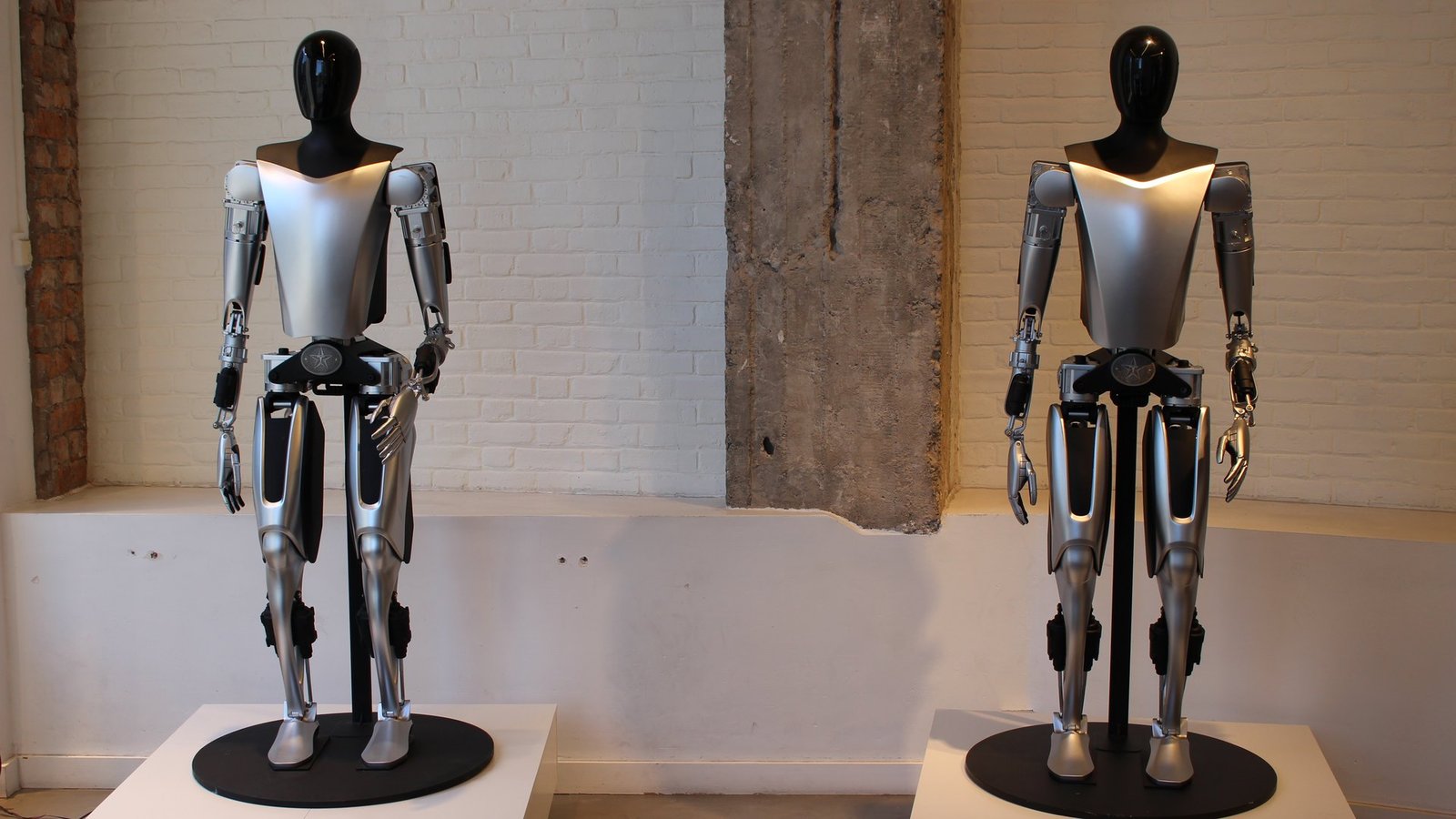
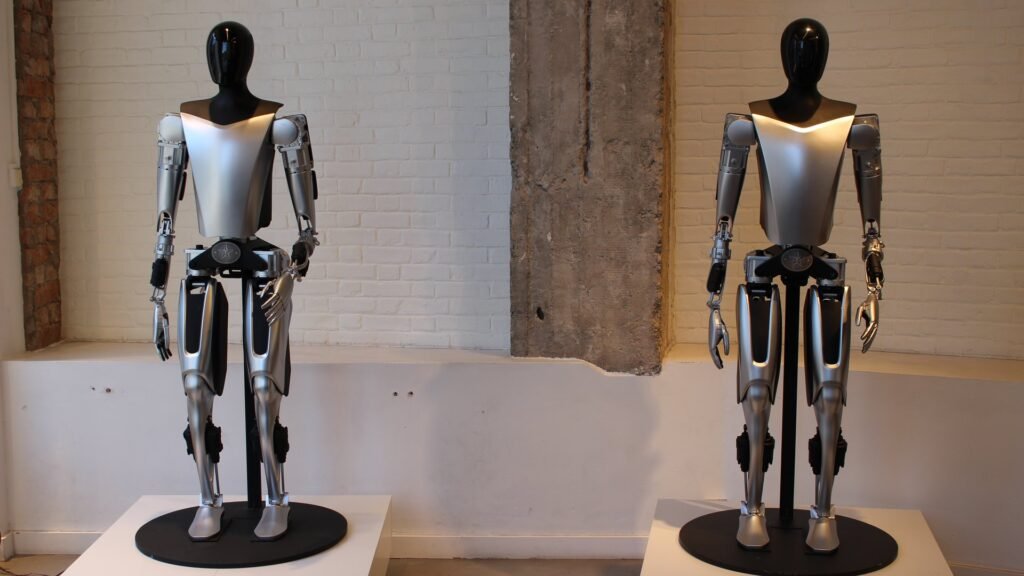
Image credit: Two Tesla Optimus robots on display stands in Stockholm, May 13, 2024 (display units, not production robots). Photo by Ulf Klingström (Ulkl), public domain, via Wikimedia Commons; cropped to 16:9.