




Nvidia’s board on Tuesday created a new standing committee to oversee the company’s national security policies, export-control compliance and global trade risk, according to a company release. It landed hours before Nvidia’s third-quarter results, due at about 1:20 p.m. PT, the first since Jensen Huang resigned as CEO last week. It also landed one day after Washington tightened the rules on renting American AI chips abroad and published its own timeline of the criminal investigation into Megaspeed, the Singapore company at the center of the Huang scandal.
Last checked: Nov 17, 2026, 7 a.m. PT
Key points
- Nvidia’s new National Security and Export Control Oversight Committee is chaired by director Suzanne Nora Johnson, with directors Stephen C. Neal and John O. Dabiri, and will meet at least quarterly.
- Nvidia’s announcement doesn’t mention Huang, Megaspeed or the board’s outside investigation of Huang’s conduct.
- On Monday the Commerce Department issued a rule requiring licenses for chips headed to data centers anywhere that provide more than 12 million units of “aggregate TPP” of computing power to companies headquartered in China or other restricted countries, plus new licenses for five countries including Singapore and Malaysia.
- Commerce and Justice said their Megaspeed probe began in 2024, and that Nvidia put Megaspeed on its “no sell” list in June 2025 after investigators asked for its sales records.
A board committee is a very corporate response to a scandal involving reported affairs, a woman U.S. officials reportedly suspect of spying for China, and the president of the United States. It’s also the clearest signal yet of who Nvidia thinks it has to reassure this week. The answer isn’t the more than 190,000 signatures CNBC reports on a petition to bring Huang back. It’s the government.
What Nvidia actually announced
The release describes a new standing committee that will give board-level oversight to Nvidia’s national security policies, export-control compliance and global trade risk management. Nvidia’s existing National Security Team and Global Trade Compliance Team will report directly to the committee, and to interim CEO Colette Kress on day-to-day operations. The committee will meet at least quarterly, including in executive session, and will “retain independent, outside experts” in law, national security and trade compliance.
The three members already sit on Nvidia’s board. Per Nvidia’s board page, chair Suzanne Nora Johnson is a former vice chairman of Goldman Sachs, Stephen C. Neal is chairman emeritus and senior counsel at the law firm Cooley, and John O. Dabiri is a Caltech professor of aeronautics and mechanical engineering.
Board chair Harvey Jones, who got that newly created title when Huang left, supplied the quote: Nvidia “recognizes that advanced silicon technologies and the emergence of artificial and superintelligence present unprecedented challenges for national security,” and is “committed to working constructively with government and industry partners.” The release says the committee reflects the board’s commitment “to enhance its engagement with relevant government stakeholders.”
What it leaves out: Huang, Megaspeed, China and the investigation. The release doesn’t name the outside experts, give a budget or say whether the committee will publish anything. It also doesn’t say whether the committee has any role in the separate probe of Huang’s conduct.
A committee is not the investigation
That probe is a different track. On Nov. 10, the board’s independent members said they had retained former acting U.S. Attorney for the Southern District of New York Joon H. Kim and his firm, Wachtell, Lipton, Rosen & Katz, to run “a thorough and independent investigation.” CNBC reports the probe covers Huang’s conduct and whether it compromised national security or company secrets. A person familiar with the matter told CNBC on Monday that the board is focused on it and isn’t considering bringing Huang back.
Huang’s resignation as president, CEO and director was announced Nov. 12, with Kress, the CFO, keeping that job while serving as interim CEO. It followed his admission of an affair with Alice Huang (no relation), a former Megaspeed executive whom U.S. intelligence officials reportedly suspect of working for China; China has denied the allegation, and she hasn’t been charged. We covered the exit and the petition to reverse it last week.
Our read: the investigation answers what happened. The committee answers a different question that regulators and lawmakers keep asking: who at Nvidia is responsible for knowing where its chips end up? Treasury Secretary Scott Bessent asked on Fox News over the weekend whether Nvidia was “pressing these seemingly illicit sales to goose their revenues,” CNBC reported. A committee with a direct reporting line is the standard corporate reply to that kind of question. It is not an answer to it.
Washington moved first
The timing matters because the government spent Monday changing the rules. The Commerce Department’s Bureau of Industry and Security released an interim final rule, “Addressing Remote Access to Advanced Semiconductors,” that it says was “written by and at the direction of the Department of Treasury and the National Security Council.” It takes effect when it’s published in the Federal Register, which the law firm Nixon Peabody expects on Nov. 19, and it opens a 60-day comment period. (The rule uses “Super Intelligence” in place of “artificial intelligence,” per an executive order, which is a sentence we did not expect to type.)
Per the rule text, it does four things:
- A data center test. A license is required to ship advanced AI chips and servers to a data center anywhere in the world if the shipper knows it will provide access to more than 12 million “aggregate TPP” to companies headquartered in China, Macau or other countries in BIS’s Country Group D:5. That counts one site or “linked data centers.” Commercial recommender systems, the kind retailers and social apps use, are exempt.
- A 90-day clock. Data centers already serving those customers at that scale must get a license within 90 days of the effective date “or face future export restrictions.”
- Five new license countries. Indonesia, Malaysia, Singapore, Thailand and Brazil now need licenses for advanced chips, which BIS says present “a higher-than-normal risk of diversion.” Shipments to companies headquartered in the U.S. are exempt if the exporter files monthly reports.
- A formal goodbye to the AI Diffusion Rule, the Biden-era framework that BIS says was never enforced.
Singapore is the one to underline: it’s where Megaspeed is based. Under the new rule, even a sale to a Singapore data center that never rents a single chip to a Chinese company needs a license, unless the buyer is a U.S.-headquartered company and the exporter reports it.
How big is 12 million TPP?
TPP, or total processing performance, is BIS’s yardstick for chip power. The rule defines it as 2 × “MacTOPS” (trillions of multiply-accumulate operations per second) × the bit length of the operation, using dense math, not the inflated “with sparsity” numbers. Nvidia’s H100 spec sheet lists 1,979 teraflops of FP16 “with sparsity” for the SXM version, so about 990 dense. Times 16 bits, that’s a TPP of roughly 15,800 per chip.
By our math, 12 million aggregate TPP is about 760 H100s, or fewer of Nvidia’s newer, faster chips.
Compare that with what Nvidia reportedly told its own customers. Two people with direct knowledge told CNBC that Nvidia said it wouldn’t sell chips to customers who rent more than 50% of their GPUs to Chinese companies. That’s a share-based test. The new rule is an absolute one: a 20,000-GPU H100 data center renting 5% of its capacity, about 1,000 chips, to a Chinese-headquartered company would pass Nvidia’s reported 50% test easily and still blow past 12 million TPP. The rule’s preamble also says BIS already treated a D:5 company that’s the “primary (greater than 50 percent of total compute)” remote user as covered under earlier controls.
Our read: Nvidia’s reported 50% policy looks a lot like that older reading of the rules, and much looser than the new one. The same CNBC sources say Nvidia warned buyers that the Remote Access Security Act, a bill that passed the House in January but not the Senate, could expose both them and Nvidia to “legal action.” Commerce just did a version of that by regulation.
The Megaspeed timeline, in Washington’s words
Also on Monday, Commerce and Justice released a joint statement on Megaspeed, saying it was “in the public interest to provide the facts and address inaccurate information circulating in public reporting.” Combined with what Singapore and Megaspeed have said, here’s the sequence as it now stands:
- 2024: Commerce opens an export-control investigation into Megaspeed after “identifying suspicious activity” in its monitoring of chip diversion (joint statement).
- May 2025: Commerce investigators ask Nvidia for records of direct or indirect sales to Megaspeed (joint statement).
- June 2025: Nvidia puts Megaspeed on its “no sell” list. The same month, BIS agents and Singaporean law enforcement run an on-site end-use check at Megaspeed and interview Alice Huang, then its CEO. Justice then takes the lead on a criminal investigation (joint statement).
- Aug. 30, 2025: Alice Huang leaves Megaspeed, according to a company statement reported by Reuters.
- February 2026: Singapore bars her from re-entering after finding she knowingly gave inaccurate information about her role at Megaspeed, per CNBC. Singapore’s Ministry of Home Affairs says she wasn’t investigated for espionage.
- Nov. 8 to 17, 2026: Huang admits an affair in an email to staff, the board hires Wachtell, Huang resigns, Commerce issues the remote-access rule, and Nvidia forms its committee.
No charges have been announced, and Megaspeed denies wrongdoing, the Washington Times reports.
The catch: the statement makes Nvidia look responsive, since it cut Megaspeed off a month or so after investigators asked for records. But it also raises the question Chris McGuire, a senior fellow at the Council on Foreign Relations, put bluntly on X, as quoted by CNBC: “The facts here just don’t add up, and this does nothing to explain why Commerce did not cut Megaspeed off from chips.” He says Megaspeed kept buying chips after Nvidia’s no-sell decision. He also asked whether Nvidia blacklisted Megaspeed’s subsidiaries Speedmatrix and PT Megaspeed International. Those are his claims and questions; the statement doesn’t address them, and we haven’t seen records either way.
The politics are not aligned
The government isn’t speaking with one voice. President Trump said Monday he “would certainly not mind” Huang returning, and “I don’t know that she’s a spy at all. Nobody’s proven that,” the New York Post reported. Bessent, meanwhile, called for a “dramatic shakeup” at Nvidia and suggested other executives should face scrutiny over export compliance, per CNBC. Huang has been asked to testify before the Senate Banking Committee on Dec. 3, CNBC says.
Our read: a committee chaired by a former Goldman vice chairman, with a Cooley lawyer beside her, is built for the Bessent half of that split. It gives Kress something concrete to point to when analysts ask about compliance this afternoon.
What Kress walks into at 2 p.m. PT
Nvidia’s August outlook for the third quarter called for revenue of $108.0 billion, plus or minus 2%, with GAAP and non-GAAP gross margins of 74.0%, plus or minus half a point. It assumed no data center compute revenue from China. Analysts expect $109 billion in sales and $2.48 in earnings per share, according to FactSet consensus figures cited by CNBC.
Nvidia’s stock fell 4% Monday to its lowest close since July 1, 2025, and was roughly flat at Tuesday’s open, CNBC reported. New Street Research estimated in a Nov. 9 analysis that as much as 10% of Nvidia’s revenue may come directly or indirectly from China, CNBC says, and other estimates run higher. Analysts CNBC spoke with mostly argued that the end customers of chips shipped to Asia are mostly American companies, which the five-country rule exempts if exporters file reports.
This story is not investment advice.
What to watch
- Whether Kress’s script names the rule. The five-country license requirement and the 12 million TPP test both hit Southeast Asian data center sales. Watch for any quantified impact in fourth-quarter guidance, or a pointed refusal to give one.
- The Megaspeed subsidiaries. If Nvidia says whether its no-sell list covered Speedmatrix and PT Megaspeed International, it answers McGuire’s question. If it doesn’t, expect a senator to ask.
- Who the outside experts are. The release promises them but names none. Hiring former BIS or national security officials would tell you what kind of oversight this really is.
- The 90-day clock. If the rule publishes Nov. 19 as expected, existing data centers serving Chinese-headquartered companies at scale have until about Feb. 17, 2027 to get licensed.
- Dec. 3. Whether Huang actually appears before Senate Banking, and what he says about Megaspeed under oath.
The takeaway
Nvidia spent the week after Huang’s exit answering a petition through anonymous sources and Washington with a press release. That ordering makes sense if the bigger risk is now a license requirement rather than a leadership vacuum. But a committee that meets quarterly is a promise about the future. The hard questions this afternoon are about the past: what Nvidia knew about where its chips went, and when it knew it.
Hype in. Signal out.
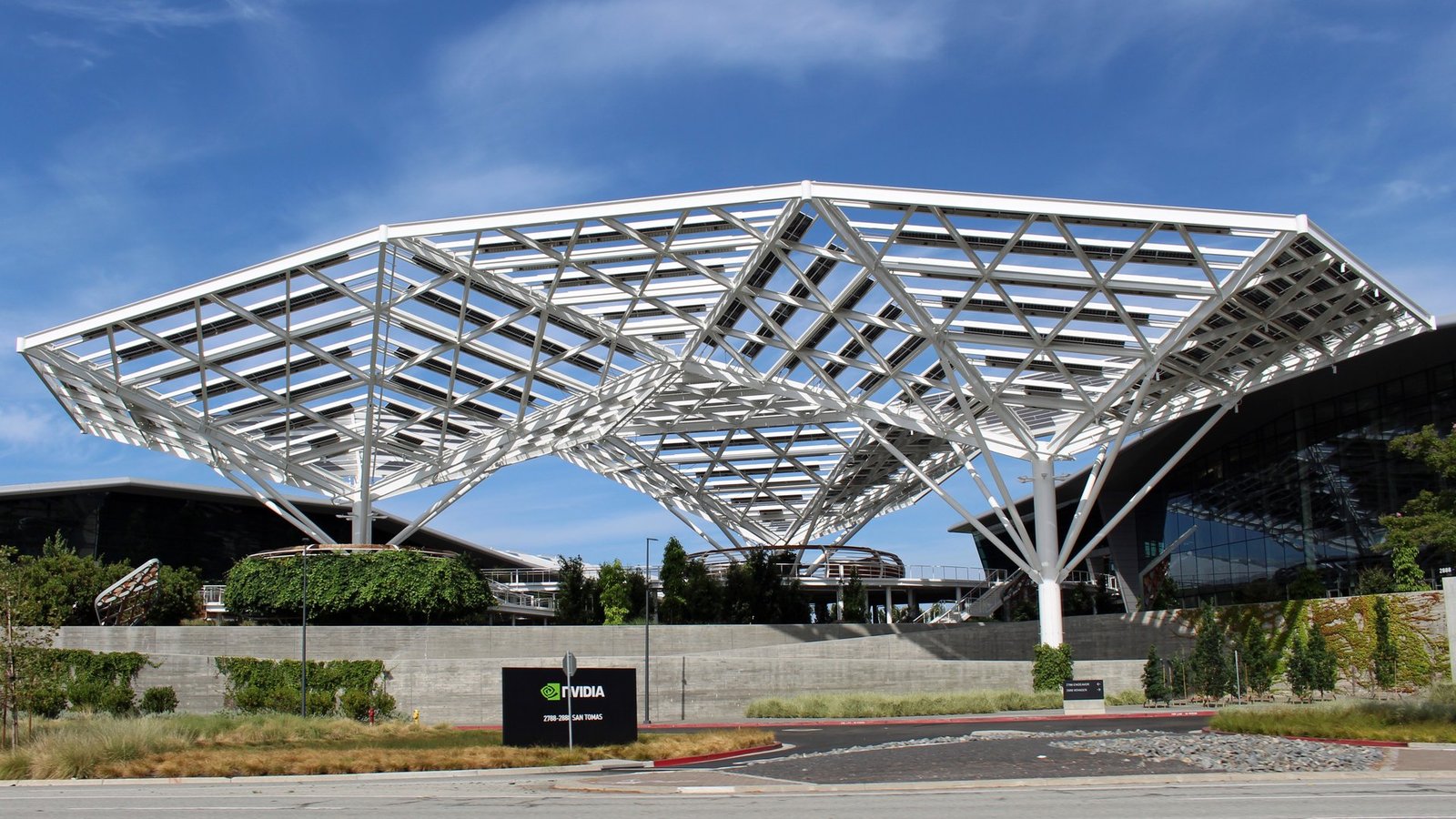
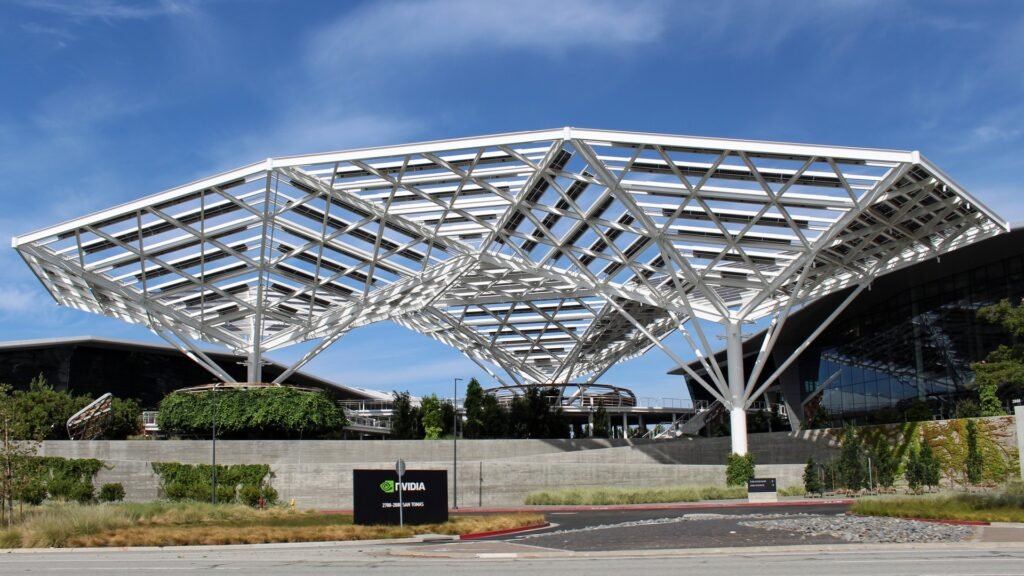
Image credit: Nvidia’s headquarters at 2788-2888 San Tomas Expressway in Santa Clara, California, in July 2023. Photo: Coolcaesar via Wikimedia Commons, CC BY-SA 4.0 (cropped).