




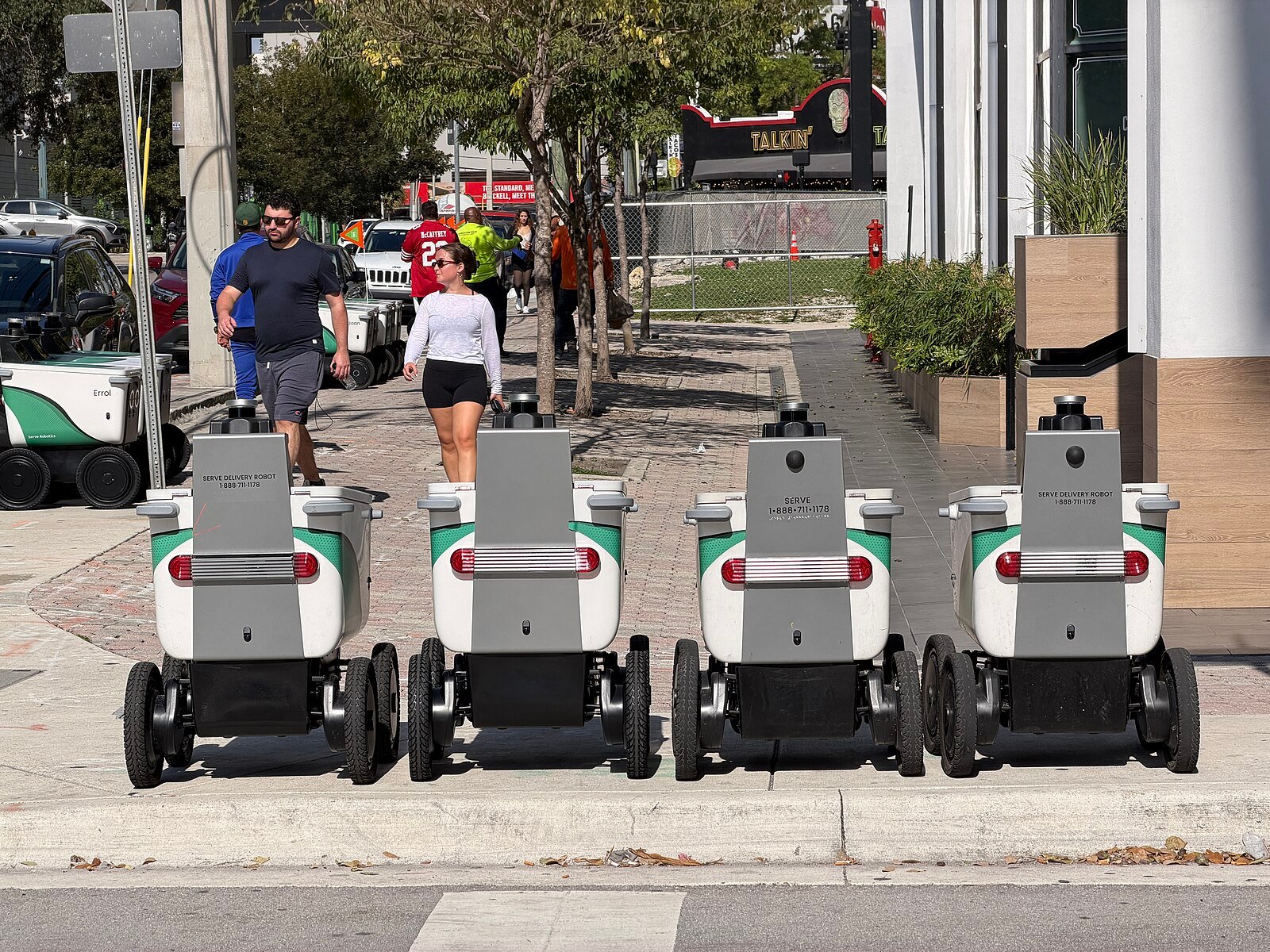
Serve Robotics, the Uber spinoff whose cooler-shaped robots roll food down sidewalks in cities like Los Angeles, Miami and Dallas, on Wednesday opened its fleet to outside software. The new AV Delivery Developer Portal offers a public API and a sandbox that, in the company’s words, let “anyone, from independent developers and hobbyists, to businesses and AI assistants” summon its robots programmatically, according to Serve’s announcement.
The headline pitch is wild: your AI agent books a robot, the robot rolls to a bakery, and a croissant shows up at your door with no app and no human courier. The fine print is tamer. Serve has to approve you before any real robot moves, and its own docs say partner signup “is not self-service yet.”
Key points
- Serve Robotics launched a developer portal on Nov. 11, 2026, with a public API and a sandbox of simulated robots for dispatching its sidewalk delivery robots.
- Serve says developers, businesses and AI assistants can request a pickup and dropoff and track the robot, but access to live robots requires Serve’s approval.
- Serve says its fleet is 2,000 robots, while its Q3 report counted an average of 917 robots performing deliveries per day, including hospital robots.
- The launch follows Serve’s plan not to renew its Uber Eats deal in 2027 and Q3 revenue of $2.8 million against a $59.2 million net loss.
What Serve actually launched
The portal has three parts: documentation, an API reference and a sandbox. Serve’s getting-started guide boils the integration down to three calls. You send a pickup and a dropoff and get back a fee in cents and an estimated arrival time. You turn that quote into a job by adding the items and the recipient. Then you track the job until it reaches a status called dropoff_complete.
Serve handles everything in the middle: dispatch, routing, navigation and supervision. The press release says robots booked through the API follow “the same operating standards as every Serve delivery, including remote monitoring by trained supervisors.” Deliveries are limited to Serve’s active service areas and hours, and to items that fit in the robot’s cargo bin.
The sandbox runs the whole delivery lifecycle on simulated robots. Serve’s guide says “nothing you do there can dispatch one,” and that you can force failures on purpose “rather than discovering them during a dinner rush.” That part is open now. Going live takes three things the guide lists: a pickup and dropoff inside a Serve service zone, a production key, and access to the shared fleet. To get those, you fill out a waitlist form.
Serve CEO Ali Kashani told The Verge that API requests get the same treatment as big-platform orders. “Until the robot is on a delivery, it doesn’t have a commitment to anybody,” he said. Serve told The Verge that access will be gated by manual approval from its employees to prevent hazardous deployments or illicit cargo, and Kashani noted that liability for stolen or broken goods will depend on how each partnership is priced and insured.
The AI agent part, minus the sci-fi
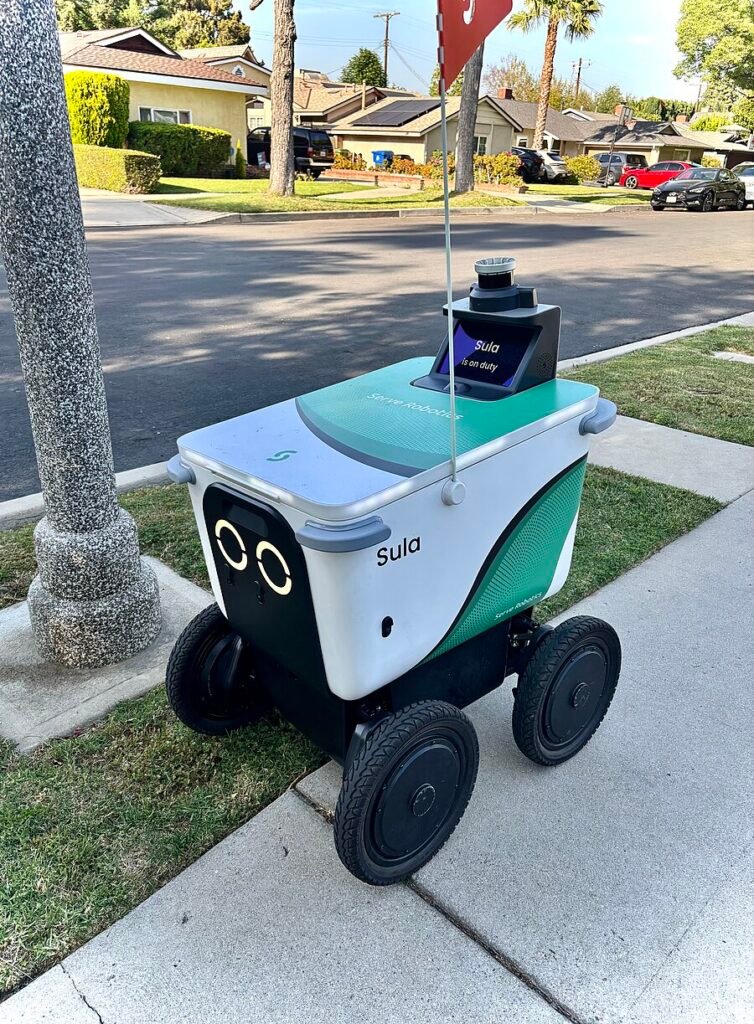
Serve’s release says that with the portal, “AI assistants can carry out tasks in the physical world for the first time.” That is Serve’s claim, and it is about access, not a new kind of robot. An agent here does what any program does: it calls an HTTP API with a pickup, a dropoff and an item list. The robots are the same ones already delivering through big platforms such as DoorDash, Grubhub and Uber Eats, and the docs we read do not describe a separate AI model or chat interface for agents.
What is new is that Serve wrote agents into its legal terms. Section 5 of the sandbox terms, dated Nov. 5, 2026, says: “You are responsible for any app, script, automation or AI agent that uses your keys, as if you took its actions yourself.” In other words, if your assistant orders a robot to the wrong address, that is on you, not the assistant.
Our read: that line is the most honest sentence in the launch. It treats an AI agent as a tool its owner answers for, which is where most of the law around software already sits. The same terms forbid publishing benchmarks or performance results without Serve’s written consent and limit sandbox users to fake test data, so do not expect independent reliability numbers from early developers.
What the docs say that the press release does not
We read the developer guide and the job reference. A few details stand out:
- A quote expires after five minutes and can be used only once. Reusing one returns an error called
used_quote. - An error called
couriers_busyis “normal” and “will happen on your busiest evening,” the guide says, so developers have to decide whether to retry, queue or fall back to another courier. - The API allows 600 requests per minute.
- The recipient opens the lid by typing a three- or four-digit code on the robot’s touchscreen.
- If the customer is not there, the job’s “undeliverable action” is either
returnordispose. - The list of cancellation reasons includes
robot_flipped,order_stolen,weather_conditionsanddropoff_untraversable, which is a pretty good summary of sidewalk life. - An endpoint that counts nearby robots counts “only robots in a fleet reserved by the partner,” which suggests live partners work from an allocated slice of the fleet.
None of that is unusual for a delivery API. It does show the gap between “anyone can summon a robot” and the real product, which is a business integration with service zones, error handling and an approval step.
Why Serve needs more customers
The timing makes sense once you look at the Uber split. In August, Kashani told investors Serve does not intend to renew its Uber agreement in 2027, citing “differing views” on how to deploy the robots, Axios reported. Serve also said quarterly volume through Uber had fallen for the first time since 2022, and cut its 2026 revenue guidance from $26 million to $9 million to $10 million. A day later, Uber disclosed it had sold its entire stake in Serve, according to Axios. On the Q3 call, Kashani said he believed the Uber contract runs through part of the first quarter of 2027, per a Motley Fool transcript.
Since then, Serve has added Grubhub and more DoorDash markets, a merchant tablet called Beacon, and on Nov. 5 a “Physical AI Services” line that sells its connectivity and data tools to other robot makers. The Q3 results it filed with the SEC the same day show why it wants more sources of work:
- Revenue was $2.835 million for the quarter, up 313% from $687,000 a year earlier but down from $3.238 million in Q2. Fleet services rose while software services fell, from $933,000 to $253,000.
- Cost of revenues was $10.39 million, so Serve spent about $3.66 delivering service for every $1 of revenue in the quarter.
- The net loss was $59.2 million for the quarter. Serve ended September with $198.0 million in cash and marketable securities.
- Serve raised its full-year 2026 revenue guidance to $12 million, from $9 million to $10 million.
Kashani pitched the developer portal to The Verge partly as a way to fill dead time. “So you have lunch, you have dinner. But then there are times in between,” he said. Off-peak errands like shuttling parts between offices, pharmacy runs or Marketplace handoffs are exactly the kind of work that would use robots that are otherwise parked.
The utilization math
Here is the number we think matters most. Serve describes a fleet of 2,000 robots. Its Q3 report says an average of 917 robots were performing deliveries per day, defined as “the average number of robots performing deliveries during the period,” and that count includes its indoor hospital robots. Daily supply hours, the hours robots were available to deliver, averaged 11,214.
Those two figures are not the same thing. A robot sitting at a charger or waiting for a dinner order is not a robot doing a delivery, and the Q3 report does not say how many deliveries each active robot makes per day. Still, the gap between the size of the fleet and the number of robots working on an average day is the business case for opening the API: every extra job from a florist or a developer is revenue from hardware Serve already paid for.
The catch is that the robots are only useful where they already are. The release says Serve serves more than 150 neighborhoods in 20 U.S. cities, and its Q3 call described a fleet across 40 cities and 27 hospitals. Either way, most people’s pickup and dropoff will not be inside a service zone, and the robot cannot leave the sidewalk. The Verge puts their top speed at around 6 mph.
Who this helps, and who should be skeptical
If you run a shop inside a Serve zone, the pitch is cheaper local delivery without paying a platform. Kashani told The Verge it would cost “a fraction” of human-powered delivery, but we did not find published API pricing, so there is no way to check that yet. The sample fee in its documentation is an example field, not a price list.
For developers, the sandbox is a free toy with real documentation. For AI-agent builders, it is an unusually direct case of a tool call moving a physical object down a street, with approval and remote supervision in the loop. That is a smaller step than the press release implies, and a more realistic one. We have seen big promises in this space before, from drone bases with undisclosed locations to Amazon’s home robot that became a trip hazard.
City sidewalks are also shared space. The press release is about developers and businesses. It does not say what local rules apply when an outside app, rather than a big delivery platform, sends robots into a neighborhood, or whether cities that approved Serve for restaurant delivery expected peer-to-peer errands too.
What to watch next
- Whether Serve publishes API pricing, and whether it really undercuts platform fees for small merchants.
- How many outside partners Serve approves for live robots, and whether the waitlist turns into self-service signup.
- Whether daily active robots rise faster than the fleet in Q4, which would show the API is filling idle time.
- What replaces Uber volume after the contract ends in early 2027.
- The “big announcements about our autonomy in the coming weeks” Kashani promised on the Q3 call.
Serve’s developer portal is a real launch with real limits: a sandbox anyone can try, live robots only for partners Serve picks, and a fleet that only works where it already rolls. The idea that your AI assistant can send a robot across town is true, as long as the town is one of Serve’s and Serve says yes.
This story is not investment advice.
Hype in. Signal out.
Lead image: Four Serve Robotics sidewalk delivery robots lined up at a curb in the Brickell neighborhood of Miami in December 2025. Photo by Phillip Pessar via Wikimedia Commons, CC BY 4.0. Resized for this post. Inline photo: Photo by The Squirrel Game via Wikimedia Commons, CC BY 4.0. Resized for this post.