

Apple researchers say the best software for running a robot arm may not be a robot model at all. In a paper posted Nov. 6, “On Agentic Manipulation Policies,” a 13-person Apple team hands a Franka arm to general-purpose frontier models (Google’s Gemini 4 Argon and Anthropic’s Claude Opus 5.5) and lets them steer it by writing Python code. Apple says the setup, called AMP1, succeeded in 104 of 108 real-world trials and beat the specialist robot AIs it was tested against. The catch is in the stopwatch: on the real robot, the arm spent about three-quarters of each successful task waiting for the model to think.
Key points
- Apple’s AMP1 lets a general AI model run a robot arm by writing and checking its own Python code, with no robot demonstrations or task-specific training.
- Apple’s paper reports an 85.6% success rate on Nvidia’s RoboLab-120 simulation benchmark with Gemini 4 Argon, and 82.8% with Claude Opus 5.5.
- On real hardware, Apple says AMP1 with Opus 5.5 succeeded in 104 of 108 trials, against 49 for FLUX 3 Action and 30 for π0.5.
- Successful AMP1 runs averaged 280 seconds, 211 of them spent reasoning, while the faster baselines averaged 44 and 62 seconds on the tasks they did finish.

What Apple actually built
Most recent robot-arm brains are specialists. Vision-language-action models (VLAs) and world-action models (WAMs) are trained on piles of robot demonstrations and output motor commands directly. That is the lane of Runway’s Praxis-1, which we covered yesterday, and of Physical Intelligence’s π0.5.
AMP1 goes the other way. Per the project page, a frontier model controls the robot only through Python code it writes, runs and checks. Apple’s “harness” gives it camera images, depth, calibration, a fused 3D point cloud, a scene model it can correct, and motion commands made of timed waypoints for the arm’s tip plus gripper open and close. The harness checks each motion for reach, speed, joint limits and collisions, and can refuse it with a reason.
What it does not get is a “grasp this” button. The paper says the basic harness supplies “no grasping, pushing, or placing skills.” The model writes those itself, fresh in each episode. In the project page’s banana-in-a-bowl walkthrough, Claude Opus 5.5 fits a box to the banana’s 3D points and grabs near the centroid because, as the page notes, a curved banana’s centroid may sit off the fruit.
Worth saying plainly: Apple did not build the brain here. The thinking comes from Google’s and Anthropic’s commercial models. Apple built the plumbing, the tests and the argument.
The scoreboard, with Apple’s numbers attributed
RoboLab-120 is Nvidia’s simulated test of 120 manipulation tasks given in plain language. Apple’s paper reports:
- AMP1 + Gemini 4 Argon: 85.6% (95% confidence interval 83.5 to 87.5%), at 10 episodes per task.
- AMP1 + Claude Opus 5.5: 82.8%.
- Best entries the paper cites: SenseNova-RoboRSI (another agent, built on GPT-6 Astra) at 57.1%, Lakeside at 51.0%, the best VLA at 49.2% and the best WAM at 42.9%.
Nvidia’s public RoboLab leaderboard now lists AMP1 first at 86.0%, from a separate 25-episodes-per-task submission (2,579 of 3,000). SenseNova-RoboRSI is second, Lakeside third, BiMind v0.5 fourth and Runway’s Praxis-1 fifth at 46.2%. So yesterday’s “top open robot model” sits 39.8 points behind a harness wrapped around a general-purpose model. Different categories, same scoreboard.
On the three CaP-Gym suites, Apple reports 95.2% on LIBERO-PRO, all 700 robosuite episodes (including two two-arm tasks), and 48 of 50 on two BEHAVIOR-1K mobile-manipulation tasks, all zero-shot, meaning one attempt with no practice. The paper is candid that rivals beat it in places: HarnessPAI scored 96.5% on LIBERO-PRO and ASPIRE solved every BEHAVIOR-1K episode, though Apple notes both improve their programs over rollouts of the evaluated tasks and so are not zero-shot.
104 of 108 on a real arm
Simulation scores are cheap. The real-world test is the more interesting part. Apple ran 12 tasks on three copies of a DROID-style setup (a 7-joint Franka Research 3 arm, a Robotiq 2F-85 gripper, two shoulder cameras and a wrist camera), nine trials per task per method. AMP1 used Claude Opus 5.5 at high reasoning effort.
Apple’s Table 1 results: AMP1 96.3% (104 of 108), FLUX 3 Action 45.4%, and π0.5 27.8%. That is where the paper’s “20x and 15x” failure-rate claims come from: 4 failures against 78 for π0.5 and 59 for FLUX. Three tasks went 0 for 9 for both baselines and 9 for 9 for AMP1, including “Cover each cube with a cup, then uncover the yellow cube,” which requires remembering what is now hidden.
Two asterisks. First, AMP1 got help the baselines didn’t: Apple gave it functions to ask the robot to recover from a controller error, such as a collision reflex. Baselines’ trials ended on such errors. Without recovery, Apple says AMP1 went 94 for 108 (87.0%), still roughly double FLUX. Second, the tasks were designed by Apple, and the paper says AMP1’s main real-world failures were collisions with the table, bin walls and itself.
The weird part: tools, forklifts and self-calibration
The paper’s list of “emergent behaviors” is the fun section, and Apple stresses none were in the prompt or the harness. It says the agent:
- Moved objects aside, one at a time, to find a target hidden from every camera.
- Used a wooden spoon to tip an out-of-reach bottle toward itself, then grabbed it by the cap. The paper compares this to New Caledonian crows picking sticks.
- Pinned a pomegranate wider than the gripper’s 85 mm opening against something heavier and slid the gripper underneath “like a forklift.”
- Couldn’t grab an upside-down bowl, so it slid the plate up to the bin and pushed the bowl off the edge onto it, never holding the bowl at all.
- Noticed its cameras were off by comparing commanded and observed motion, then compensated.
The paper also shows AMP1 planning and executing a winning strategy in a game of chess, then putting the pieces away. These are curated highlights, though, not scored tasks. Treat them as proof the behavior can happen, not as how often it does.
The stopwatch problem
Here is the number Apple puts in the table but not the headline. On the real robot, successful AMP1 runs averaged 280 seconds: 69 seconds of the arm actually moving, and 211 seconds of reasoning, code execution, camera capture and 3D processing. That’s about 75% of the clock spent thinking. The slowest task, lining up four cubes with a spatula, averaged 601 seconds, a hair over 10 minutes.
FLUX 3 Action averaged 44 seconds and π0.5 62 seconds on their successful trials. Those averages only cover what each method finished, so the baselines are timed mostly on easier tasks; it is not a clean race. Still, the gap is wide. In simulation it is hidden entirely: the project page says the sim pauses while AMP1 reasons, so “only executed motion counts against the time limit.”
Apple doesn’t dodge it. The paper says AMPs “are not yet practical, as the robot spends much of each episode waiting for the model to reason,” and adds a second limit: the model “cannot reconsider a trajectory while it executes,” so the tests were mostly quasi-static scenes. A slipping object or a moving target would need a reaction before the model’s next turn. Its comeback is blunt: “A policy that fails every other task is not practical, however quickly it does so.”
One thing the paper does not give: a dollar cost per task. With Opus 5.5 averaging 34.8 model calls per RoboLab episode at full sensor input, per the paper, running a factory shift this way would mean a lot of API calls. The researchers bet on prices falling, citing estimates that the cost of a given capability level drops roughly an order of magnitude per year.
It’s mostly the model, and it learns without retraining
Apple’s ablations say the choice of model matters most. Same harness, same RoboLab-120: Opus 5.5 hit 82.8%, Haiku 5.5 51.6%, and the older Opus 4.5 35.2%. Swapping images for text descriptions cut Opus 5.5 to 36.8%. Removing depth and calibration barely dented Opus 5.5 (75.8%) but crushed Haiku 5.5 to 10.7%. Stronger models also did best without Apple’s optional grasp-and-place helper routines, while weaker models needed them.
Then there’s memory. Given a persistent notebook it writes after reflecting on wins and failures, with model weights untouched, AMP1 improved on RoboDojo’s 42 two-arm tasks from 26.4% to 84.1% after practicing each task, per the paper. A single pass of continual learning across tasks more than doubled success to 57.6%, and agents with memory used about 35% fewer model calls.
Our read: grade the claims, not the vibe
This is a real result with real receipts: a paper, a public leaderboard entry, real-robot trials, and code on GitHub to reproduce the benchmarks (under Apple’s own license terms, not a standard open-source license). That is more than most robot demos offer.
But mind where the confidence comes from. Apple also argues RoboLab-120 is nearly saturated and that most of AMP1’s remaining failures come from benchmark quirks, such as objects a parallel gripper can’t hold or a “flaky verifier.” By its own count, excluding those, Gemini 4 Argon succeeded on 96.2% of the remaining 95 tasks. That may be right, but it’s the test-taker grading the test. The leaderboard owner and other labs should weigh in.
The bigger shift is strategic. If the leading robot “brain” is a rented frontier model plus good plumbing, the moat moves from robot datasets to model access and latency. That’s awkward for startups that raised money on demonstration data. For Apple, nothing in the paper mentions a product. It’s research, with Matthias Müller and Vladlen Koltun listed last among the 13 authors.
What to watch
- Independent reruns. Whether other labs reproduce 85%-plus on RoboLab-120 with the released code, and how much the H100 setup Apple used changes results.
- A speed number. Apple proposes overlapping planning with motion, reusing code and distilling AMP behavior into smaller onboard controllers. A faster AMP1 with similar success would matter far more than another benchmark point.
- Dynamic tests. Moving targets, slipping objects and people in the workspace, the exact conditions the paper says it largely did not test.
- The specialists’ answer. Whether VLA and WAM makers adopt agent-style harnesses themselves, or argue RoboLab undercounts their speed advantage.
Hype in. Signal out.
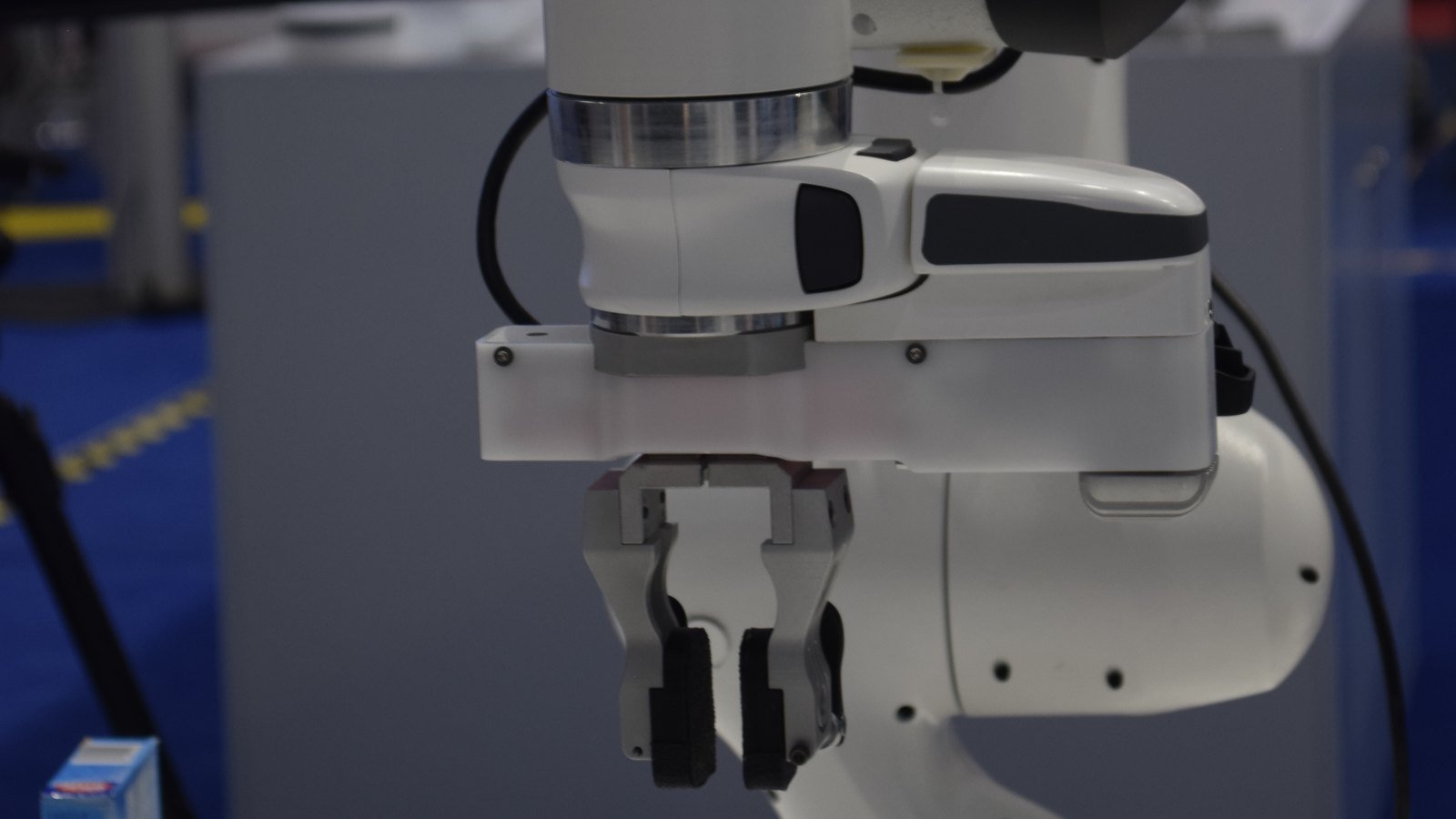
Image: Franka Emika robot arm at a 2017 trade show, by Ims via Wikimedia Commons, licensed CC BY-SA 4.0; cropped and resized. Not from Apple and does not show AMP1.