Tesla said Wednesday, October 21, that it has started producing its Optimus humanoid robot at its Fremont, California, factory, in space once used to build electric vehicles, TechCrunch reported. The same earnings report showed profit down 43% from a year earlier.
“The bots coming off this line are the first production-quality bots that we have manufactured,” Tesla wrote in its third-quarter update. “We have proven that the current manufacturing process for Optimus is suitable for a commercial product.”
A short history of a long promise
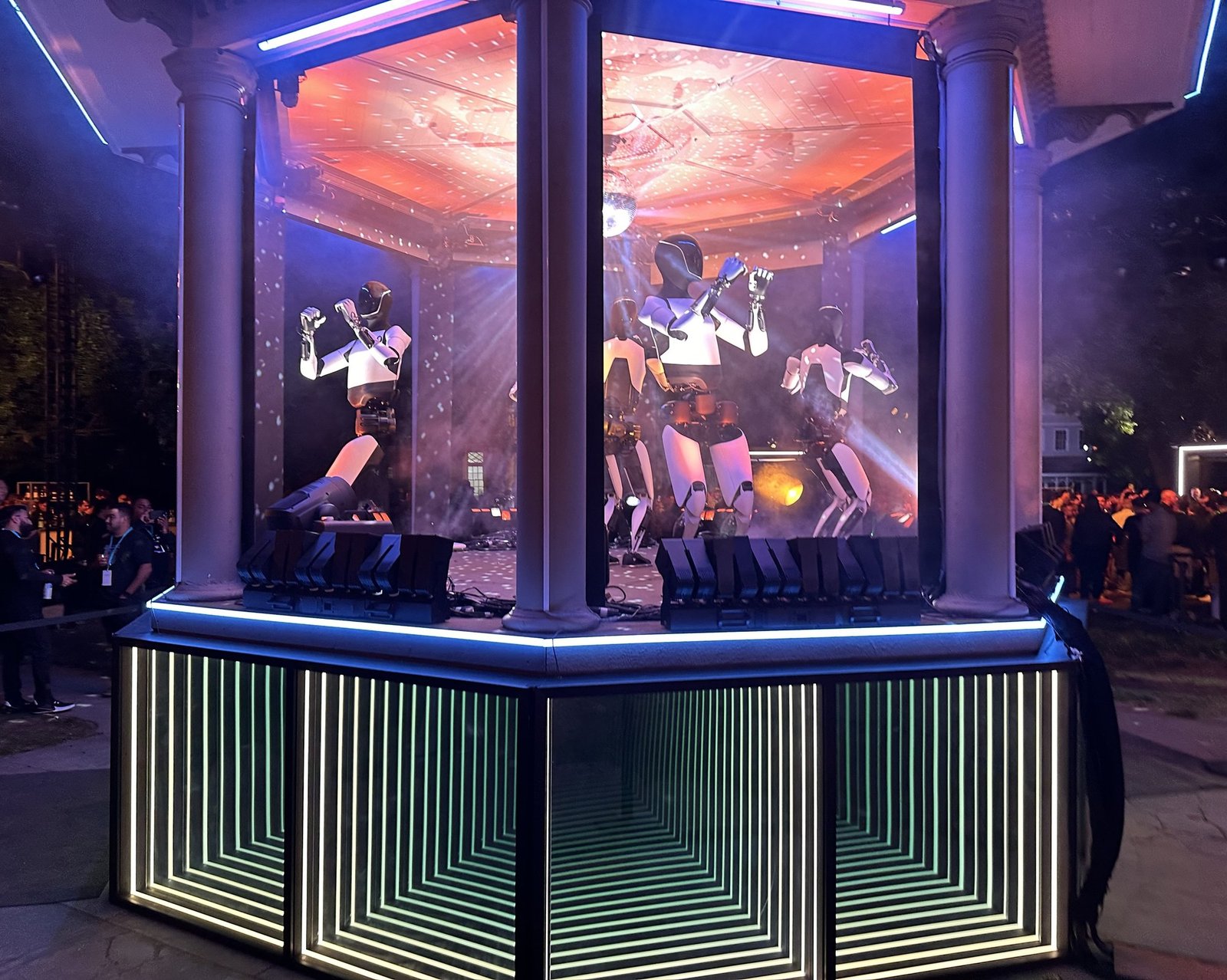
Optimus has been a centerpiece of Tesla’s pitch for five years. Musk introduced the idea at the company’s 2021 AI Day, memorably with a person in a robot suit dancing on stage. Working prototypes followed, and at Tesla’s “We, Robot” event in October 2024, a fleet of them walked among guests, served drinks and danced in a glass gazebo (pictured above). Reports afterward said the robots had help from remote human operators.
The pitch has always been huge: a general-purpose humanoid that can work in factories, then homes. Musk has repeatedly suggested Optimus could eventually be worth more than the car business.
So “production-quality bots coming off a line” is a genuine step. It’s also a step that comes with a lot of qualifiers, many of them from Musk himself.
“Early production,” and an ambitious number
Musk called it “early production” on the earnings call and warned the ramp would be slow and “somewhat bumpy because it is such a radically new product.” He then claimed Tesla could be making 20,000 robots per week by the end of 2027.
The caveats were his too. “There’s still some things we need to tweak about the design, because you need to deliver a robot that is safe and reliable and has long duration, so it can’t, like, wear out after a month,” he said. And there’s “still quite a lot of work to do with regard to the AI and the robot for it to be truly useful for open-ended tasks.”
Tesla’s update deck lists Fremont Optimus as “early ramp” and a second Optimus facility in Texas as under construction. It also notes, in the fine print, that installed capacity does not equal current production rate.
So: the robots exist, they’re coming off a line, and they can’t yet do much useful on their own. That’s honest. It’s also the whole problem.
The quarter that paid for it
The rest of Tesla’s report looked like a company in the middle of a big bet:
- Revenue: $28.04 billion, essentially flat versus $28.09 billion a year earlier, though it beat Wall Street’s estimates.
- Net income: $787 million, down 43% from $1.37 billion.
- Deliveries: 486,532 vehicles, about 6,000 more than Q2 but below the same quarter last year.
- Energy: solar and storage revenue fell 16% to $2.8 billion, which Tesla blamed on tariff-related customer refunds.
- Services: up 33% to $4.6 billion, with a record $734 million in gross profit. That bucket includes Full Self-Driving subscriptions.
Spending on AI, Optimus and autonomy, plus lower sales of regulatory credits (which other automakers buy from Tesla to meet emissions rules), ate the margin.
The twist: Tesla spent less than expected
Here’s the odd part. For a company “betting the future” on AI and robots, Tesla actually invested less than Wall Street thought it would.
Third-quarter capital spending was $4.7 billion, double a year earlier but well below the $7.5 billion analysts expected, Reuters reported, citing LSEG data. Tesla cut its full-year capex forecast to about $20 billion, from more than $25 billion, without saying what it would spend less on. The result was $1.53 billion in positive free cash flow, versus an expected cash burn.
Reuters tied the timing to Musk’s talk of merging Tesla with SpaceX, which he called a “good idea” the day before; the companies have formed special committees. One analyst told Reuters the lower spending “suggests less of an ‘all-in’ approach to the AI arms race than one would expect from Elon.”
Shares rose about 2% after hours, then reversed to trade down about 2%.
There was good news in the car business too. Tesla reported its biggest passenger-vehicle order backlog in four years, and Musk said demand is “exceeding our production by a significant margin.” Automotive gross margin excluding credits was 18.1%, above estimates.
Robotaxi timing, again
Unsupervised Full Self-Driving for customer cars slipped once more. Today, owners can buy FSD (Supervised), which requires an attentive driver ready to take over. The unsupervised version would let a privately owned car join Tesla’s robotaxi fleet.
Tesla’s VP of AI software, Ashok Elluswamy, said: “We suspect somewhere around Q2 next year is when we can turn on some of the first customer vehicles to be part of the robotaxi fleet.” In April, Musk had said the unsupervised version would “probably” arrive in the fourth quarter of this year.
Tesla did say FSD (Supervised) was attached to more than three-quarters of new North American deliveries, up nearly 20 percentage points from Q2.
Why it matters
Why it matters: humanoid robots are one of the most hyped corners of AI, with Figure, Agility, Apptronik, Unitree and others racing to show real deployments. A Tesla production line, even an early one, raises the stakes. If anyone can drive down the cost of complex hardware through volume, Tesla has the factory experience to try.
For Tesla’s investors, Optimus is a big part of why the stock trades like a tech company rather than a carmaker. Evidence of real production supports that story. Evidence of real usefulness is what would justify it.
The skeptical read
The catch: a production line proves Tesla can build the robot. It doesn’t prove the robot can do a job. Musk’s own words, that it isn’t yet “truly useful for open-ended tasks,” are the most important sentence of the call.
“20,000 a week by end of 2027” is the kind of number Tesla has historically treated as a mood rather than a schedule. The robotaxi timeline slipped again in the same call. And the company just cut its spending plan, which makes an aggressive robot ramp harder, not easier.
The takeaway
Our read: starting a production line is a real milestone, and Tesla deserves credit for saying plainly that the hands-on usefulness isn’t there yet. The financials show a company trying to fund a moonshot while trimming the budget for it.
What to watch:
- Deliveries of Optimus to outside customers, and any hard data on what these robots do on a factory floor.
- Whether Tesla explains where the capex cut of at least $5 billion landed.
- The SpaceX merger talks, and what they mean for Tesla’s AI spending.
- Whether “Q2 next year” for unsupervised FSD holds.
Image: Steve Jurvetson / Wikimedia Commons, CC BY 2.0