Alphabet just put up a quarter with 25% revenue growth, a cloud business that more than doubled, and a chatbot it says has a billion users. Wall Street’s response was to knock roughly half a trillion dollars off the company in a single morning. Shares fell about 13% on Thursday, erasing about $511 billion in market value by 9:35 a.m. New York time, Bloomberg reported, the biggest wipeout in the company’s history.
Key points
- Alphabet fell about 12.6% on Thursday, its worst day ever, losing $482 billion in market value by the close by Yahoo Finance’s count.
- Third-quarter revenue rose 25% to $127.6 billion and Google Cloud revenue more than doubled, but the results missed analysts’ revenue and earnings estimates, CNBC reported.
- Google’s chief business officer told analysts that lower monetization in AI Mode weighed on search, which grew 12%.
- Free cash flow was negative $9.07 billion as capital spending hit $51.36 billion, and Alphabet says capex will “increase significantly” in 2027.
The trigger wasn’t that Google stopped growing. It’s that the thing paying for Google’s AI bet, search ads, grew slower than expected, and one of Google’s own executives told analysts that Google’s own AI search product was part of the reason. Meanwhile the bill for the AI buildout pushed Alphabet’s free cash flow below zero. By the close, Alphabet was down about 12.6%, its worst day ever, with the loss in market value put at $482 billion by Yahoo Finance and roughly $500 billion by CNBC.
What actually happened
Alphabet reported third-quarter results after the bell on Wednesday, Oct. 28. According to its earnings release, revenue rose 25% to $127.6 billion, Google Services revenue rose 11% to $96.3 billion, and Google Cloud revenue rose 103% to $30.7 billion. Operating income rose 30% to $40.6 billion. Net income fell to $26.2 billion, or $2.12 a share, from $34.98 billion, or $2.87 a share, a year earlier, CNBC reported.
Against Wall Street’s expectations, it was a miss almost across the board. Revenue came in at $127.58 billion versus the $128.22 billion analysts polled by LSEG expected, and adjusted earnings per share were $2.67 versus $3.02 expected, according to CNBC, which called it the company’s first top-and-bottom-line miss in nearly four years. Search and other revenue of $63.35 billion fell short of a $64.96 billion estimate. “The cloud business was the only business that beat,” Jefferies analyst Brent Thill said on CNBC. “Everything else missed.”
Shares slid more than 10% after hours and kept going Thursday. By Yahoo Finance’s count, Alphabet lost $482 billion in market value by the close, and it was the stock’s steepest post-earnings drop since it went public in 2004, according to Bespoke Investment Group. NBC News put Alphabet’s value at about $3.47 trillion after the close, still the fourth-largest U.S. company.
Google’s AI search is eating some of Google’s search money
The most quotable moment of the call came from chief business officer Philipp Schindler. Asked about search, he said that “the strong growth in AI Mode queries had an impact because of the lower monetization we were seeing in AI Mode,” according to a transcript of the call. AI Mode is the chatbot-style tab Google added to Search. Schindler followed that immediately with reassurance: “To be clear, we feel very good about our trajectory here,” and said Google is now scaling ads inside AI Overviews and AI Mode to more users and queries, including international markets and multiturn ads in the U.S.
That is the uncomfortable shape of Google’s AI pivot in one sentence. For two years the company has argued that AI answers would grow search rather than cannibalize it. On the usage side, it says that’s working: CEO Sundar Pichai said in his prepared remarks that search query growth is the highest it has been in five years, and on the call he said AI Mode queries are on average three times longer than traditional searches. On the money side, those longer conversations currently carry fewer ads. More searching that earns less per search is how you get 12% growth in a line investors wanted to grow faster.
Some context the headline numbers hide. Search grew 12% year over year, which is not a collapse. Alphabet’s CFO, Anat Ashkenazi, also pointed to calendar effects, saying on the call that Q2 was unseasonably strong because the FIFA World Cup pulled ad budgets into June. And she warned that Q4 will be harder, because Google “will continue to lap the search performance acceleration that began in the third quarter last year, which will pressure revenue growth in Q4,” per the transcript.
Two Googles, side by side
The quarter makes more sense when you split Alphabet into the old engine and the new one. Here is the same quarter a year apart, straight from Alphabet’s own segment tables:
| Q3 (July to Sept.), $ millions | 2025 | 2026 | Change |
|---|---|---|---|
| Google Search & other revenue | 56,567 | 63,350 | +12% |
| YouTube ads revenue | 10,261 | 11,207 | +9% |
| Google Network revenue | 7,354 | 7,455 | +1% |
| Google Cloud revenue | 15,157 | 30,709 | +103% |
| Google Services operating income | 33,527 | 39,157 | +17% |
| Google Cloud operating income | 3,594 | 11,121 | +209% |
| Total Alphabet revenue | 102,346 | 127,577 | +25% |
Read it this way. Cloud added about $15.6 billion of quarterly revenue in a year, while search added about $6.8 billion. Cloud’s operating income roughly tripled. But the old engine is still much bigger: Google Services made $39.2 billion in operating income in the quarter, about 3.5 times Cloud’s $11.1 billion. The fast-growing business is not yet large enough to cover for a wobble in the slow-growing one, which is why a few billion dollars of search shortfall moved the stock more than a doubling of cloud revenue.
There’s a catch on the cloud number too. Alphabet said sales of TPU systems, its custom AI chips sold as hardware rather than rented by the hour, were “a meaningful contributor” to Cloud growth, per the release. Hardware sales are lumpier than recurring cloud rental. Ashkenazi said on the call that Cloud’s growth rate excluding TPU systems was “again incredibly strong,” but Alphabet didn’t give that number in the release. She also said Google started renting third-party compute at the end of Q3 to meet demand and expects “margin headwinds in the near term” as it ramps that up.
Why free cash flow went negative
The other number that spooked people was free cash flow, the cash a company has left after paying for its buildings and equipment. Alphabet’s was negative $9.07 billion for the quarter, much worse than the negative $2.70 billion analysts expected, CNBC reported.
The arithmetic is simple. Alphabet generated $42.3 billion in operating cash flow in the quarter, according to the call transcript, and spent $51.36 billion on capital expenditures, mostly servers, networking gear and data centers. Spend more than you bring in and free cash flow goes negative. The transcript summary also lists a $5.2 billion cash payment for a European Commission fine as a drag in the quarter, and Ashkenazi said a buildup of inventory for TPU system sales hit operating cash flow. Inventory stood at $13.3 billion, up from $2.4 billion at the end of 2025, per the same summary.
Capex actually came in below the $55.09 billion analysts expected. The problem is the direction of travel. Alphabet kept its 2026 capex guidance at $195 billion to $205 billion and Ashkenazi said, “We continue to expect our CapEx to increase significantly in 2027,” with details promised on the Q4 call. Long-term debt reached $125.1 billion, up from $21.6 billion a year earlier, CNBC reported.
Then there are the long-tail promises. Ashkenazi said Alphabet ended the quarter with “future purchase commitments of $924 billion and pre-commencement leases and other obligations of $152 billion,” while adding that these “reflect the maximum contractual obligations” and that some deals have “variable pricing and volume flexibility, which could result in lower spend.” Those are two different kinds of obligation covering different periods, so we’re not adding them together. On the other side of the ledger, she said Google Cloud’s backlog of signed customer contracts was $561 billion, of which Alphabet expects to recognize just over 55% as revenue over the next 24 months.
The weird part: SpaceX is now an Alphabet earnings line
Part of the net income drop has nothing to do with search or cloud. Other income and expenses came in at negative $8.2 billion, which Ashkenazi attributed “primarily to unrealized loss from our investment in SpaceX from a decline in its stock price in the third quarter,” per the transcript. In the second quarter, gains on equity holdings, including stakes in SpaceX and Anthropic, had swung the other way, CNBC noted. That’s a paper loss, not cash, but it means Alphabet’s reported profit now moves with the share prices of other big AI-era companies, which is not something a search company used to worry about.
How big is a $500 billion day?
Big enough to need a timeline. Here’s where Thursday ranks, using figures reported by others:
- Jan. 27, 2025: Nvidia lost about $589 billion to $593 billion in one session after DeepSeek’s cheap model rattled AI investors, the record for a U.S.-listed company (Reuters uses $593 billion; Bloomberg used $589 billion).
- June 22, 2026: SpaceX lost about $400 billion, the previous No. 2, according to Yahoo Finance.
- July 23, 2026: Alphabet’s previous worst day, about $275 billion, also per Yahoo Finance.
- Oct. 29, 2026: Alphabet, about $511 billion as of the morning (Bloomberg) and $482 billion at the close (Yahoo Finance), second only to Nvidia.
Yahoo Finance also counted 18 sessions this year through Wednesday in which a U.S.-listed stock shed $200 billion or more in a day, up from 13 in all of 2025 and none before 2022. Part of that is simply that the biggest companies are now so large that ordinary percentage moves become enormous dollar figures. A 13% drop is brutal, but it’s the scale of Alphabet, not just the size of the drop, that produces a record-sized number.
Microsoft, the inconvenient comparison
Microsoft reported the same night, and its stock was roughly flat Thursday morning, CNBC reported. It spent $45.2 billion on capex and finance leases in its quarter, 30% more than a year earlier but below analyst estimates, and its free cash flow fell 27% to $18.63 billion but stayed positive. “Microsoft is building out its architecture in a measured way and as such contains fewer surprises,” Quilter Cheviot’s Ben Barringer told CNBC, calling Alphabet’s quarter “a fairly messy set of results and a poorly handled earnings call.”
Not everyone is panicking. Rosenblatt Securities analyst Scott Devitt told CNBC, “I don’t think it’s a sea change,” arguing that any problem with monetizing AI answers is a problem for every consumer AI product, and that Alphabet’s huge search audience leaves it well placed when it’s solved. That’s the real debate: whether AI Mode’s lower ad yield is a temporary gap while Google builds an ad format for conversations, or a permanent reset in what a search is worth.
Our read
Alphabet’s quarter wasn’t bad. It was expensive. The company is asking investors to accept negative free cash flow, rising debt and a capex number headed past $200 billion this year and “significantly” higher next year, on the promise that AI will pay for itself. On Wednesday it showed that AI is driving usage and cloud demand. It also showed, in its own executive’s words, that its flagship AI search product earns less than the search it’s replacing. When you’re spending at this pace, that admission costs more than a small revenue miss would normally suggest.
It’s also worth separating the stock from the company. A single day’s market value swing says a lot about expectations and very little about whether Gemini is good. On Wednesday Google announced Gemini 4 Carbon, which it says leads most rows of its own benchmark table and is going first to a subset of cyber defenders, and Pichai says the Gemini app has hit one billion users. Those are company-reported figures. Neither changes the cash math this quarter.
What to watch next
- Ad load in AI Mode. Schindler said ads are expanding to international AI Mode users and multiturn ads in the U.S. The test is whether Google starts reporting anything about AI Mode monetization directly, rather than leaving investors to infer it from search growth.
- The Q4 capex number. Ashkenazi promised 2027 capex details on the next call. CNBC has reported that 2027 spending is expected to exceed $300 billion; Alphabet itself has only said “significantly” higher.
- Cloud growth without TPU sales. If TPU system sales are a growing share of Cloud revenue, the 103% figure will be harder to repeat. Alphabet hasn’t broken out that number, and its 10-Q may say more.
- Third-party compute and margins. Google has started renting other companies’ capacity to meet demand. Watch whether Cloud’s 36.2% operating margin holds as that ramps.
- The SpaceX line. With SpaceX shares swinging, Alphabet’s net income will keep getting paper gains and losses that have nothing to do with Google’s businesses.
Hype in. Signal out.
Update (Oct 29, 2026): this story was published while markets were open and cited intraday figures, including a $524 billion loss at the day’s low and a $3.42 trillion midday market value. We’ve updated it with closing figures: Alphabet fell about 12.6% and lost $482 billion in market value by Yahoo Finance’s count (CNBC rounds it to about $500 billion), leaving it worth about $3.47 trillion, per NBC News.
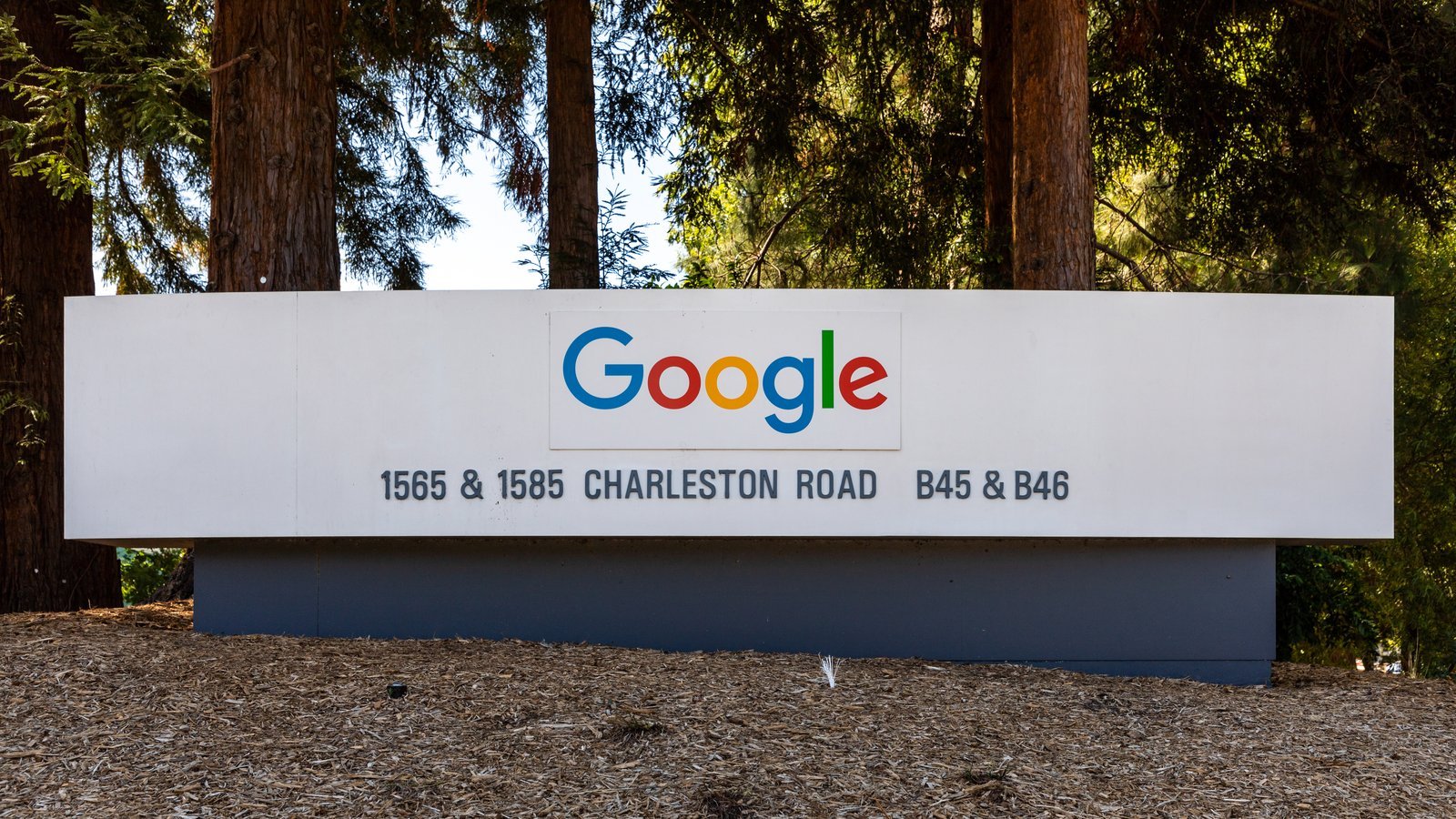
Image: A Google sign on Charleston Road in Mountain View, California. Photo by Dietmar Rabich / Wikimedia Commons, CC BY-SA 4.0; cropped to 16:9.