




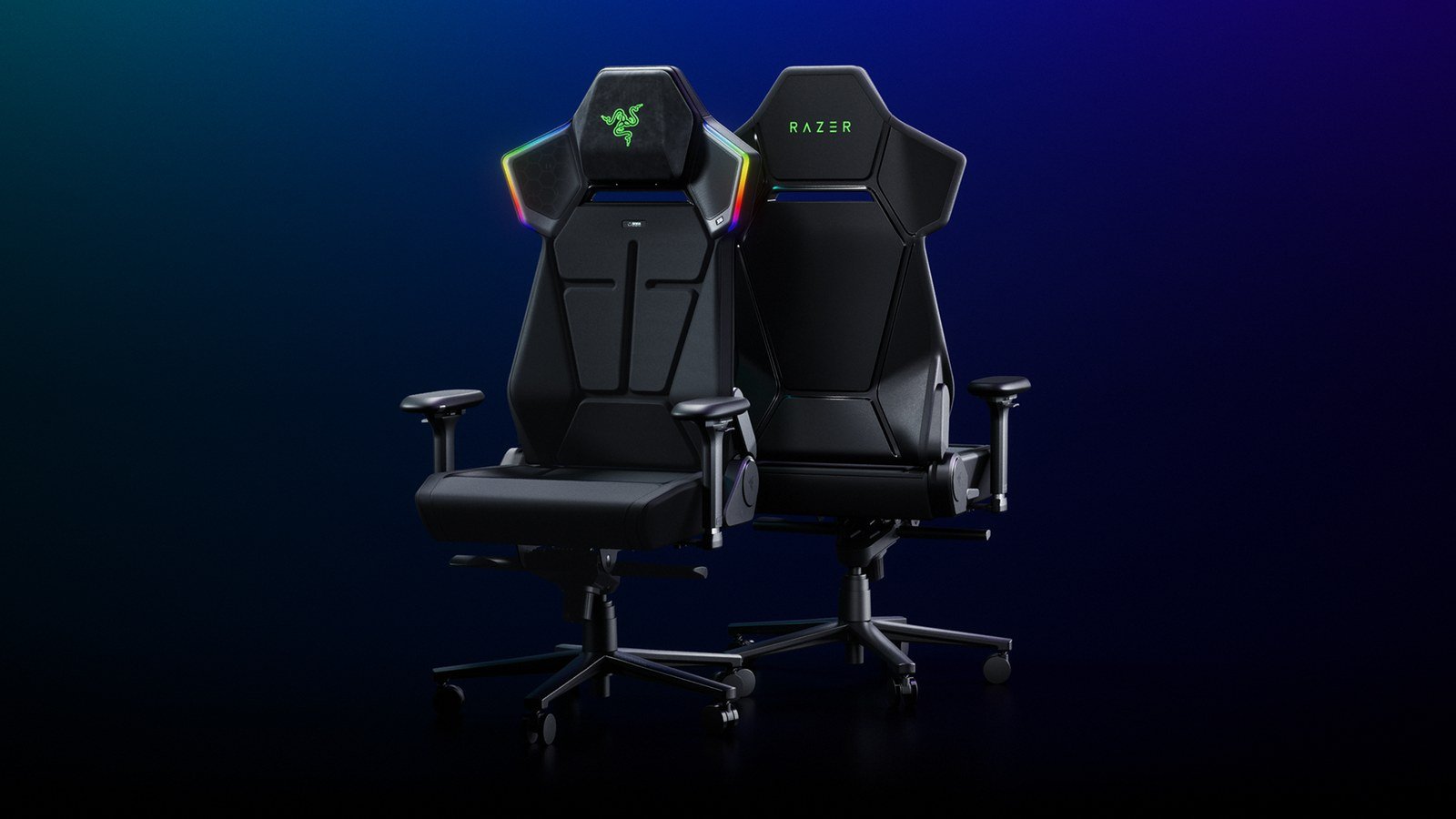
Razer has spent years selling gamers things that shake. The Soma Pro, announced Friday and on sale now at $999.99 on Razer.com, puts six haptic motors, a pair of THX Spatial Audio speakers and Chroma RGB lighting into one office-style gaming chair. A cheaper sibling, the Soma Sensa HD Haptics, keeps the six motors and drops the speakers and lights for $569.99. The early verdicts are surprisingly warm: Windows Central‘s Daniel Rubino reviewed the Pro and loved it. The fine print is less glamorous: neither chair comes with a power bank or a wall adapter, and you need one to make any of the tech work.
Key points
- Razer announced the Soma Pro ($999.99) and Soma Sensa HD Haptics ($569.99) gaming chairs on Nov. 13, and both were listed as in stock on Razer.com.
- Both chairs have six haptic motors that Razer says match the direction and intensity of in-game action; the Pro adds built-in THX Spatial Audio speakers, Chroma RGB, 4D armrests and a frog tilt mechanism.
- Neither chair includes a power bank or wall adapter, according to Razer’s product pages; Windows Central says the Pro needs at least a 45W USB-C PD source.
- Windows Central’s reviewer praised the Pro’s haptics, speakers and comfort, and flagged the price, the fixed lumbar support and a fiddly haptics connector.

What’s actually in the chair
Razer calls the Soma Pro “the first gaming chair to unite Razer Sensa HD Haptics, THX Spatial Audio, and Razer Chroma RGB in one seat,” which is a company claim and also a very specific way to be first. The core of it is six haptic actuators. Razer says they deliver “multi-zone feedback” designed to match “the intensity, direction, and distance of in-game action.” Rubino’s review places four of the motors behind your back and two under your thighs. In games that support Razer’s Sensa HD system (Razer counts more than 100 PC titles) the effects are mapped to specific events. In everything else, an audio-to-haptics mode turns sound into vibration, which Razer pitches for movies and music too.
The Pro’s speakers live in the RGB “wings” around the headrest. Razer says you can use them alone or as the rear half of a surround setup with your existing desk speakers. The lighting syncs with more than 300 Chroma-integrated games, by Razer’s count. The chair talks to your PC over Razer’s 2.4GHz HyperSpeed Wireless or to other devices over Bluetooth LE, switchable from a control panel built into the chair.
The furniture parts matter too, since you will be sitting in this thing for a long time. Razer lists a fixed built-in lumbar arch, dual-density cold-cured foam, a backrest that reclines to 132 degrees, a steel frame, a maximum load of 150 kg (331 lbs) and a recommended height range of 165 to 200 cm (5’5″ to 6’6″) for the Pro. The Pro adds 4D armrests, a magnetic head cushion, a frog tilt mechanism and a powder-coated aluminum alloy wheelbase. The Sensa HD model gets a 5-star steel wheelbase and a recommended range starting at 160 cm (5’3″). Razer lists a 3-year limited warranty on the Pro, and its launch release says both chairs carry 3 years of coverage on mechanisms and moving parts and 2 years on electronic parts.
What the reviewers felt
Futureshock hasn’t sat in either chair. Here is what people who did reported.
Rubino, Windows Central’s editor-in-chief, set the haptic intensity to five out of six and called the result “a real butt rumbler.” The point, he wrote, is that in native Sensa games such as Marvel Rivals the effects “move around the chair rather than feeling like somebody simply bolted a giant rumble motor underneath you.” He named audio-to-haptics as possibly his favorite feature, because it works with movies, trailers, music and unsupported games. The speakers were his biggest surprise. Alone, he compared them to “really good open-ear headphones,” and he has been using them for daily video calls. Paired with front desktop speakers, Synapse let him tune front and rear volume, EQ, balance and delay.
His complaints were specific. Assembly took about 25 minutes, but connecting the seat haptics to the upper chair meant lining up a “tiny four-pin connector” hidden in a rear pouch, which “took far more swearing than building the rest of the chair.” He prefers the adjustable lumbar system of Razer’s older Iskur V2 to the Pro’s fixed arch. And the chair weighs 63.3 pounds by his account.
Gizmodo‘s Kyle Barr, whose outlet sat in the prototype (called Project Madison) at CES 2026, described the Pro as roughly Razer’s Freyja haptic cushion and Clio neck speaker merged into one seat. That makes more sense than juggling separate gadgets, he argued. But he also warned that audio-driven haptics can misfire: with the Freyja, “you may occasionally hear a deep, bassy voice of an NPC in your spine.” His pick of the new pair is the $570 Sensa HD model, without what he called the “unnecessary RGB” and “obscene” $1,000 price.
The power question nobody puts on the box
Here’s the part worth reading twice. Both chairs run from a single USB-C connection, fed by either a power bank or a wall adapter. Razer’s product pages say neither is included. The Pro ships with a 200 mm USB-C extension cable. The Sensa HD page says even that cable is sold separately. Rubino says the Pro needs at least a 45W USB-C Power Delivery 2.0 source, and that with speakers, six motors and RGB all running, he was more inclined to leave it plugged in than run it from a battery. Barr’s experience with the earlier Soma Chroma (the lights-only model) is a warning for battery users: a 10,000mAh pack “didn’t seem to do the trick,” and Gizmodo needed a 25,000mAh brick to light it up.
So the real price is $999.99 plus whatever USB-C power you already own or have to buy. For most people with a decent laptop charger, that’s zero. For everyone else, it’s one more box to order and one more cable running across the floor of a chair Razer markets as wireless.
Doing the math on Razer’s chair ladder
The Soma line now has three rungs, using Razer.com’s current prices:
- Soma Chroma, $499.99: RGB lighting, no haptics, no speakers.
- Soma Sensa HD Haptics, $569.99: six haptic motors, no RGB, no speakers, steel base.
- Soma Pro, $999.99: haptics, THX speakers, RGB, plus 4D arms, frog tilt, a magnetic head cushion and an aluminum base.
The jump from Chroma to Sensa HD is $70 for the haptics. The jump from Sensa HD to Pro is $430, and that buys speakers, lights and the nicer mechanical parts all at once. You can’t get the haptics and speakers without the RGB. Rubino’s own value argument starts from the $299 Freyja cushion and the $499 Soma Chroma, which together come to about $800 before you add speakers and the Pro’s hardware upgrades. That’s a fair way to see it if you wanted all of those things anyway. If you only want the rumble, Razer’s own ladder says the Sensa HD model is the far better value, though we haven’t found an independent review of that chair yet. Razer is also offering $50 in Razer Store credit on Soma Pro orders placed during launch week, per its product page. That is store credit, not a discount.
Open questions
- Durability of the electronics. Motors, speakers and LEDs in a chair you sit in daily is a new kind of wear test. The electronics warranty is two years, a year shorter than the one on the moving parts.
- Console and Mac use. The full experience depends on Razer Synapse on a PC. Razer says the chair’s built-in control panel still works with “limited functionality” without Synapse or its Furniture mobile app, and the native haptic library is PC games.
- The Sensa HD in practice. Reviews so far focus on the Pro. Whether six motors without the Pro’s speakers still feel worth $570 is untested in public reviews we found.
Who should buy it, and who should skip it
Consider the Soma Pro if you game on a PC, already live in Razer’s Synapse and Chroma world, and want the most immersive seat you can buy without building a racing rig. Windows Central’s review says the haptics are more than a novelty and the speakers are genuinely good.
Look at the Sensa HD if the rumble is the point and the lights aren’t. It’s $430 cheaper, with the same six motors.
Skip both if adjustable lumbar support matters more to you than vibration, if you mostly play on a console, or if $1,000 for a chair that still needs you to supply its power source feels like a lot. It is a lot. There is no Amazon listing for either chair that we could verify, so we aren’t linking one.
The takeaway: Razer finally shipped the shaking, singing, glowing chair it teased at CES, and Windows Central’s reviewer liked it more than he expected to. Just budget for the power brick.
Hype in. Signal out.
Lead image: Razer’s official Soma Pro key visual, showing the chair from the front and the back, from its Nov. 13 launch announcement. Image: Razer. Resized for this post.