




Acer’s first Predator gaming handheld had one big selling point when it reached the US on Nov. 1: it put Intel’s fastest handheld chip in your hands for $500 less than MSI did. Ten days later, that gap shrank. Windows Central reported on Nov. 10 that Best Buy, the only major US retailer it found selling the Predator Atlas 8, had raised it from $1,299.99 to $1,449.99. Reviewers like the hardware. Whether the price still works depends on which rival you compare it with.
Key points
- Acer’s Predator Atlas 8 Windows handheld went on sale in the US on Nov. 1 at $1,299.99, then Best Buy’s listing rose to $1,449.99 on Nov. 10, Windows Central reported.
- It uses the same Intel Arc G3 Extreme chip as MSI’s $1,799.99 Claw 8 EX AI+, but with 24GB of RAM and 512GB of storage instead of 32GB and 1TB.
- Engadget measured 88 fps to the MSI’s 95 in Cyberpunk 2077 at 35 watts, and both Engadget and Windows Central faulted the D-pad and the speakers.
- MSI’s own store now lists a $1,499 Claw 8 EX AI+ with 32GB and 512GB, but with the slower, non-Extreme Arc G3 chip.
What the Atlas 8 is
The Atlas 8 is a Windows 11 handheld PC with built-in controls, like Valve’s Steam Deck or Asus’s ROG Ally, at more than three times the Steam Deck’s original $399. Acer announced it in May alongside Intel’s Arc G-Series, a new Intel processor family designed for handhelds. The US model sold at Best Buy is a single configuration. Here is what it includes, per Best Buy’s listing and Windows Central’s review:
| Part | US Atlas 8 configuration |
|---|---|
| Chip | Intel Arc G3 Extreme (14 cores, up to 4.7GHz) with Arc B390 graphics (12 Xe cores) |
| Memory and storage | 24GB LPDDR5X; 512GB PCIe 4.0 SSD (user-replaceable behind eight screws, per Windows Central); UHS-II microSD slot |
| Screen | 8-inch IPS touchscreen, 1920 x 1200, 120Hz with variable refresh, 500 nits |
| Controls | TMR joysticks, Hall-effect triggers with a switch for short or full travel, two rear macro buttons |
| Battery and ports | 80Wh battery; two Thunderbolt 4 ports; Wi-Fi 7, Bluetooth 5.4; 65W charger included |
| Extras in the box | Protective case, anti-glare screen protector, two months of Xbox Game Pass Premium |
Acer’s own product page lists “up to 1TB” of storage and “up to 32GB” of RAM, and a version with the cheaper, non-Extreme Arc G3 chip. Windows Central says that model sells in the UK from about £999 but didn’t appear to have launched in the US as of Nov. 10.
The $150 jump
The Atlas 8’s road to stores was bumpy before the price changed. Acer’s May release promised North American availability “from October 2026.” According to Windows Central’s Cale Hunt, Best Buy pulled the preorder page on Oct. 28, and Acer told him the handheld would return on Nov. 1 at $1,299.99. It did. Then, on Nov. 10, Best Buy’s listing showed $1,449.99, more than 10% higher, and was again marked unavailable. Hunt said he had asked Acer for comment. His Nov. 16 review doesn’t give a reason, and we found no public explanation from Acer.
Hunt pointed to the industry-wide squeeze on RAM and storage prices as the backdrop. NoobFeed raised a more cynical possibility: a pre-holiday increase that a later “discount” could reverse. That is speculation, and nothing we found shows it happening. One practical consequence: Engadget’s Nov. 25 review, the most recent major one, judges the Atlas 8 at $1,450, not its launch price. We couldn’t load Best Buy’s page on Friday to check for a Black Friday price.
How it compares on price
At launch, the comparison was simple. MSI’s Claw 8 EX AI+ uses the same Arc G3 Extreme chip, the same size screen and the same 80Wh battery, and costs $1,799.99 at Best Buy with 32GB and 1TB. Hunt listed the OneXPlayer 3 at $1,699. MSI’s US store now also lists a $1,499 Claw 8 EX AI+ with 32GB and 512GB; Amazon shows it releasing Nov. 29. Read the spec sheet closely, though: MSI’s own store page says that model uses the standard Arc G3 chip with Arc B370 graphics, not the G3 Extreme. Amazon’s listing for the same model number says “G3 Extreme.” Trust MSI’s page.
| Handheld | Chip | RAM / storage | US price (source) |
|---|---|---|---|
| Acer Predator Atlas 8 | Arc G3 Extreme | 24GB / 512GB | $1,449.99 (Best Buy, per Windows Central); $1,299.99 at launch |
| MSI Claw 8 EX AI+ | Arc G3 Extreme | 32GB / 1TB | $1,799.99 (Best Buy, per Windows Central and HotHardware) |
| MSI Claw 8 EX AI+ (CG3M-072USY) | Arc G3 (non-Extreme), Arc B370 graphics | 32GB / 512GB | $1,499 (MSI US store, Nov. 27) |
| OneXPlayer 3 | Arc G3 Extreme (per HotHardware) | 24GB / 512GB (per HotHardware) | $1,699 (per Windows Central) |
So the Atlas 8 is still the cheapest way to buy an Arc G3 Extreme in the US, by $350 against MSI’s 1TB model. But against MSI’s new $1,499 model, you’re choosing between $50 in savings plus the faster chip (Acer) and 8GB more memory (MSI). Windows Central says an early Reddit test found only about a 5% to 10% gap between the two chips in some games. That’s one user’s test, not a lab result.
What reviewers measured
In Engadget’s review (8.2 out of 10), Sam Rutherford ran Cyberpunk 2077 at 35 watts, 1080p medium settings with XeSS upscaling and got 88 fps on the Atlas 8 versus 95 fps on the MSI Claw 8 EX AI+. He called that “barely more than five percent lower”; by our math it’s about 7%. At 15 watts in Returnal, the two were essentially tied: 60 fps versus 59. He blamed most of the price gap on the MSI’s extra memory and storage, not on performance.
Windows Central’s Hunt, who said he’s switching from his Steam Deck, liked the IPS screen, the thumbsticks and triggers, and the cooling: in his stress test, CPU and GPU temperatures leveled off around 62°C and 68°C without the fans getting loud. In 3DMark Time Spy, the Atlas 8 scored 6,413 to the MSI’s 6,726.
| Reviewer | Liked | Complaints |
|---|---|---|
| Engadget (Sam Rutherford) | About 95% of the MSI’s performance for less; bright 120Hz screen; familiar layout; solid battery life | “Still pretty expensive”; speakers distort at high volume; mushy round D-pad; no USB-A port |
| Windows Central (Cale Hunt) | Performance; quiet, cool thermals; comfortable; screen that “makes a strong case against OLED” | D-pad; speakers; PredatorSense app sometimes wouldn’t open; value “dropped due to a $150 hike” |
The battery number to watch
Best Buy’s listing says the 80Wh battery delivers “up to 9 hours of gaming (MobileMark 2030).” Reviewers saw much less in demanding games. Hunt measured 2 hours in a gaming battery rundown using Acer’s most efficient Quiet preset, versus 3 hours and 23 minutes for the MSI in its Endurance mode. He traced the gap to power limits: Acer’s Quiet mode runs at 25 watts, MSI’s Endurance mode at 15. Rutherford got 1 hour 45 minutes of World of Warcraft at 1080p and more than three hours in a lighter game, both in the 30-watt Balanced mode.
The fix is manual. Acer lets you set power limits as low as 10 watts, and Hunt said doing so improves runtime. He estimated “an hour and change” of Cyberpunk with ray tracing or four to five hours of indie games per charge. If you won’t touch power settings, expect presets that favor speed over battery life.
Who should buy it, and who should skip it
Consider it if you want Intel’s Arc G3 Extreme, which Windows Central calls the best handheld gaming performance available right now, at the lowest US price for that chip, and you’re comfortable adjusting power limits to stretch the battery.
Skip it if $1,449.99 is more than you want to spend on a handheld; even Engadget’s Rutherford wrote that he’s “still not sure how I feel about PC handhelds that cost well above $1,000.” Also skip it if you need more than 512GB without a microSD card, play D-pad-heavy games like fighters, or want OLED. And if you’re comparing it with MSI’s new $1,499 Claw, check which chip you’re getting. On Friday, the Atlas 8 was hard to buy anyway. Amazon has an Acer-store listing for this model, but it said “Currently unavailable,” and its bullet points list a 1TB drive while its title says 512GB.
What to watch
Three things specific to this handheld. First, whether Acer or Best Buy explains the $150 increase, or whether the price drops back toward $1,299.99. A return to that price after a jump would be a sale only in name. Second, whether the cheaper Arc G3 version reaches the US, and how far below $1,449.99 it lands. Third, whether Acer fixes the PredatorSense bugs Windows Central hit, since that app is where you set the power limits that stretch the battery.
Hype in. Signal out.
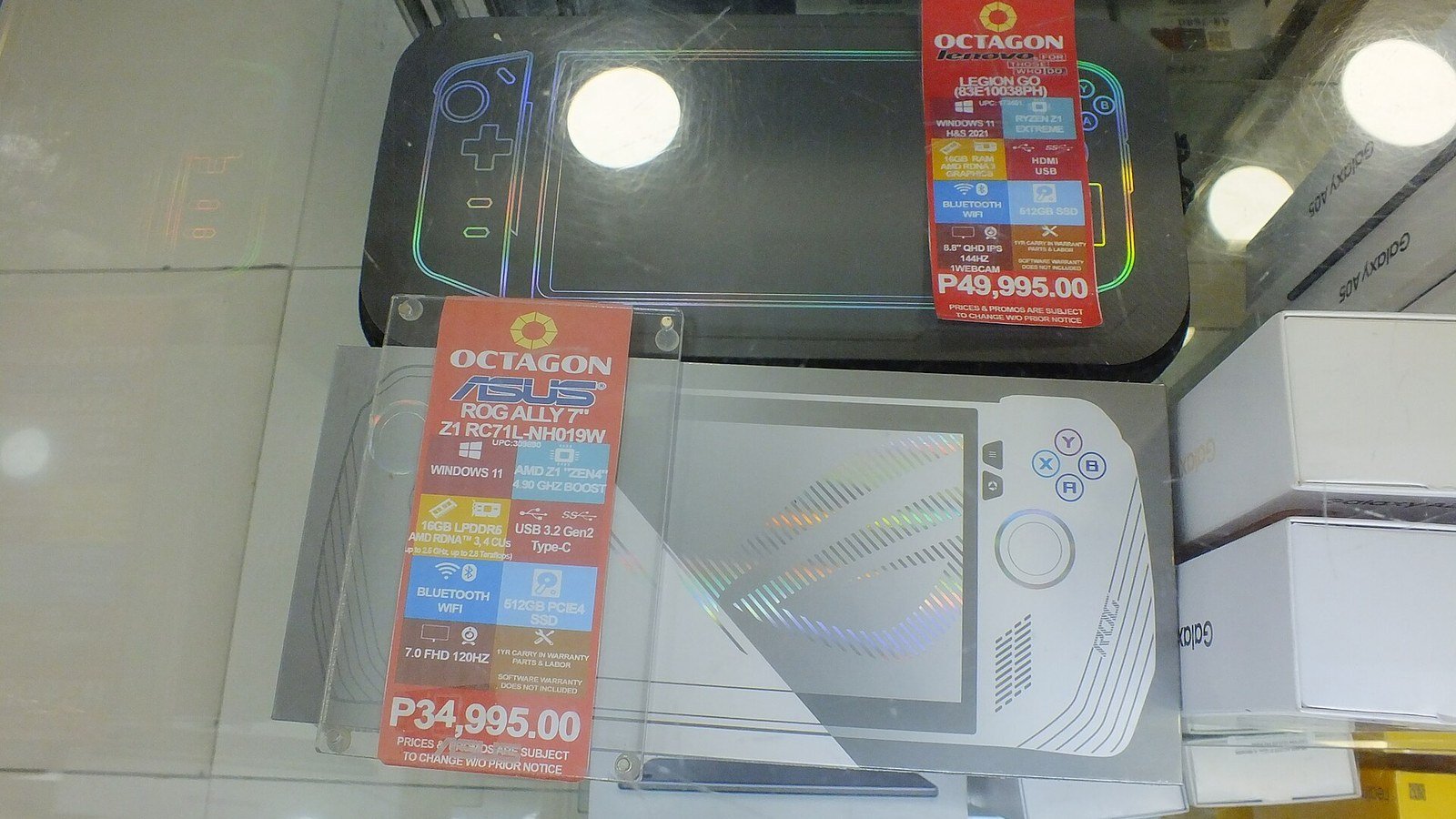
Lead image: not the Atlas 8. Boxes for two earlier Windows handhelds, Lenovo’s Legion Go and Asus’s ROG Ally, with price tags in a Cebu City store in May 2024 (cropped). Photo: Wide Awake!, via Wikimedia Commons, licensed CC BY 4.0.