OpenAI has cut the target for its latest funding round by $10 billion, to about $20 billion, and lowered the valuation it’s asking for to $1.25 trillion from $1.4 trillion, the Financial Times reported, as relayed by CNBC and Reuters. That landed a day after S&P Global Ratings put Meta’s credit on negative outlook, Intel’s stock fell about 28%, and the Nasdaq dropped 2.9%. For two years the market treated giant AI budgets as a sign of strength. This week it started asking for the receipts.
Key points
- OpenAI cut its funding-round target by $10 billion to about $20 billion and lowered its valuation goal to $1.25 trillion, the FT reported.
- S&P affirmed Meta’s AA- rating but moved its outlook to negative, forecasting free cash flow deficits through at least 2028.
- Intel fell about 28% on a weak forecast, and the Nasdaq dropped 2.9% to sit 7.8% below its Oct. 6 record.
- Amazon’s 10-Q discloses a new secured loan facility of up to about $80 billion backed by the infrastructure it buys.
What happened in about 48 hours
The FT report says OpenAI had set a Friday deadline for investors to commit, and that the “first close” is now expected to raise less than $20 billion after some investors cut their allocations. A consortium of UAE investors including the state-backed fund MGX is expected to be the largest participant, and OpenAI would get an option to lease newly built computing capacity in the region. Founders Fund, Coatue, Sequoia Capital and Andreessen Horowitz are also expected to take part, and wealthy individuals would get a later retail offering at the same $1.25 trillion valuation. OpenAI and the named investors didn’t immediately comment to Reuters. (CNBC’s copy says the old valuation target was “$1.4 billion”; the context makes clear that’s a typo for trillion.)
On Friday, Oct. 30, S&P affirmed Meta’s AA- rating but moved the outlook to negative from stable, citing “significant uncertainty around capex and free operating cash flow.” A negative outlook isn’t a downgrade. It’s a formal warning that one is on the table.
The same day, Intel shares fell about 28% after it guided fourth-quarter revenue to $15 billion to $16 billion, below the roughly $17 billion analysts expected, and warned gross margin would slip to 37% from 43%, TechCrunch reported. The drop cut about $12 billion from the value of the US government’s roughly 10% stake, per CNBC’s math cited by TechCrunch.
The broader market followed. The Nasdaq fell 2.9% on Friday and closed 7.8% below its Oct. 6 record, CNBC reported. Nvidia fell 4%, Broadcom more than 5% and Qualcomm 11%, per TechCrunch. That came a day after Alphabet’s 12% plunge, which we covered Thursday.
The problem isn’t demand. It’s cash
Nobody in this week’s reports is saying people stopped using AI. Google, Amazon and Microsoft all reported cloud growth, and AWS revenue grew 39%, TechCrunch noted. The worry is free cash flow, the money left over after a company pays for its operations and its capital spending. Several of the richest companies on Earth are now spending more than they bring in.
Here’s how the four biggest spenders looked in their latest results, as compiled by TechCrunch. Note that the periods differ, so these aren’t directly comparable:
- Alphabet: negative free cash flow of $9.1 billion in the third quarter, its second straight quarter in the red, with quarterly capex of $51.4 billion and up to $205 billion planned for the year.
- Amazon: negative free cash flow of $42.4 billion over the trailing 12 months, versus positive $14.8 billion a year earlier, with about $220 billion of capex expected this year.
- Meta: negative free cash flow of $2.1 billion in the third quarter, its first quarter in the red, with full-year capex guidance of $135 billion to $145 billion.
- Microsoft: the exception, with positive free cash flow of $18.6 billion in its latest quarter and capex of $45.2 billion, below the $50 billion it had projected. Microsoft blamed delays at third-party capacity providers, not a deliberate pullback.
Alphabet adds a twist that makes investors especially twitchy: Google’s search ad growth slowed to 12%, its weakest pace in five quarters, while its AI Mode grows. The company is paying for the technology that may be shrinking its own best business.
Who’s actually paying for all this
“AI spending” sounds like one pile of money. It isn’t, and the differences matter more than the totals. This week’s documents show at least five separate funding routes, each with a different person holding the risk. We’re deliberately not adding these together, because a lease, a loan and a stock sale aren’t the same kind of money.
1. Leases instead of debt (Meta). S&P’s report is the most revealing primary document of the week. It says Meta’s leverage could rise above 1.0x, the agency’s downgrade threshold for the AA- rating, as early as 2027, up from about 0.1x in 2025. The jump “primarily stems from its strategy of leasing data center capacity (including its mega-data center projects Beignet and Sopaipilla) rather than from issuing debt.” In other words, Meta kept bonds off its tab, and the rating agency counted the lease bills anyway.
2. Bonds (nearly everyone). Microsoft, Alphabet, Amazon, Meta and Oracle raised a combined $326 billion in debt in 2026, triple last year’s amount, according to S&P Global Market Intelligence data cited by TechCrunch.
3. Loans secured by the hardware itself (Amazon). Amazon’s quarterly 10-Q filing discloses a new secured “Loan Facility” for “certain purchases of technology infrastructure assets” of up to approximately $80.0 billion. Amazon can borrow at its discretion from the first quarter of 2027 through the third quarter of 2028, each borrowing carries a variable rate and matures in five years, and Amazon “will grant a security interest in certain purchased assets.” The filing doesn’t name the lenders or suppliers or say how much Amazon expects to draw. It also says the borrowings will be booked as long-term debt, so this isn’t hidden off the balance sheet. What’s new is the collateral: the servers and gear themselves back the loan.
4. Selling stock. S&P’s forecast includes a $37.5 billion Meta equity raise and notes a separate $60 billion at-the-market stock program that it left out of its base case. Reuters described Meta’s plans as selling $97.5 billion in stock to fund the buildout.
5. Private rounds and chip-backed deals (the labs). OpenAI’s shrinking round is one version. Anthropic is another: Blackstone, the anchor investor in a $63 billion financing for Anthropic’s chips, told investors it now expects the company to get a “high” junk rating, in the double-B range, after its IPO rather than the investment-grade rating it had previously signaled, according to the FT as reported by TechCrunch. Anthropic and Blackstone declined to comment. In that deal, more than $42 billion of senior debt is guaranteed by Broadcom, which co-develops the chips and has an investment-grade rating, per the FT’s report as republished by Valor Econômico. A junk rating shuts out many pension funds and insurers and makes borrowing more expensive, which would leave Anthropic leaning harder on its highly rated suppliers to carry the debt. Anthropic filed to go public this week, as we covered.
Our read: the common thread is that the spending is migrating from “paid for out of profits” to “paid for by someone else’s balance sheet.” That doesn’t mean it’s a bubble. It does mean more parties now have a reason to care whether AI revenue shows up on schedule.
Read the S&P report, not just the headlines
S&P’s numbers are worth seeing in its own words, because some coverage garbled them. The agency now forecasts Meta’s capex at $140 billion this year, rising to more than $225 billion in 2027 (up from its earlier $163 billion forecast) and $252 billion in 2028 (up from $178 billion). It forecasts free operating cash flow deficits of $22 billion in 2026, $71 billion in 2027 and $39 billion in 2028. It had previously expected Meta to turn cash-positive again in 2028, and it now says the cash flow could stay negative beyond 2028.
A Reuters write-up, carried by CNA and others, said S&P forecasts deficits of “$39 billion in 2026 and $71 billion in 2027.” S&P’s own text gives $22 billion for 2026; $39 billion is its 2028 figure. It’s a small slip, and a good reminder of why we read the filing.
S&P also explained why Meta looks worse than its peers: several rivals “are already monetizing their data center investments by leasing compute capacity to third parties,” while Meta mostly uses its own. Meta is betting that better ad tools and new products like its Muse agent will pay off, but S&P says “it is unclear when these revenue streams will generate material contributions that exceed their rising costs.” Meta disagreed. “We respectfully disagree with S&P’s assertion about Meta’s AI monetization capabilities,” a spokesperson told Reuters, adding the company sees “significant product and business opportunities ahead.”
Intel is the AI boom’s collateral damage
Intel’s fall is a different story with the same cause. Intel isn’t overspending on AI so much as getting squeezed by it. AI data centers are soaking up memory and other components, which raises PC prices and slows PC sales, Intel’s core business. “Our customers began signaling a PC slowdown based on the memory prices and availability,” CEO Lip-Bu Tan said on the earnings call, as quoted by TechCrunch.
The odd part is that Intel’s own AI-adjacent business is booming. Data center revenue grew 78% from a year earlier. But Intel can’t fully cash in until it has more factory capacity and more outside foundry customers, and its next Arizona fab isn’t expected online until 2028. Even after Friday, TechCrunch notes the stock is still up more than 70% this year, so the government’s stake remains a paper winner.
What this doesn’t mean
It’s tempting to call this the bubble popping. The evidence so far doesn’t say that. Cloud demand is growing, Meta’s ad revenue grew 26%, and OpenAI is still on track to raise roughly $20 billion at a trillion-plus valuation, which is still an enormous private raise. A Nasdaq that’s 7.8% off its high is a correction in progress, not a collapse.
What has changed is the price of patience. Investors used to reward every capex increase. Now they’re punishing companies that can’t show when the spending turns into cash, and rating agencies are starting to put that doubt in writing. That pressure lands hardest on the companies without a big cloud business renting out their chips: Meta, and the AI labs that rely on everyone else’s money.
The catch: nearly every number in this story is either a forecast (S&P’s), a company’s own guidance, or anonymous-source reporting (the FT’s on OpenAI and Anthropic). The hard, audited facts are the quarterly results and Amazon’s filing. Everything else could move fast in either direction.
What to watch next
- OpenAI’s actual first close. The FT says it’s expected below $20 billion. Whether OpenAI confirms a number, and how much comes from the UAE consortium versus US venture firms, will show who still wants in at $1.25 trillion.
- Anthropic’s IPO pricing and its first credit ratings. If the agencies land in the double-B range Blackstone now expects, watch whether Anthropic leans further on supplier-guaranteed debt like the Broadcom-backed chip deal.
- Meta’s 2027 capex guidance. S&P says Meta hasn’t disclosed its 2027 plans and is forecasting more than $225 billion. The real number, likely with fourth-quarter results, decides whether the negative outlook becomes a downgrade.
- Whether Amazon draws on the $80 billion facility. Borrowing can’t start until the first quarter of 2027, so its 10-Q for that quarter is the first place a draw would show up.
Hype in. Signal out.
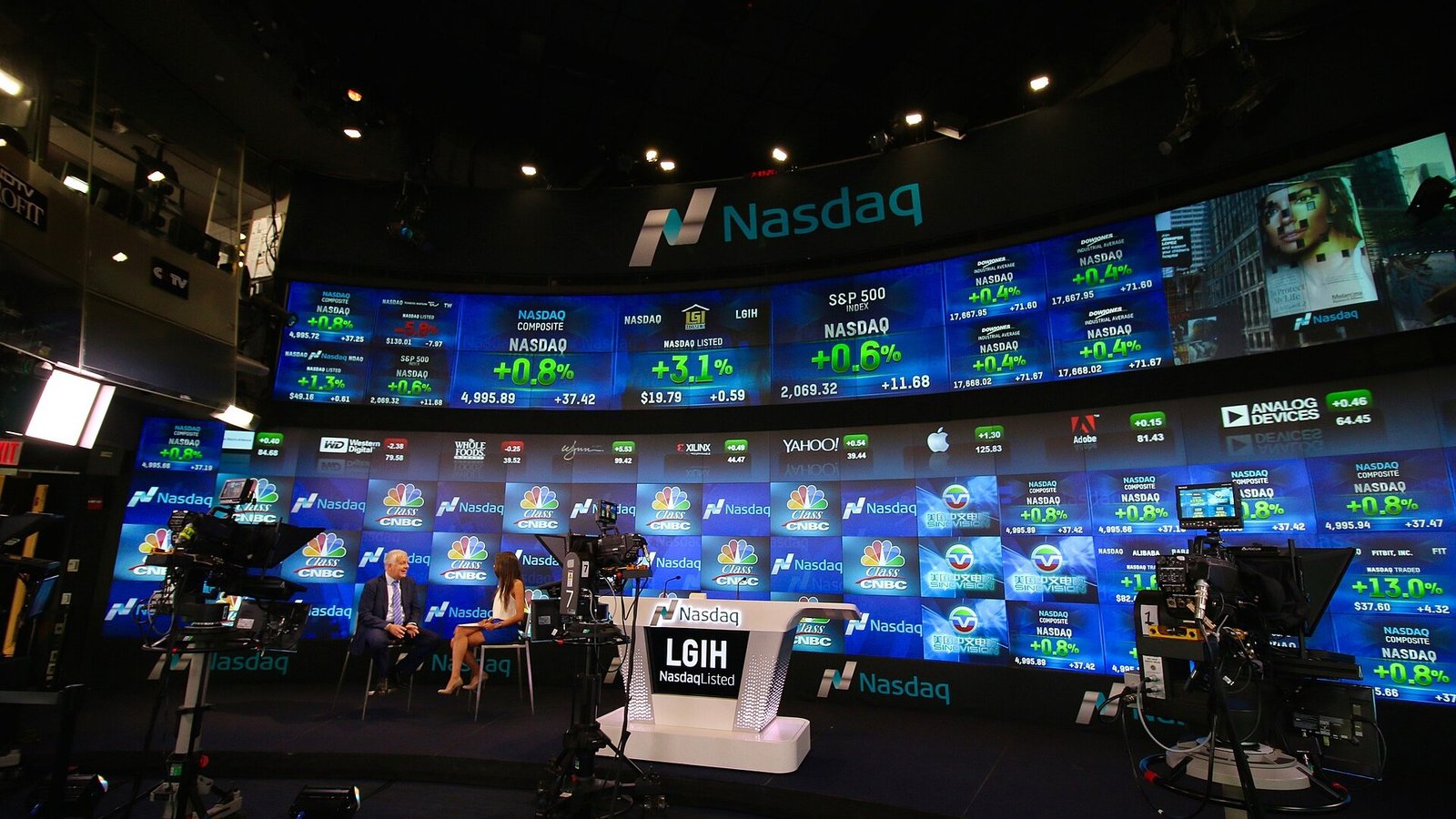
Image: The Nasdaq MarketSite studio in New York, June 30, 2015 (the green numbers on screen are from that day, not this week). Photo by Luca Marfè (Italia all’ONU), via Wikimedia Commons, CC BY 2.0; cropped to 16:9.