



Apple’s new iPad mini, announced Oct. 26 and on sale in the US since Nov. 6, is the first of the line with an OLED screen and an IP67 water-and-dust rating. It is also the most expensive mini Apple has launched, at least at the starting price: the 128GB Wi-Fi model is $699, and cellular starts at $849. The Verge‘s David Pierce, who spent a week with a loaded $1,249 unit, called it the best mini yet and still would not, “in good conscience,” tell you to buy the one in his hands. The other catch reviewers keep coming back to: the new OLED still refreshes at 60Hz.
Key points
- Apple’s new 8.5-inch iPad mini, announced Oct. 26 and on sale in the US since Nov. 6, starts at $699 for 128GB Wi-Fi and $849 for 128GB cellular.
- It is the first mini with an OLED Super Retina XDR display, a 5.4mm-thin body and an IP67 rating; Apple says peak HDR brightness is 1,200 nits.
- Nano-texture glass is a $100 option on 256GB and 512GB models. The 512GB config is the only one Apple lists with a 6-core CPU and a Dual 16-core Neural Engine.
- The Verge’s David Pierce, testing a $1,249 cellular 512GB nano-texture unit, called it the best mini yet but would not tell you to buy that config. Reviewers say the display is still capped at 60Hz, with no Face ID.
A bigger OLED in the same footprint
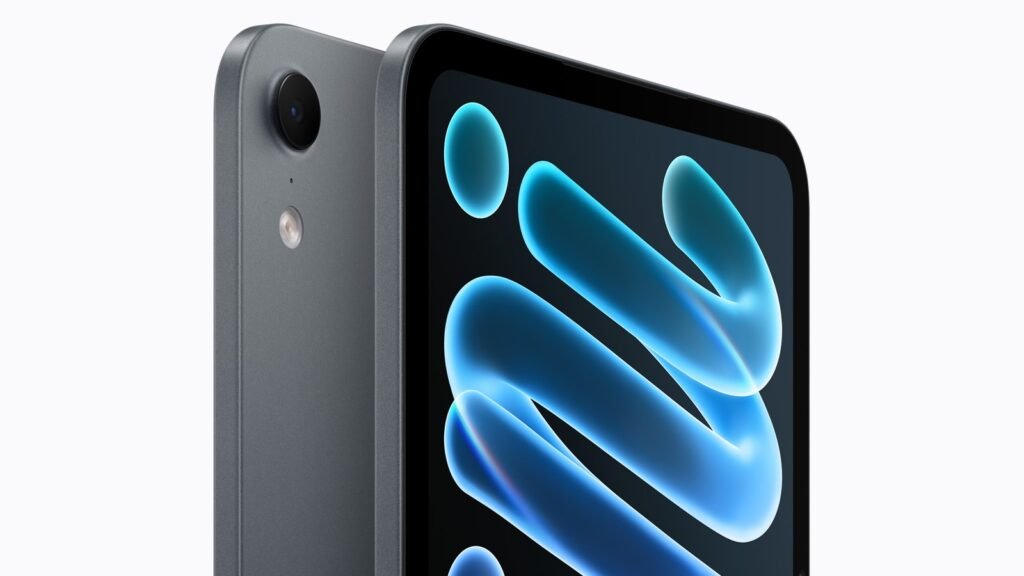
Apple’s tech specs list an 8.5-inch Super Retina XDR OLED, 2,316 by 1,512 pixels at 326 ppi, in a body that is 7.69 by 5.22 by 0.21 inches (5.4mm thin). The previous mini was 8.3 inches. Apple says the extra screen comes from bezels that are 24 percent thinner, so the overall footprint stays the same. The company rates full-screen brightness at 600 nits for SDR and HDR content, peak brightness at 1,200 nits for HDR only, contrast at 2,000,000:1, and a 1-nit minimum. It also says that 1,200-nit peak is more than twice the previous generation.
Pierce, testing a midnight mini with cellular, 512GB and the nano-texture coating, wrote that the OLED was a “solid improvement”: brighter highlights, darker blacks, and a low enough minimum to read in the dark in dark mode. He also found the optional nano-texture, which Apple says cuts glare, dulled and slightly darkened the panel and shimmered on a very white background, even though it did an “excellent job” of killing overhead reflections. Nano-texture is available only on 256GB and 512GB models. On Amazon this afternoon, the 256GB Wi-Fi mini was $799, and the same tablet with nano-texture glass was $899, a $100 step that matches what Pierce reported.
What Apple did not put on the spec sheet is ProMotion. Multiple reviewers, including Pierce, TechRadar and The Guardian, say the display is capped at 60Hz. Pierce wrote that Apple’s answer to other writers has been, in effect, that 120Hz is irrelevant because OLED’s faster pixel response solves the problem. He disagreed. The Apple Pencil felt “more juddery” on his screen, and scrolling text went blurry, in a way it does not on a 120Hz panel. He did not call it a dealbreaker for most people. He did call it a bummer at this price.
Thinner, lighter, and finally rated for water
The Wi-Fi mini weighs 0.56 pound (255 grams); the cellular model is 0.58 pound (263 grams), according to Apple. Pierce, comparing it with the 2024 mini, described the change as about a tenth of an inch thinner and about an ounce and a half lighter. The finishes are midnight and starlight. There is still no Face ID; Unlock is Touch ID on the top button, as before. Apple moved the 12MP Center Stage front camera to the landscape edge, which Pierce found clearly right for every other iPad and more of a mixed bag on the one iPad he actually holds vertically for long periods.
The new IP67 rating, tested under IEC 60529, is for a maximum depth of 1 meter for up to 30 minutes. Apple is careful, in the usual footnote, that splashes and submersion are not permanent protection. Pierce still found the rating changed how he used the tablet: he worried less about handing it to a toddler, cooked with it nearby, and at one point took it into the shower during a close football game. “It’s still kicking,” he wrote. He would not use it as an underwater camera.
To get that seal, Apple dropped the speaker holes for what it calls an Acoustic Display, with sound firing through the front panel. Pierce said it did not sound better than before, “maybe a tiny bit bassier,” and was slightly better for having the sound pointed at you. “Mostly it’s a wash in service of the ruggedization, which is good enough for me.”
The A20 Pro is not the same chip in every mini
Apple says the A20 Pro is built on the company’s 2-nanometer process and that the mini delivers up to 60 percent faster multithreaded CPU performance, up to 2.7x graphics performance and up to 4.5x faster AI performance than the previous generation. Those are Apple’s figures, not third-party benchmarks. The company’s own spec sheet also splits the chip by storage. The 128GB and 256GB models get a 5-core CPU (two performance cores and three efficiency cores), a 7-core GPU and a 16-core Neural Engine. Only the 512GB model, $999 for Wi-Fi on Amazon this afternoon, gets the 6-core CPU and the Dual 16-core Neural Engine. If you buy the $699 starting config, you are not getting the top A20 Pro Apple mentions in the same breath as a Dual Neural Engine in its announcement.
Pierce, whose review unit had that extra CPU core, said his own benchmarks were about 50 percent faster than the 2024 mini for standard tasks and about three times as fast for graphics. He noticed faster app launches and games; Assassin’s Creed Mirage, “all but unplayable” on the last mini, “work[ed] nicely” on this one. He also found battery life “steadfastly somewhere around nine hours of screen time,” even though he thought the battery itself was a bit smaller. Apple rates the mini at up to 10 hours of Wi-Fi web surfing or video, and up to 9 hours of web use on cellular, from tests it says it ran in September 2026 on preproduction units.
Who should buy it, and who should skip it
Shop: iPad mini 128GB Wi-Fi, $699, 256GB Wi-Fi, $799, 256GB Wi-Fi with nano-texture, $899, 128GB Wi-Fi + Cellular, $849, 512GB Wi-Fi, $999.
Consider it if you already know you want a small iPad you can hold in one hand, you care about the OLED and the IP67 rating, and $699 (or more, once you add storage, cellular or nano-texture) is a price you can live with. Pierce, a longtime mini owner, said this one finally feels like a tablet made for a reason. The $79 TechWoven Smart Folio and the $129 Apple Pencil Pro or $79 USB-C Pencil are extras, not requirements.
Skip it if you do not specifically need the small screen. Pierce wrote that, as of his Nov. 3 review, the base iPad started at $449 and the 11-inch iPad Air at $749, and that unless you really want the compact size, “$50 more gets you a much better and more versatile iPad Air.” Skip the loaded configs if $1,249 for cellular, 512GB and nano-texture feels like paying flagship money for a 60Hz, Touch ID tablet. And skip nano-texture if you want the punchiest OLED; even Pierce, who liked how it killed glare, thought he might prefer the standard glass.
The takeaway: Apple finally gave the mini the screen and the durability its fans have been asking for, and then charged a new high for the privilege while leaving the refresh rate where it was. For iPad mini people, this is the one to get. For everyone else, the size is still the whole argument, and $699 is a lot of money to spend on an argument.
Hype in. Signal out.
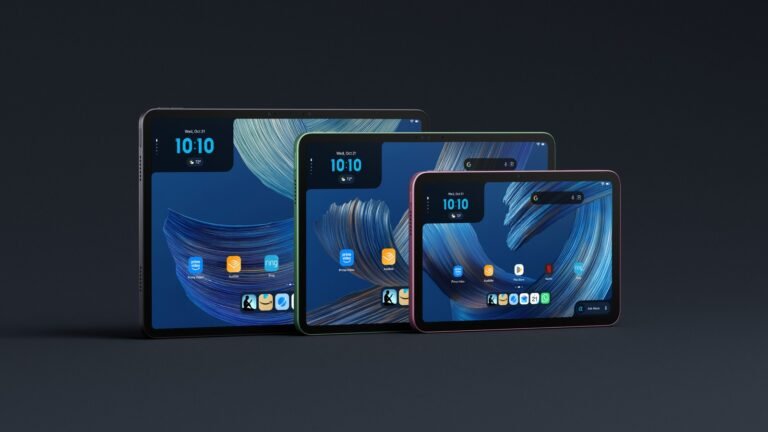
Lead image: The 2026 iPad mini in midnight, an official product photo from Apple’s Oct. 26 announcement. Image: Apple. Cropped and resized.