




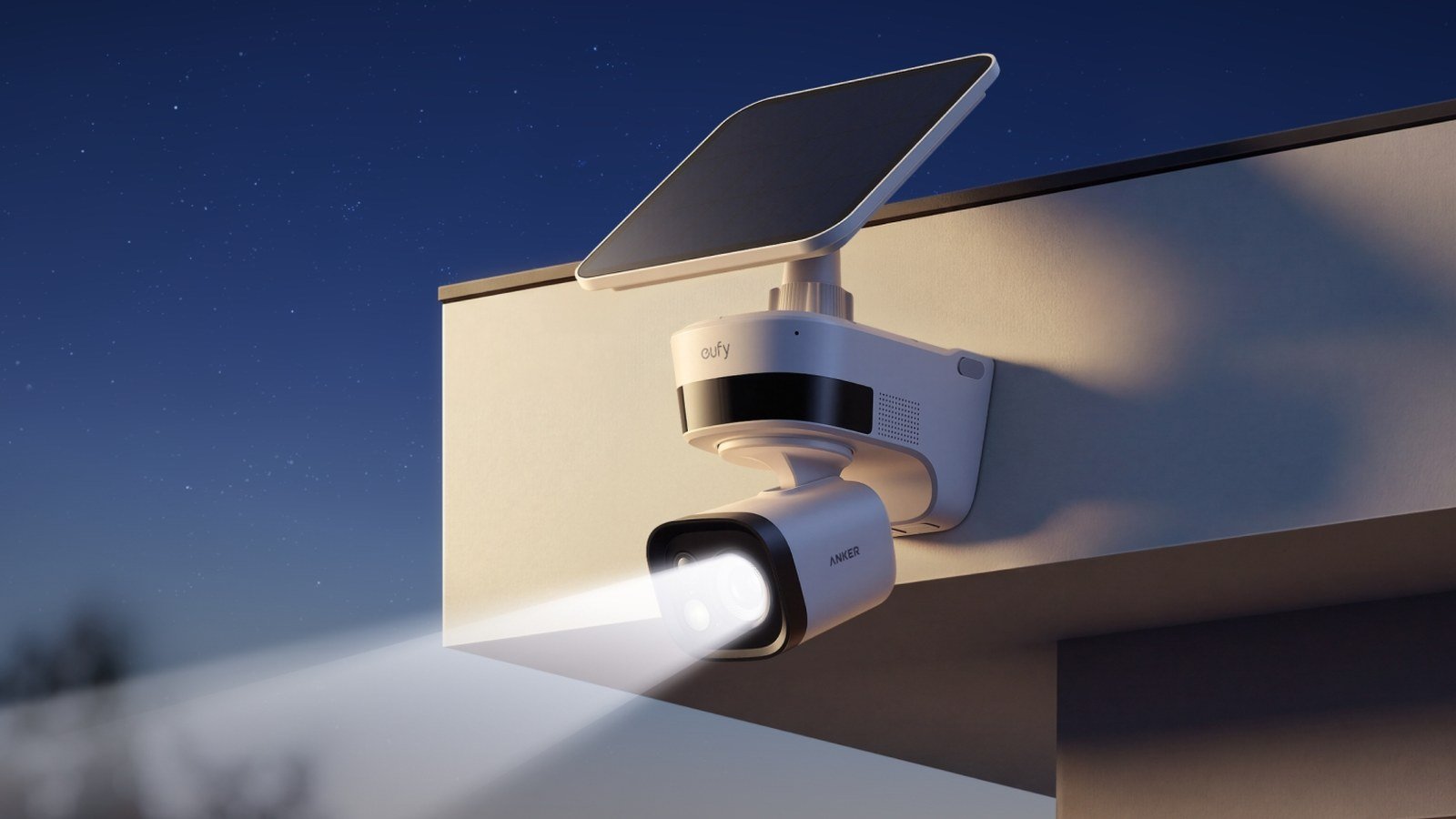
Anker’s new Eufy TrackLight Cam S1 doesn’t just record a stranger crossing your yard. It aims a motorized beam of light at them and keeps it there as they move. Anker’s Nov. 9 announcement says the solar-powered outdoor camera is on sale now in the US for $299.99 at eufy.com and Amazon, and in the UK for £249.99. We found no written review from a major outlet yet, only launch coverage and a handful of YouTube videos, so for now nearly everything about it is Anker’s own claim.
Key points
- Anker says its $299.99 Eufy TrackLight Cam S1, on sale now in the US, aims a motorized 10-to-30-degree beam at a person it flags as suspicious within about 40 feet and can add a 105 dB siren.
- Its radar detects across 180 degrees, but Anker lists the lens view at 85.8 by 46.6 degrees, so it covers more ground by panning up to 355 degrees.
- Anker’s product pages say 24/7 recording needs wired power, the light caps at 120 seconds per trigger and storage needs a microSD card or Eufy hub sold separately.
- Baseus began selling a similar spotlight-tracking camera, the $279.99 U2 Pro, in October, and we found no S1 review from a major outlet yet.

What the light actually does
According to Anker, when the camera decides it is looking at a suspicious person within 12 meters (about 40 feet), the TrackLight locks on. The beam is a “10- to 30-degree adaptive beam with 20 lux of focused light,” narrowing to a spotlight when the person is far away and widening as they come closer. The camera head pans 355 degrees and tilts 75 degrees, and Anker says it can track at up to 87 degrees per second.
Owners can pair the beam with a 105-decibel siren in what Anker calls tracking deterrence mode, or switch to red and blue flashing lights. Anker’s materials don’t say how far from the camera that 105 dB figure, or the 20 lux, was measured. Both numbers get much smaller across a yard.
There’s also a gentler mode. Family members added to a Family List in the Eufy app get recognized by their phone over Bluetooth, and the camera gives them “soft welcome lighting” instead of an interrogation. Facial recognition, through Anker’s BionicMind AI, requires its HomeBase S380 hub, according to the product page.
Our read: the phone trick is clever and cheap, but it puts a lot of weight on who has the app. Anker’s materials don’t explain how the camera tells a “suspicious” person from a delivery driver, a neighbor’s kid fetching a ball or a guest whose phone isn’t on the list. Anker says you can set three detection zones and the distance at which the beam fires, “without disturbing neighbors.” Expect to spend time tuning those.
Decoding the spec sheet: 180, 86 and 355
The marketing says “360° coverage.” The numbers underneath tell a more specific story, and they’re worth separating:
- Detection: 180 degrees. Two radar sensors cover a half circle in front of the camera, out to 12 meters, Anker says.
- What the lens sees at once: 85.8 by 46.6 degrees. That’s narrower than the 140-by-80-degree view Anker lists for “other spotlight cams” in the comparison chart in its own press-kit fact sheet. The camera covers more ground by turning, not by seeing wide.
- Where it can turn: 355 degrees horizontally, 75 degrees vertically. That’s the “360°” in the marketing, minus five degrees.
- Zoom: up to 10x, digital. Anker’s own release says digital, which means cropping the 4K image, not optical magnification.
Why it matters: a narrow telephoto-style lens on a fast motor is a good fit for following one person down a driveway. It’s a worse fit for watching two things at once. While the head is chasing someone on one side, the lens isn’t looking at the other side. The radar can still sense movement across its 180-degree field, but Anker doesn’t say how the camera chooses between targets.
The power fine print
The camera runs on a 15,000mAh battery fed by a 5.5-watt solar panel. The press release says that setup keeps the camera “running continuously, even on cloudy days.” Eufy’s product landing page is more careful: “Connect to wired power to keep your security running 24/7.” In other words, continuous recording is a plugged-in feature, a point GeekRadar also flagged.
Anker’s FAQ gives its own math. In optimal sunlight, it says, the panel collects 1,000 to 2,500mAh a day, while the camera uses 300 to 550mAh a day based on 36 daytime 20-second recordings and one 60-second nighttime deterrence event. (The landing page’s version of the same footnote says two nighttime events.) If those consumption figures hold, a full battery alone would last roughly four to seven weeks with no sun at all. That’s our arithmetic, not an Anker claim, and a busy sidewalk or a cat that keeps tripping the radar would shorten it.
Two more limits from Anker’s FAQ: the light can’t stay on as a regular porch light, and each trigger tops out at 120 seconds, with at least five seconds between triggers. And there’s no built-in storage. You need a microSD card, which isn’t included, or a compatible Eufy hub.
The hidden costs
Out of the box, Anker says the camera works with Google Home. Apple Home requires a Eufy hub, and the product page names HomeBase S380, which is also what unlocks face recognition, cross-camera tracking and up to 16TB of storage on an attached drive (not included). Eufy sells the camera bundled with that hub for $499.98 on its own store, so the smarter version of this camera is really a $500 purchase.
Anker pitches the system as local-first with no monthly fees, and says sensitive biometric data is processed on the device. Its own footnotes add two caveats: “optional or premium features may require a subscription,” and if you turn on cloud storage or push notifications with thumbnail previews, “videos or thumbnail previews will be sent to the cloud.”
That fine print matters more for Eufy than for most brands. In 2022, The Verge reported that it could watch unencrypted streams from Eufy cameras over the internet, contradicting Eufy’s privacy claims, and relayed a security researcher’s finding, which Anker reportedly acknowledged, that notification thumbnails had been uploaded to its cloud. In January 2023 Anker admitted the cameras were not natively end-to-end encrypted and said it had fixed the web-portal streams and was bringing in outside security auditors. That was more than three years ago, but it’s the context for any Eufy camera that sells on privacy.
Not the only camera with a flashlight
Anker calls the S1 “the world’s first outdoor security track light camera with an auto-tracking light.” It’s not alone on shelves. The Verge noted that the S1 follows the “similar” Baseus Security PrimeSentinel U2 Pro, which went on sale through Amazon in the US for $279.99 in October with a motorized spotlight that follows moving people. Both were trade-show debuts: 9to5Toys reports the S1 was first introduced at IFA 2026 in Berlin, and Baseus’s own Sept. 4 release says it showed the U2 Pro at the same show. Baseus simply reached US shelves first.
The two take different approaches, based on each company’s claims:
- Eufy TrackLight Cam S1 ($299.99): one 4K pan-tilt camera, radar detection, a 15,000mAh battery and a 5.5W panel; storage on a microSD card you buy separately or a Eufy hub.
- Baseus U2 Pro ($279.99): two 3K cameras, one fixed and one that pans 360 degrees; a 3W solar panel; Baseus says footage is stored locally on a 512GB encrypted memory card, and claims up to 150 days per charge.
Futureshock hasn’t tested either one.
Who should buy it, and who should skip it
Anker lists an IP65 rating for dust and water resistance, a weight of 2.2 pounds and a size of 7.28 by 7.13 by 9.84 inches. White is sold at eufy.com and Amazon and black at eufy.com, according to the release.
Consider it if you already use Eufy gear or Google Home, you have a single approach to cover (a driveway, a side gate, a long backyard), you want the camera to react rather than just notify you, and you have a sunny spot or a nearby outlet.
Skip it if you want wide, always-on coverage of a whole yard from one device; you live close to neighbors or a busy sidewalk and don’t want to spend time tuning zones; you need 24/7 recording without running a cable; you’re an Apple Home household that doesn’t want to add a hub (about $200 more in Eufy’s bundle); or Eufy’s 2022 encryption episode is a dealbreaker. And if you just want the moving-spotlight trick for less, the Baseus U2 Pro launched in the US at $20 less and has been on sale longer.
The takeaway: moving the light instead of just the lens is a real idea, and two companies shipped it within a month of each other. What nobody has shown yet is how the S1 behaves on a real street: how often the beam hits the wrong person, how long the battery lasts in a Seattle winter and whether its AI really filters out pets and passing cars. Those are the reviews to wait for.
Hype in. Signal out.
Lead image: The Eufy TrackLight Cam S1, a staged marketing image from Anker Innovations’ TrackLight Cam S1 media kit, linked from the company’s Nov. 9 press release for media coverage. Image: Anker Innovations. Cropped and resized.