


Instant cameras are a small gamble every time you press the shutter: each shot spends a print that costs about a dollar. Fujifilm’s hybrid Instax cameras take the gamble out by shooting digitally first and printing only the pictures you pick. The new Instax Mini Evo 2 adds the first touchscreen on any Instax, a bigger sensor and a short pre-shot video mode, and Fujifilm says it reaches US stores at the end of November for $289.95. Reviewers mostly like it. The odd part comes after you shoot: Fujifilm’s own release says its phone app takes photos off the camera only once you’ve printed them.
Key points
- Fujifilm says the Instax Mini Evo 2 costs $289.95 in the US and arrives at the end of November; its Tokyo release lists sales starting Nov. 27.
- It is the first Instax with a touchscreen, and Fujifilm says it can record up to 13 megapixels, but only with a microSD card and its Expanded View mode off; reviewers found most shots come out at about 6 megapixels.
- Fujifilm’s own release says photos and videos can be sent to its phone app only after they’re printed on the camera.
- Reviewers at DPReview, Amateur Photographer, Digital Camera World and Cameralabs liked the controls and prints but cited a slow startup, short battery life and prints flatter than the screen.
What $289.95 buys
According to Fujifilm’s US launch release and spec sheet, the Mini Evo 2 is a small digital camera with an Instax Mini printer built in. A 4.5-inch LCD touchscreen covers the back, about 1.5 times the size of the original Mini Evo’s screen, Fujifilm’s Tokyo release says. Two clicky dials pick from 10 lens effects (vignette, light leak, double exposure, half frame and so on) and 10 film effects, for 100 combinations, and a lever styled like an old film-advance lever makes the print. The f/2 lens covers shutter speeds from 1/4 to 1/8000 second at ISO 100 to 1600, with automatic exposure and plus or minus 2 stops of exposure compensation.
Internal memory holds about 45 photos; a microSD card of up to 256GB adds more. It charges over USB-C, talks to Fujifilm’s app over Bluetooth and Wi-Fi, and can work as a remote-controlled camera or as a printer for photos from your phone. Prints use standard Instax Mini film: 86 by 54 millimeters overall, with a 62-by-46-millimeter picture, developing in about 90 seconds. Amateur Photographer lists it at 330 grams and 87.5 by 125.3 by 43.7 millimeters. There’s no viewfinder, and it comes in a single black-and-silver finish.
The 13-megapixel asterisk
Fujifilm’s Tokyo release says the Mini Evo 2’s maximum resolution is 13 megapixels, “more than double” the original’s. A footnote adds the conditions: that’s the maximum “when using a microSD card with the ‘instax Expanded View’ mode turned off.” The sensor is bigger, a 1/2.77-inch chip versus the original’s 1/5-inch, The Verge reported. But Expanded View, which shows a border of live image around the area you’re actually capturing, a bit like a rangefinder viewfinder, uses part of that sensor for preview.
In practice, DPReview found that standard shots come out at 2144 by 2860 pixels, about 6.1 megapixels. The full 3100 by 4128 pixels (about 12.8 megapixels) comes only from the wide-angle effect or with Expanded View switched off, and only when saving to a card; anything saved to internal memory is capped at 6.1 megapixels. Cameralabs‘ Gordon Laing adds that images sent through the phone app are resized too. Digital Camera World‘s Hillary K. Grigonis put it plainly: the larger sensor “isn’t quite as exciting as it sounds.”
Our read: 6 megapixels is plenty for a picture the size of a business card, which is what this camera is for. It matters only if you hoped the Evo 2 would double as a pocket camera for sharp digital files. Cameralabs’ Laing said a half-decent phone will beat it on that.
Two more spec-sheet details are worth knowing. Fujifilm’s US release promises “crisp 600 dpi resolution” for prints; its spec sheet lists 635 by 318 dpi, so the 600 figure holds in one direction only, and prints made from a phone through the app drop to 318 dpi. Even so, Laing found that phone photos printed through the app looked more detailed than the Evo 2’s own. And the new Immersive Movie mode, which saves the moments before each shot as a vertical 560-by-992 clip on a microSD card, is described as four seconds in the US release and five seconds in the Tokyo release. Digital Camera World and Cameralabs both found that the still photo saved with each clip drops to 616 by 464 pixels.
The app only takes what you print
Here’s the catch that’s easy to miss. Fujifilm’s Tokyo release says images and Immersive Movie clips “can be transferred to the dedicated app after printing with the ‘mini Evo 2.’” Amateur Photographer’s Andy Westlake ran into exactly that: you can’t browse the camera’s photos from your phone and copy your favorites, only the ones you’ve printed. “This feels like a thinly-disguised attempt to get you to make more prints (and therefore buy more Instax film),” he wrote. Cameralabs adds that the USB-C port is for charging only, so you can’t pull photos off over a cable either. Westlake’s workaround for unprinted shots is to copy them off the memory card, and Laing recommends using a microSD card and a card reader from day one.
The cost math, by our count: Digital Camera World lists a 20-pack of Instax Mini film at about $19.49, or roughly 97 cents a print. Moving 10 favorite shots to your phone the official way therefore costs about $10 in film, unless you take the card out. The other direction is unrestricted: the app will print any JPEG, PNG or HEIF photo from your phone, per the spec sheet.
What the reviewers liked, and what bugged them
Futureshock hasn’t tested the Mini Evo 2. Here’s what the reviewers who did found:
| Reviewer | Liked | Didn’t like |
|---|---|---|
| DPReview (Abby Ferguson) | Generally reliable autofocus, including faces in low light; previewing before printing made her want to experiment | Prints had “noticeably less contrast and less vibrant colors” than the screen; Macro mode sometimes missed focus; tiny prints |
| Amateur Photographer (Andy Westlake) | Slick touchscreen, nice colors, attractive prints, printing from a phone | About 6 seconds to start up; the screen covers the back, so it “isn’t really usable one-handed” |
| Digital Camera World (Hillary K. Grigonis) | Her new favorite Instax; creative modes “unlike any other cheap point-and-shoot” | Battery rated for about 90 shots; tends to overexpose; screen hard to see in bright sun |
| Cameralabs (Gordon Laing) | Wide-angle modes “genuinely useful”; Fujifilm’s best hybrid yet | About 80 shots per charge in his use; reflective screen that is “almost invisible in direct sunlight” at default brightness; plastic body |
Laing also noted that only the EU manual documents how to replace the built-in battery. Elsewhere, he wrote, buyers are expected to dispose of the camera when the battery gives out.
Price check
The original Mini Evo lists for about $234, according to Amateur Photographer and Digital Camera World, so the Evo 2 costs about $55 more. Grigonis thinks the screen and resolution are worth that difference if you’re choosing between the two, but she called upgrading from the original “more of a want than a must,” and Westlake said he wouldn’t upgrade. Laing suggested watching for deals on the original. If you mostly want to print phone photos, Westlake pointed out that Fujifilm’s Instax Mini Link 3 printer costs about half as much. Budget for film, too: a 20-print pack runs about $19.49, per Digital Camera World.
Availability is the other caveat. Fujifilm’s US release says only “expected to be available at the end of November 2026,” and Fujifilm’s Tokyo release lists Nov. 27 for Japan. When we checked Amazon on Thursday morning, we didn’t find a listing for the Evo 2, only the original, so there’s no shopping link here. We’ve covered other unusual cameras lately, from HoverAir’s flying pocket camera to OM System’s $1,000 PEN; this one is far simpler, and that’s the point.
Who should buy it, and who should skip it
Consider it if you want instant prints without wasting film on bad shots, you like turning physical dials more than tapping filters on a phone, and you’re happy keeping a microSD card and a card reader handy. It’s a fun gift for someone who already likes Instax prints.
Skip it if you already own the original Mini Evo; if you want sharp digital files (your phone will do better); if you mainly print phone photos (a Mini Link 3 is cheaper); if you want bigger prints (Instax Square or Wide formats); or if a 6-second startup and roughly 80 to 90 shots per charge would get in the way of how you shoot.
What to watch
Three things specific to this camera. First, whether Fujifilm changes the app so unprinted photos can be transferred; that’s a software decision, and reviewers have complained about it. Second, when US stores actually ship it, since Fujifilm has only said “end of November.” Third, whether the flatter-than-the-screen prints DPReview saw show up in more reviews, or turn out to be a setting you can fix with the camera’s brightness, contrast and saturation edits before printing.
Hype in. Signal out.
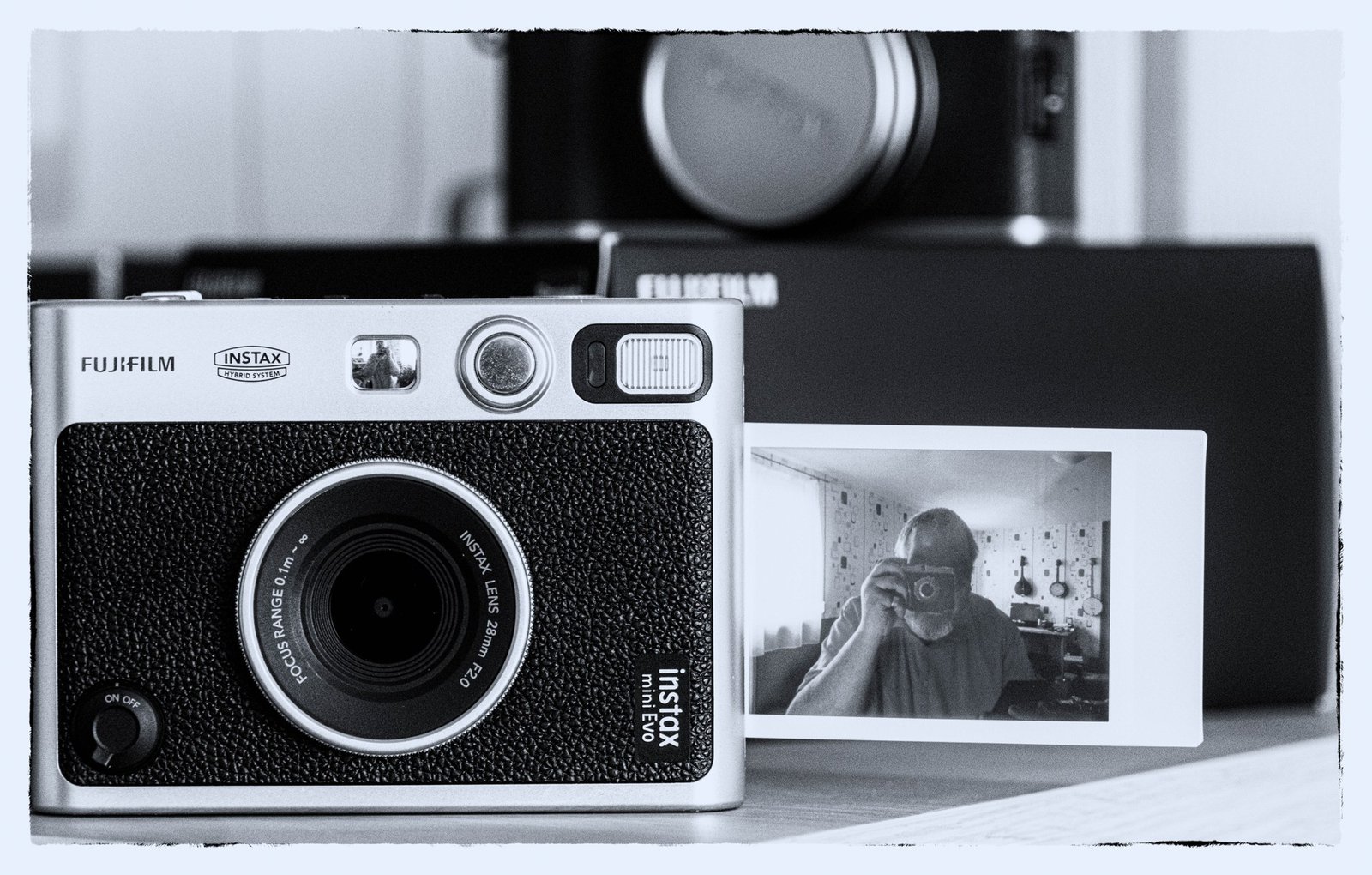
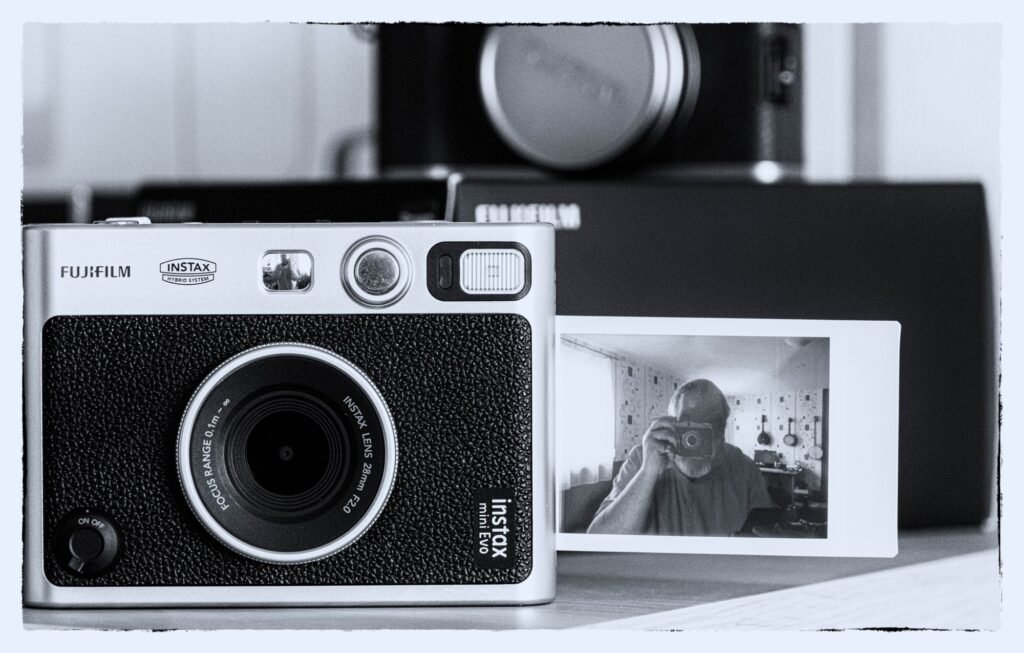
Lead image: the original Instax Mini Evo (2021), not the Mini Evo 2, beside one of its prints. Photo: senpatientulo, via Wikimedia Commons, released under CC0 1.0 (public domain dedication).