Google’s first data center satellite has sent its first AI answer back to Earth, and naturally it was a haiku. Engineers uplinked a prompt to the Project Suncatcher prototype, a Gemma 4 model running on a Google TPU in low Earth orbit wrote a three-line poem about being in space, and the reply came down as the satellite passed over Svalbard, Norway. It’s a cute “Hello World.” It’s also a genuinely useful test of whether the chips that run Google’s AI can survive up there, and a long way from a data center.
Key points
- Google says its Project Suncatcher prototype, launched Oct. 1 on SpaceX’s Transporter-18 rideshare, produced what it calls the first AI response from a data-center-class TPU in orbit this week.
- The satellite, built with Planet, carries four TPUs and up to about 1 kW of solar power, so it can run only one chip at a time and only for roughly 15 to 20 minutes per burst, according to TechCrunch and Payload.
- The real test is next: Google will measure how the chips handle heat and radiation in orbit before flying two linked satellites in 2027.
- Google’s own peer-reviewed paper says space compute only competes on cost if launch prices fall below about $200 per kilogram, which it estimates could take roughly 1,800 Starship flights.
What happened
Here is the poem, as Google published it on Oct. 30:
Blue marble below
Data streams in silent grace
Starlight feeds my core.
Travis Beals, who leads the project as senior director of Google’s Paradigms of Intelligence group, wrote that the team spent the weeks since launch on a commissioning checklist that “included powering up the host and TPU trays and successfully running early machine learning tests.” After the haiku, the team tried “space-themed limericks and telemetry prompts reporting the technical status of the payload systems.” A Google spokesperson told TechCrunch the satellite is operating nominally.
Google posted a short video of the moment on its official YouTube channel:
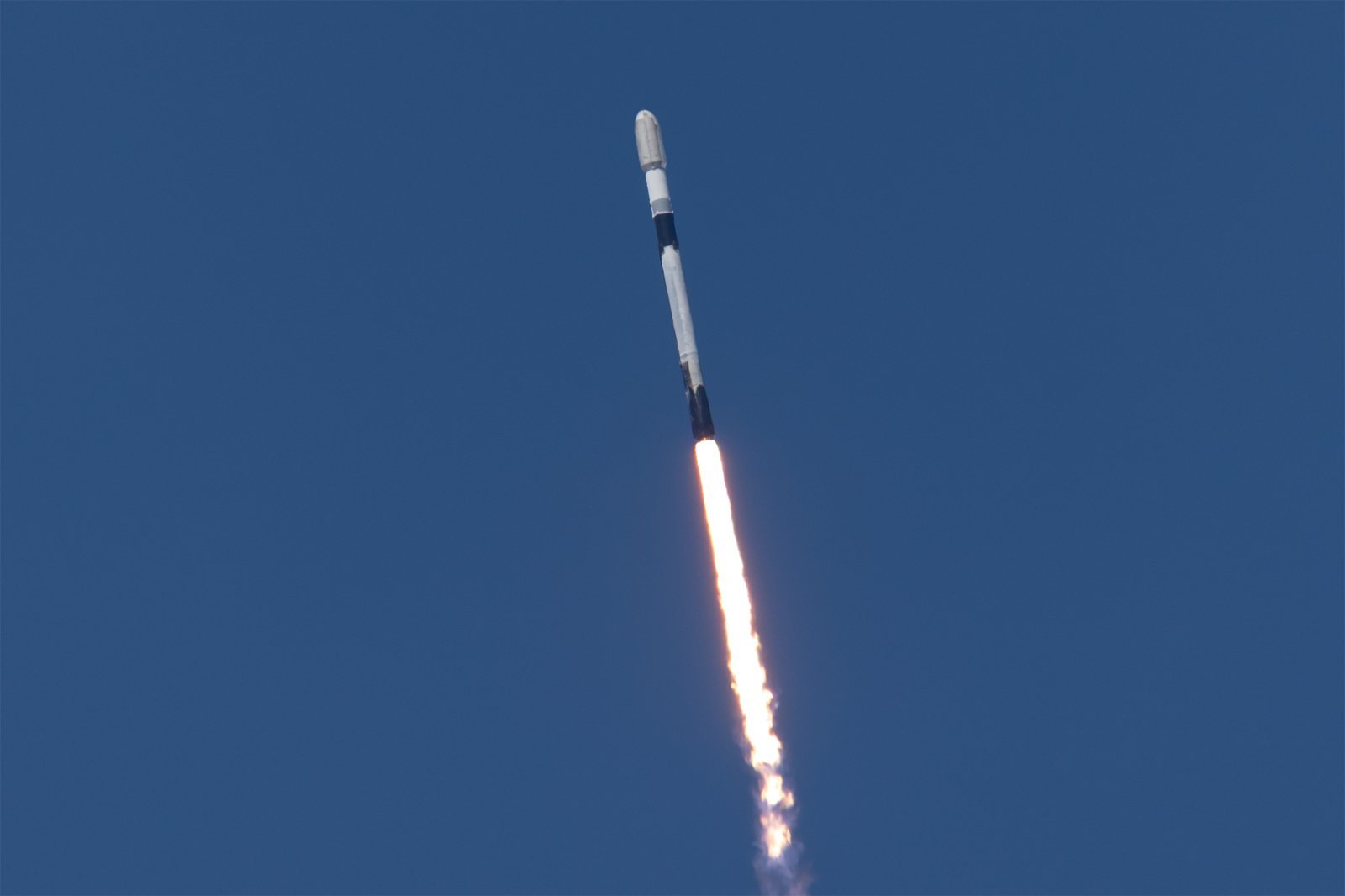
The satellite itself is modest. It rode to orbit on Oct. 1 aboard SpaceX’s Transporter-18 rideshare from Vandenberg Space Force Base in California, alongside more than 100 other spacecraft. It’s built on a standard Planet Labs platform, carries four of Google’s Trillium TPUs, and generates up to about 1 kW of electricity, per TechCrunch. Payload describes it as fridge-sized and roughly one server’s worth of compute.
That power budget is the catch. TechCrunch reports the satellite can switch on only one TPU at a time, for about 20 minutes, before power and heat force a break (its launch-day story said 15-minute bursts). So the first orbital “data center” Google has flown runs one chip, part-time, on roughly the power of a microwave oven.
“First” comes with an asterisk
Google’s wording is careful: the first AI response “from a data center class TPU in orbit.” The TPU part matters, because this isn’t the first time a data-center chip has run a chatbot in space.
In December 2025, Nvidia-backed startup Starcloud said its Starcloud-1 satellite, launched the month before with an Nvidia H100 GPU on board, was running Google’s own open Gemma model in orbit. Its first message began, “Greetings, Earthlings!” Starcloud also says it trained Andrej Karpathy’s small NanoGPT model on the complete works of Shakespeare up there, which it bills as the first language model trained in space.
So the scoreboard reads: an H100 ran Gemma in orbit about 10 months before a TPU did. Google’s milestone is real for Google, since it’s the first public test of its own accelerator in space, but “AI in orbit” was already done, and Gemma was already the guest star.
Why put AI chips in space at all
The pitch, laid out in Google’s November 2025 paper and its peer-reviewed version in Joule, starts with energy. AI demand keeps climbing, and the Sun is the biggest power plant around. The paper says solar panels in certain orbits get nearly continuous sunlight and can collect up to 8 times more energy per year than a panel at mid-latitude on Earth. Instead of beaming that power down, which has defeated space-solar schemes for decades, Google wants to use it where it’s generated, on chips in orbit.
The design Google sketches isn’t one giant station. It’s swarms of smaller satellites in a dawn-dusk sun-synchronous orbit (an orbit that rides the line between day and night so the panels almost never go dark), flying close enough to talk over laser links. The paper’s illustrative cluster packs 81 satellites within a 1-kilometer radius, with neighbors drifting between roughly 100 and 200 meters apart. Close formation is the trick: commercial satellite laser links top out around 1 to 100 gigabits per second over thousands of kilometers, while Google’s analysis says it needs on the order of 10 terabits per second per link to act like a TPU pod. A bench demo on the ground hit 800 Gbps one way.
Our read: the formation flying is the most novel part of the plan, and nothing on today’s prototype tests it. That’s what the 2027 pair is for.
The real experiment is radiation, not poetry
Space is hard on chips. Charged particles slowly degrade transistors over time (total ionizing dose) and, more annoyingly, can flip individual bits in an instant. A flipped bit that no error check catches is called silent data corruption: the chip keeps working and quietly gives a wrong answer.
Google already tested this on the ground. Its paper describes firing a 67 MeV proton beam at a Trillium TPU at the UC Davis Crocker Nuclear Laboratory. The results, as the company reports them:
- Lifetime dose: a five-year mission in the target orbit works out to about 750 rad. The chip’s high-bandwidth memory started showing irregularities at about 2,000 rad, and everything else kept working to the 15,000-rad maximum tested, with no permanent failures.
- Silent errors: roughly one silent corruption per 17 rad during transformer workloads. At an estimated 150 rad per year in orbit, Google translates that to about 1 error per 3 million inferences, assuming one inference per second.
- Crashes: the host computer saw a crash or reboot about once per 450 rad for the CPU and 400 rad for RAM.
Some quick math puts that in human terms. Three million seconds is about 35 days, so at one answer a second a chip would serve up roughly one silently wrong answer every month or so. And at 150 rad a year, one crash per 400 to 450 rad works out to a host reboot only every two to three years. That’s fine for a chatbot. Google itself says training is a different story, because one undetected bit flip can poison a long training run, and the paper calls that question one that “requires further study.”
The catch: a proton beam in a lab isn’t orbit. Real space radiation includes galactic cosmic rays and a mix of particle energies that a single beam can’t fully mimic, and TechCrunch notes the in-orbit campaign is meant to check the ground results against reality. Until Google publishes those numbers, the reliability case rests on a simulation.
The economics hang on Starship
Google is blunt that launch cost is the make-or-break number. The paper estimates that if getting to low Earth orbit falls to about $200 per kilogram, the yearly launch cost per kilowatt for a Starlink-like satellite (about $810 per kW per year, spread over a five-year life) lands near what US data centers spend on electricity, which the paper puts at roughly $570 to $3,000 per kW per year. At today’s Falcon 9 price of about $3,600 per kilogram, the same satellite works out to around $14,700 per kW per year.
Note what that comparison leaves out, and the authors say so: it sets launch cost against power cost only, not chips, buildings, repairs or ground links, and they stress it “does not constitute a full economic analysis.” It also compares a cost that’s amortized over a satellite’s life with a running electricity bill, so it’s a feasibility check, not a price quote.
Getting to $200 per kilogram is the hard part. Google’s learning-curve analysis assumes SpaceX keeps cutting prices about 20% for every doubling of mass it has launched. Keeping that pace until about 2035 would take roughly 370,000 more tonnes to orbit, or about 1,800 Starship launches at 200 tonnes each, around 180 a year. As TechCrunch pointed out at launch, that’s a lot of flights from a rocket that, as of August, SpaceX was still preparing to re-fly for the first time around the end of this year or early 2027.
There’s a business wrinkle too. TechCrunch notes Alphabet holds a significant stake in SpaceX, so Google’s space data center plan depends on, and would feed demand to, a company it partly owns.
Who else is racing
Google isn’t alone, and the field is splitting into two camps. Starcloud is building bigger single satellites that each run inference on their own: it plans two 8 kW Starcloud-2 satellites on rideshares in 2027 and has asked the FCC for permission to operate 88,000 spacecraft, after raising a $250 million extension in August that valued it at $2.3 billion. TechCrunch reports Cowboy Space also plans single-satellite inference, and Cowboy’s Reason-1 flew on the same Transporter-18 launch to test laser power beaming, per Payload.
Google’s bet is the opposite: many small satellites wired together tightly enough to split one big job, the way chips in a TPU pod do on the ground. TechCrunch says that makes Suncatcher “largely alone” among space data center plans, with SpaceX’s own expected designs also using laser links but flying too far apart to share work closely.
A rough sense of scale for where things stand:
- Suncatcher prototype (in orbit): about 1 kW, one TPU running at a time, in short bursts.
- Starcloud-2 (planned for 2027): 8 kW per satellite, company-reported.
- Google’s long-term goal: satellites holding roughly a rack’s worth of compute, about 50 to 100 kW each, per Payload’s summary of the Joule paper.
In other words, the satellite now writing haiku is somewhere between one-fiftieth and one-hundredth of what one of Google’s future satellites is supposed to be, before you even get to clusters of 81.
How we got here
- Nov. 4, 2025: Google announces Project Suncatcher and a preprint paper, promising two prototypes with Planet by early 2027.
- November to December 2025: Starcloud-1 launches with an H100 and runs Gemma in orbit.
- Oct. 1, 2026: Google’s single prototype launches on Transporter-18, earlier than the original two-satellite plan, and the peer-reviewed paper appears in Joule.
- This week: commissioning wraps and the first prompt gets a haiku back.
- 2027: two purpose-built satellites with higher power and laser links between them, per Google.
One thing changed along the way: the 2025 plan was two prototypes by early 2027. Google instead flew one off-the-shelf Planet satellite first and pushed the linked pair to 2027. That’s a sensible way to de-risk, and it also means the hardest idea in the plan hasn’t flown yet.
What it means right now
For anyone using Gemini or Google Cloud, nothing changes. This is a research mission with one chip awake at a time. The audience that should care is the data center industry, which is fighting over power, land and water on the ground; Google says a long-run benefit of orbit is “minimizing the impact on terrestrial resources such as land and water.”
It also lands in an awkward week for Alphabet, which shed about $500 billion in market value after saying AI in search is weighing on ad growth. Suncatcher is, in TechCrunch’s words, “a classic Google moonshot” aimed at the 2030s. Moonshots tend to get more scrutiny when the core business wobbles.
What to watch next
- The in-orbit error rate. If Google publishes measured silent-corruption and reboot rates, compare them with the lab figures of one error per 17 rad and one host crash per 400 to 450 rad. A big gap would reset the whole reliability case.
- Burst length. Whether the prototype can run longer than its roughly 15 to 20 minute sessions as engineers learn its thermal limits is the most direct read on how hard cooling in a vacuum really is.
- Any training test. Inference was always the easy case. A training run in orbit, even a tiny one like Starcloud’s NanoGPT, would test the failure mode Google’s paper flags as unresolved.
- Starship’s reuse milestones. The paper’s math needs about 180 Starship launches a year. The first re-flight of a recovered Starship is the first data point on whether that learning curve is even starting.
This story is based on Google’s Oct. 1 and Oct. 30, 2026 blog posts, the Suncatcher paper on arXiv and in Joule, and reporting available as of Friday afternoon, Oct. 30.
Hype in. Signal out.
Image: A SpaceX Falcon 9 rocket lifts off on the Transporter-18 rideshare mission, which carried Google’s Project Suncatcher prototype, from Vandenberg Space Force Base, California, Oct. 1, 2026. Photo by SpaceX, via Wikimedia Commons, CC0 1.0 (public domain).