

OpenAI has broken up its stand-alone robotics team and moved the people on it into other parts of the company, Fortune reported in an exclusive on Friday. OpenAI confirmed the reorganization to Fortune and insisted it is a push forward, not a retreat: its argument is that general-purpose models such as GPT-6 Astra can now be pointed at robots directly, so a separate team building robot-specific brains is no longer the fastest route. The timing was abrupt enough that OpenAI still had a booth registered at CoRL, the big academic robot-learning conference in Austin this week. When Fortune’s reporter went to booth #208, it was empty, with no OpenAI logo in sight.
Last checked: Nov 15, 2026
Key points
- OpenAI confirmed to Fortune that it has dissolved its stand-alone robotics team, moving robotics researchers under Chief Research Officer Mark Chen and applied robotics and hardware staff under President Greg Brockman.
- An OpenAI spokesperson told Fortune the change is meant to speed up robotics work because general models such as GPT-6 Astra have shown they can be applied directly to robots.
- The main public evidence is an Nvidia study in which a GPT-6 Astra agent succeeded on 74.8% of simulated pick-and-place tasks, versus 51.0% for the best specialized model on that benchmark.
- The same Nvidia study found Astra averaging 18.56 seconds per call in its direct setup and about $36.40 in tokens per successful episode in its best one, with the simulation paused while it thought.
What OpenAI actually changed
Per Fortune, the robotics research group now reports into OpenAI’s main research organization under Chief Research Officer Mark Chen. The applied robotics and hardware teams moved into the larger Applied organization, which reports to President Greg Brockman. A spokesperson said robotics “remains a core part” of OpenAI’s long-term vision and that the company is still committed to bringing general-purpose robots into the world.
What nobody has published: a headcount, a list of who moved where, or an OpenAI statement of its own. The reporting describes reassignments, not layoffs. The Decoder changed its own opening line on Nov. 14 after OpenAI clarified that it reorganized the team to work more closely with research and product and that robotics work continues. So the honest phrasing is the one OpenAI is pushing and the one Fortune used: the stand-alone team is gone; the people are, for now, still there.
The awkward detail is the conference. CoRL 2026 ran Nov. 9 to 12 in Austin, and the conference app and floor plan still showed OpenAI at booth #208. Fortune’s story also notes that a few former members of the team were milling around booth #208 and still drew a crowd, despite having no display or demo. Nothing says “we are accelerating robotics” quite like a booth with no robot.
The reason: a chatbot model that can grab things
OpenAI’s explanation, as relayed by Fortune, is a change of plan inside a single year. At the start of 2026, the spokesperson said, OpenAI’s researchers assumed robotics progress would build on its video work, models like Sora that have to implicitly understand how the physical world moves in order to render it. Since then, the company says, its general-purpose frontier models, including GPT-6 Astra, have shown they can be applied to robotics directly. That finding, OpenAI says, is why it folded the team into the groups building those general models.
The most detailed public test of that claim isn’t OpenAI’s. It’s Astranomy, a study by three Nvidia Seattle Robotics Lab researchers (Jenai Xuning Yang, Ashna Khetan and Shun Zhang), dated Oct. 14 and listed as a CoRL 2026 late-breaking result. They gave GPT-6 Astra camera views and a control interface and let it run a simulated DROID robot arm on RoboLab-120, Nvidia’s 120-task simulated pick-and-place benchmark, with no robot-specific training.
Nvidia tested three ways of wiring Astra in:
- Direct Policy: the robot software asks the model for the next actions each time. Best result: 66.3% success.
- Agentic Policy: Astra runs inside a persistent Codex session that keeps its history. Result: 74.8%, which the study says beats the best specialized policy on its RoboLab-120 board, Lakeside, by 23.8 points (Lakeside: 51.0%).
- Orchestrated Policy: Astra supervises while a robot foundation model generates the actions. Result: 66.5%.
There is also hardware evidence, though small. On StationeryBench, a five-task test from a team publishing as RoboCurve, Astra drove a pair of real YAM robot arms through 100 trials on desk chores like uncapping a Sharpie and passing a ruler between arms. It fully completed 7 of 100 trials. Ai2’s MolmoAct2, a dedicated vision-language-action robot model run zero-shot (with no practice on the tasks), completed none, and Astra’s average progress score was 46 out of 100 to MolmoAct2’s 12. That is a clear win and also a 7% completion rate. Both things are true.
The fine print Nvidia wrote itself
The Astranomy authors are unusually blunt about their own result, and their caveats are the part of this story that headlines skip:
- The clock stops while the model thinks. The simulator was paused during inference. In the study’s direct setup, each Astra call averaged 18.56 seconds, and inference made up about 97% of each episode’s estimated time. In Nvidia’s yogurt-task example, the arm spent about 5.2 seconds actually moving and the whole task took an estimated 3 minutes 57 seconds.
- It is expensive. The 74.8% agentic setup averaged about 30.9 million tokens, roughly $36.40, per successful episode at October API prices, versus about 160,000 tokens ($1.96) for the direct setup.
- It is one kind of task. RoboLab-120 is pick-and-place. The authors say it doesn’t cover insertion, assembly, long mobile jobs or anything that needs fast reactions, and that five episodes per task wasn’t enough to establish statistical significance for smaller differences.
- Grasping is still the weak spot. The study’s failure section lists grippers that keep adjusting without securing the object, objects dropped in transit and the wrong bin chosen.
For scale, the specialist models on the same chart answer in milliseconds: the study cites a median of about 47 milliseconds per action chunk for Physical Intelligence’s π0.5. π0.5 also scored 28.0% on the board. Smart and slow versus fast and clumsy is the whole trade.
Our read: the bet isn’t exclusive to OpenAI
Here is the part that makes OpenAI’s reorg less of a moat and more of an industry-wide shrug. Nine days ago Apple posted a paper making the same argument with its rivals’ models. As we covered on Friday, Apple’s AMP1 harness let Google’s Gemini 4 Argon and Anthropic’s Claude Opus 5.5 run a robot arm by writing their own code. Apple reported 85.6% on RoboLab-120 with Gemini 4 Argon and 82.8% with Claude Opus 5.5, and Nvidia’s public RoboLab leaderboard lists AMP1 first at 86.0% from a separate submission.
Those numbers are not a clean head-to-head with Nvidia’s 74.8% for Astra: different harnesses, different episode counts and a different amount of help from the surrounding software. But they point the same way. On this one simulated test, the top of the chart now belongs to general-purpose models wrapped in good plumbing, not to robot-specific brains. If that holds, the advantage doesn’t come from owning a robotics team. It comes from owning the best general model and the best harness. OpenAI is betting it has the first. Apple just showed the second can be built by someone else, around someone else’s model.
OpenAI has done this before
This is OpenAI’s second exit from a stand-alone robotics team, and the first one looks a lot like this one in hindsight:
- 2017-2018: OpenAI released Roboschool simulation software and then Dactyl, a system that used a Shadow Dexterous Hand trained entirely in simulation to rotate blocks. Its author list included cofounder Wojciech Zaremba and Jakub Pachocki, who later became OpenAI’s chief scientist.
- October 2019: the robot hand solved a Rubik’s Cube, succeeding roughly 20% to 60% of the time depending on the setup, per VentureBeat.
- October 2020: OpenAI decided to stop robotics research, a decision Zaremba explained in 2021 as a data problem: “There [are] actually plenty of domains that are very, very rich with data. And ultimately that was holding us back in terms of robotics.”
- 2024: OpenAI rebuilt a stand-alone robotics team and announced a deal with Figure to develop AI models for humanoids. In February 2025, Figure walked away, with CEO Brett Adcock telling TechCrunch: “We can’t outsource AI for the same reason we can’t outsource our hardware.”
- November 2026: the stand-alone team is dissolved again, this time on the theory that the general models have caught up. Fortune reports OpenAI is still developing its own humanoid, with CEO Sam Altman targeting a first public demonstration in 2027.
The through line: in 2020 OpenAI left robots because language models were a faster road to its goals. In 2026 it is folding robots back into the language-model teams because it thinks that road now reaches the robot. Same direction of travel, opposite conclusion about whether robotics needs its own room.
Who this hurts, and who it doesn’t
The obvious pressure is on robot-brain startups, which have raised billions on the idea that robots need models of their own. Fortune’s sources pushed back. MIT professor Russ Tedrake, cofounder and CEO of Walden Robotics, argued robot companies have something AI labs don’t: robots already working on real factory floors, collecting site-specific data that better foundation models can learn from faster. Carnegie Mellon’s Guanya Shi, who read the move as OpenAI treating robotics as “no longer a special problem,” still sees a need for small models that run on the robot without a constant internet connection. Generalist cofounder Pete Florence said it was unclear any existing model would dominate robotics long-term.
Investors aren’t acting like the specialists are finished either. The same week, Munich-based Agile Robots announced a $500 million Series F led by SoftBank at an $8.5 billion valuation, with Nvidia among the participants. That is a company-reported equity raise, not revenue, but it is real money betting on vertically integrated robots.
There is also a money story inside OpenAI. Fortune notes Altman has told staff to drop “side quests,” that the company shut down efforts including Sora to free up computing power, and that OpenAI is under pressure to cut heavy operating losses, reportedly $10.9 billion in the most recent quarter, ahead of a possible IPO in early 2027. A reorg that removes a stand-alone research group while promising faster progress is also, conveniently, a focus story for investors.
What to watch next
- Whether anyone leaves. Reassignments are a polite first step. Watch for named robotics researchers departing for labs or startups in the coming weeks; that would tell you more than the org chart.
- Real-time numbers on real robots. Nvidia’s 74.8% came with the simulation paused. The test that matters for OpenAI’s bet is a general model running a physical robot while the world keeps moving, with latency and cost per task disclosed.
- The 2027 humanoid demo. If Altman’s target holds, it will be the first public test of whether a robot run by OpenAI’s general models can work in real time, not in a paused simulator. Watch for whether the demo shows teleoperation, a disclosed speed-up, or the robot acting on its own.
- Who publishes the robot numbers. So far the public evidence for Astra as a robot controller comes from Nvidia and outside teams, while Apple’s AMP1 runs on Google’s and Anthropic’s models. Watch whether OpenAI publishes its own robot results, with success rates, latency and cost, now that robotics sits inside its core research group.
OpenAI’s robot team was folded into the chatbot teams because, on one simulated benchmark, a chatbot-class model out-grabbed the robot specialists. It also needed roughly 11 to 22 seconds per call to decide what to do next, depending on the setup. Fast is the next problem, and it doesn’t have its own team anymore.
Hype in. Signal out.
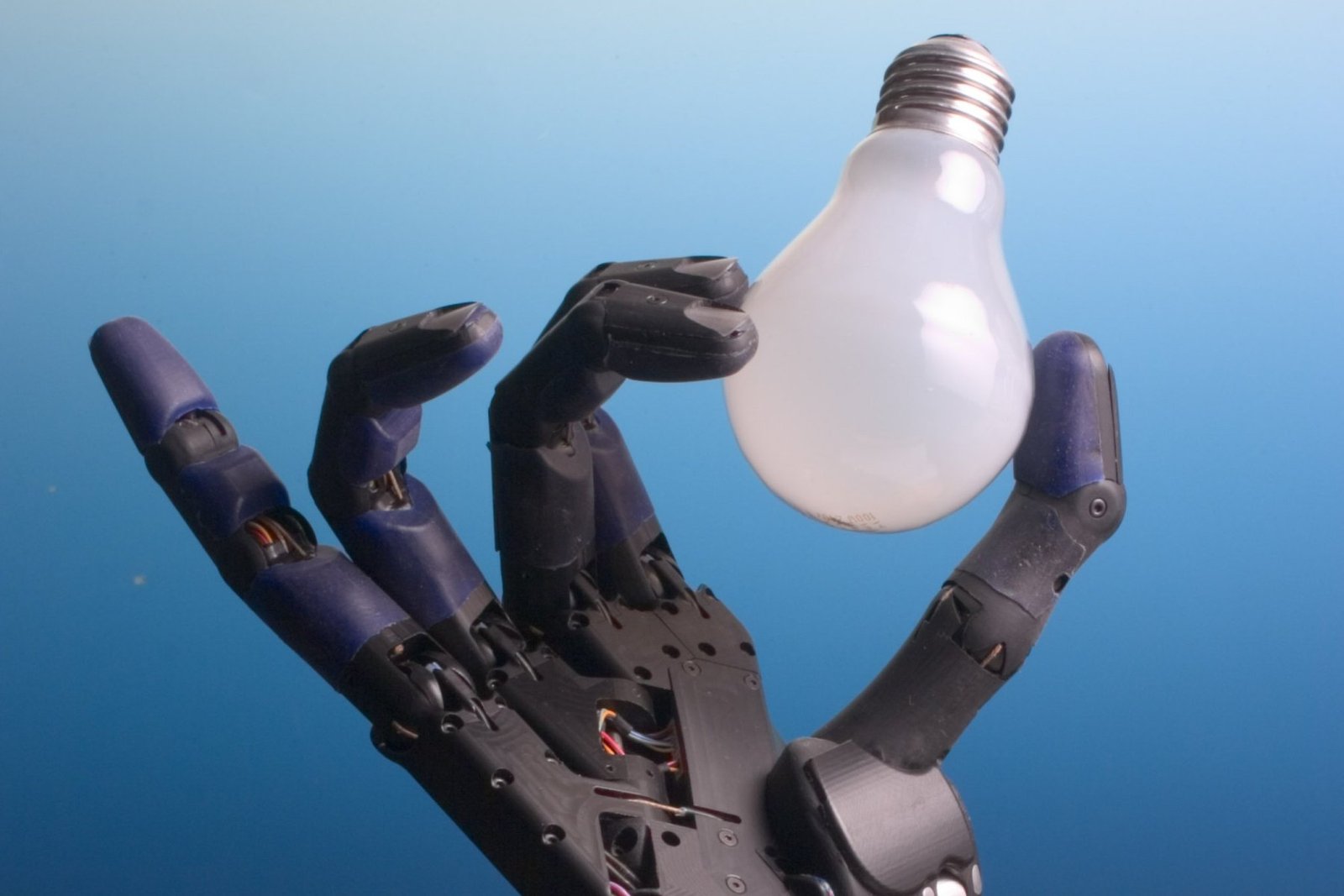
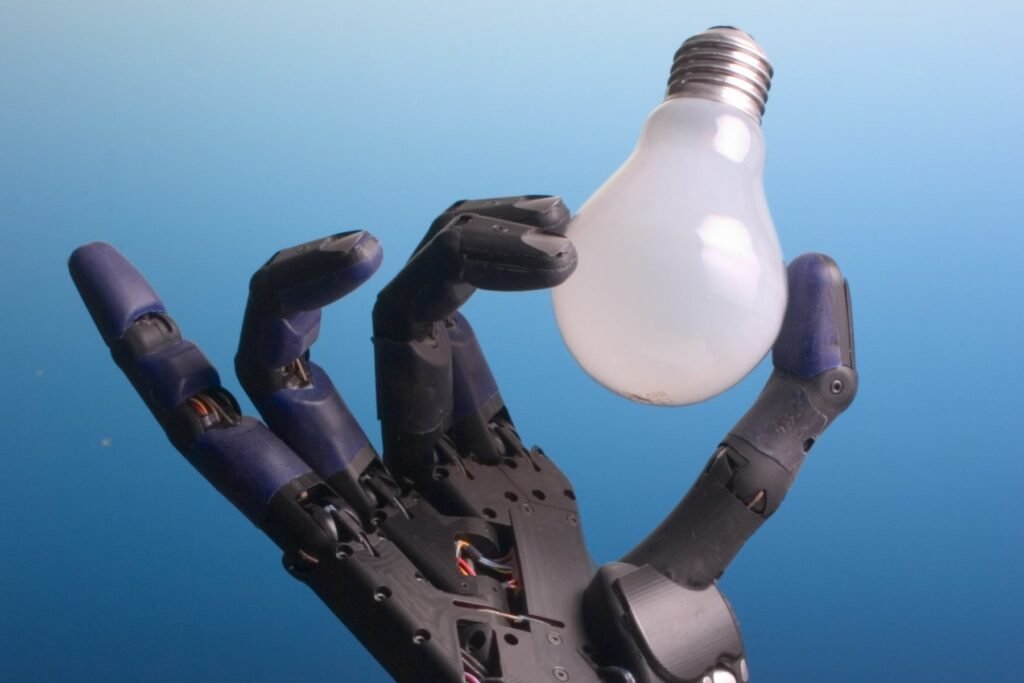
Image credit: Shadow Dexterous Hand holding a light bulb, 2007 (not OpenAI hardware). Photo: Richard Greenhill and Hugo Elias of the Shadow Robot Company, via Wikimedia Commons, licensed CC BY-SA 3.0; cropped to 3:2.