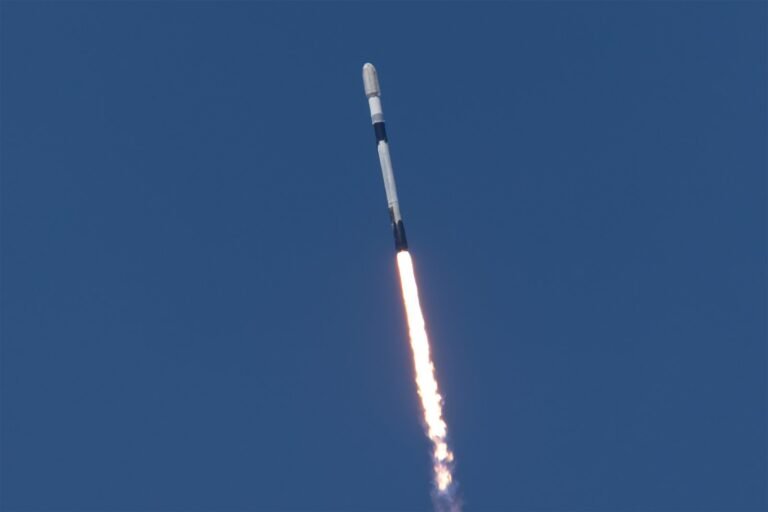

Japan launched its Martian Moons eXploration spacecraft on Monday, the first mission designed to collect a sample from a Martian moon and return it to Earth. The H3 rocket lifted off from Tanegashima Space Center at 04:41:03 Japan time on October 20, which was 12:41 p.m. Pacific on October 19.
The rocket “flew as planned,” JAXA said, and the spacecraft separated about 71 minutes after liftoff. On October 21, JAXA confirmed that MMX had deployed its solar arrays, established attitude control and was in good health.
It’s the largest mission into the solar system JAXA has ever undertaken, according to DLR, Germany’s space agency and one of its partners.
Two years late, for a good reason
MMX was supposed to launch in September 2024. JAXA pushed it to the 2026 Mars launch window after the H3 rocket’s first flight failed in 2023, SpaceNews reported at the time. The agency wanted the new launcher proven before trusting it with an interplanetary spacecraft.
Mars launch windows open roughly every 26 months, when Earth and Mars line up for an efficient transfer. Miss one and you wait for the next, which is why a rocket problem cost the mission two years.
Why it matters: this flight is also a vote of confidence in H3, Japan’s next-generation workhorse rocket. Getting a flagship science mission onto the right path to Mars is a meaningful milestone after that rocky start.
The mission, in order
- August 2027: enter orbit around Mars, then orbit Phobos from September 2027.
- Early 2029: release the Idefix rover onto Phobos.
- 2030: the main spacecraft lands on Phobos and collects samples.
- 2031: a return capsule drops at least 10 grams of Phobos material in Australia.
MMX will be the first spacecraft to orbit Phobos and, ESA says, the first to collect samples from a moon other than our own. Its orbit is a “quasi-satellite orbit,” in which the spacecraft circles Mars while staying close to Phobos, which has too little gravity to hold a normal orbit around itself. On the way home, MMX will also fly past and study Deimos, Mars’ smaller moon.
The capsule will be flown from Australia to Japan, where the sample will be extracted, catalogued and shared with mission partners, ESA says.
Who built what
MMX carries 11 science instruments, seven on the main spacecraft and four on the rover. JAXA leads the mission, with NASA, ESA, the French space agency CNES and DLR as partners.
NASA’s contribution is MEGANE, a gamma-ray and neutron spectrometer that will measure what elements Phobos is made of. NASA delivered it to JAXA in March 2024. ESA says its long-running Mars Express orbiter, confirmed to operate until at least 2029, may support MMX’s observations.
The rover that weighs 15 grams
The most fun part is Idefix, a 25-kilogram rover built jointly by DLR and CNES. Phobos’ gravity is less than one-thousandth of Earth’s, so on the surface Idefix will weigh the equivalent of about 15 grams, per ESA.
That makes landing strange. DLR says MMX will drop the rover from about 40 to 100 meters up, after which it will hit the surface unbraked, bounce, flip itself upright, deploy its solar panels and start a 100-day mission. Temperatures there swing by more than 200 degrees Celsius over a seven-hour day-night cycle.
“Landing and driving on Phobos is uncharted territory for robotics,” said DLR’s Idefix project manager Markus Grebenstein. “Our first real test will be getting the rover to right itself from any position in this unknown environment.”
Idefix has two jobs. It will study the surface’s texture, temperature and minerals with instruments including DLR’s RAX Raman spectrometer and miniRAD radiometer. And it will scout conditions for the main spacecraft’s own landing and sampling. Rover operations will alternate between control centers in Toulouse and Cologne.
Why Phobos matters
Nobody knows where Mars’ moons came from. They may be captured asteroids, or debris thrown into orbit by a giant impact on Mars. Phobos is up to 27 kilometers across and Deimos 15, according to DLR, and so far we’ve only seen them in flybys.
The two origin stories predict different things. A captured asteroid should look like asteroid material. Debris from an impact should carry chemical fingerprints of Mars itself. A sample measured in an Earth lab could tell them apart.
“Bringing samples to our most sophisticated labs here on Earth is a multiplier for discoveries, because our most precise instruments are too large, complex or sensitive to send to space,” said ESA project scientist Elliot Sefton-Nash. “Samples brought to Earth are the gift that keeps on giving.”
MMX would also be the first mission to visit the Mars system and come back, a useful rehearsal for bringing samples back from Mars itself.
The catch
Sample return is the hardest kind of planetary mission, and MMX stacks several firsts: a quasi-satellite orbit, a bouncing rover, a landing in near-zero gravity, and a round trip from Mars. Japan has done this before at asteroids with Hayabusa and Hayabusa2, which is the best reason for optimism. But Phobos is much farther away, and the whole schedule runs until 2031.
There’s a long road between “in good health” and “10 grams in a lab.” Every milestone above is a plan, not a result.
The takeaway
Our read: in a news cycle full of AI announcements measured in weeks, here’s a project measured in decades. JAXA project manager Yasuhiro Kawakatsu said watching the launch took him back to “the very beginning of this project more than a decade ago,” and the payoff lands in 2031.
What to watch: Mars orbit insertion in August 2027, and the rover’s bounce-and-flip landing around the turn of 2029, which will be either a triumph or a very expensive pinball.
Image: NASA / JPL-Caltech / University of Arizona / Wikimedia Commons, Public domain