






Runway, the company best known for AI video tools, on Nov. 11 released the weights for Praxis-1, a 27.2-billion-parameter model that steers robot arms by first imagining what the next moment of video should look like. The launch post and technical report put the model, the inference code and the fine-tuning tools on Hugging Face and GitHub under the Apache 2.0 license, including for commercial use. Runway calls Praxis-1 the top world action model and the top open-source robot foundation model on Nvidia’s RoboLab-120 leaderboard. The live board, which we checked on Nov. 12, does put it first in that lane, at 46.2% success. It is fifth overall.
Key points
- Runway released Praxis-1 on Nov. 11 with open weights and code under the Apache 2.0 license, including for commercial use, on GitHub and Hugging Face.
- On Nvidia’s RoboLab-120 benchmark, the DROID fine-tune succeeded in 555 of 1,200 simulated episodes, or 46.2%, first among world action models and fifth on the overall board as of Nov. 12.
- Runway says a Nov. 2 comparison on a real Franka FR3 arm succeeded in 88 of 100 episodes, versus 80 for FLUX 3 Action, and that a fine-tune on Google’s unseen RT-1 robot reached 80.0% on SimplerEnv, above the original RT-1 policy’s 52.4%.
- The company’s report lists limits with look-alike objects, vague instructions and multi-step tasks from a single prompt. The full-precision model is documented at 54.4 GB and as running on one 80 GB GPU; a 4-bit path is aimed at smaller cards.
A video model that also outputs motion
Praxis-1 is what Runway calls a world action model: a system that predicts a short stretch of future video and, from that imagined scene, the robot commands that would make it happen. The technical report describes a 27.2-billion-parameter stack. A mixture-of-experts video backbone accounts for 26.9 billion of those parameters, with about 2.8 billion active for any given token. A smaller action expert, about 314 million parameters, reads the video model’s internal state and emits motion. On each call, the model takes a text instruction, the latest camera frames and the robot’s current pose, and returns a predicted chunk of video plus 1.6 seconds of actions: 24 command rows at 15 Hz, according to the report.
The idea is not subtle. If a model trained to predict video has already learned how objects slide, how hands close and what a finished task looks like halfway through, a robot can reuse that knowledge instead of learning every motion from scratch on expensive teleoperated data. Runway says its research found that ordinary web video matches teleoperated robot video as pre-training data for policy performance, which would make the bottleneck “how much general video a model can learn from.” That is a company claim, and it is also a convenient one for a video company.
The same report says a single Praxis-1 checkpoint, with light fine-tuning or LoRA adapters, has been adapted to different machines: a single Franka arm, a bimanual YAM station, Google’s RT-1 mobile manipulator and the low-cost SO-101 hobbyist arm. Launch partners named in the Nov. 11 post are Noble Machines, Standard Bots and Ultra, which Runway says have been running the model on a legged humanoid, a six-axis industrial arm and a dual-arm warehouse robot since a September preview.
Fifth overall, first in its lane
RoboLab-120 is Nvidia’s simulation benchmark of 120 tabletop tasks for a DROID-style arm. Under the official protocol of 10 trials per task, Runway’s DROID fine-tune solved 555 of 1,200 episodes, or 46.2%. That number appears in the technical report and matches the live RoboLab leaderboard we opened on Nov. 12, where Praxis-1 is listed as a 27.3-billion-parameter world action model using about 70 GB of video memory.
The comparisons Runway highlights are real, and they are also selective. Among world action models on the same board, Praxis-1 leads FLUX 3 Action at 42.9%, Cosmos3 Nano at 36.8% and several others. It also beats the open-weight vision-language-action models Runway names, including Physical Intelligence’s π0.5 at 28.0% and Nvidia’s GR00T N1.6 at 7.2%. Four entries still sit above it:
- AMP1, listed as an agentic language-model system, at 86.0% (2,579 of 3,000 episodes). That run used 25 episodes per task, not the 10-episode protocol most of the board, including Praxis-1, reports.
- SenseNova-RoboRSI, another agentic system, at 57.1% (685 of 1,200).
- Lakeside, a large world model, at 51.0% (1,531 of 3,000, also at 25 episodes per task).
- BiMind v0.5, a vision-language-action model, at 49.2% (590 of 1,200). The leaderboard marks it as having been fine-tuned with RoboLab or Isaac data.
Runway’s own report flags those four results. It argues that AMP1 and SenseNova are agents that drive a frontier model rather than trained robot policies, that SenseNova’s authors have described the compute as impractical for deployment, and that Lakeside and BiMind v0.5 are closed models, with BiMind trained in part on the benchmark’s own data. We did not independently audit those licenses. Our read is simpler: 46.2% is a real score, it is the best world-action-model result on the board, and it still means the model failed 645 of 1,200 simulated episodes. “State of the art” here is a column heading, not the whole table.
What Runway says it did on real arms
Simulation is cheaper than a warehouse. On a real Franka FR3 station operated by Positronic, Runway says it ran Praxis-1 on FLUX 3 Action’s published set of 10 single-item tasks, 10 episodes each, in two sessions of five on Nov. 2. Pooled, Praxis-1 succeeded in 88 of 100 episodes and FLUX 3 Action in 80, according to the report. That is a company-run comparison on a company-chosen task set, not an independent bake-off.
The same report says a fine-tune on Google’s RT-1 mobile manipulator, a robot that “never appeared in its training data,” reached 80.0% on SimplerEnv’s official visual-matching grid of 864 episodes across four tasks, above the original RT-1 policy’s 52.4% and above a FLUX 3 Action fine-tune on the same data at 39.7%. The recipe given is 30,000 training steps, about 28 hours on 32 H100s, on roughly 78,000 episodes and 95 hours of RT-1 data. Those figures are Runway’s.
Andy Chen, Runway’s head of robotics, gave The Robot Report a more informal warehouse anecdote: with Noble Machines, an earlier model “needed a lot of training” to pick up wooden planks and place them in a container, while Praxis-1 “learned it from half an hour of examples and got it right 15 times out of 15,” then cleared a messy pile it had not seen “six times out of 10.” That is an interview claim, not a number in the report’s tables.
Open weights, with a hardware asterisk
The release is broader than a single checkpoint. The report says three Apache 2.0 weights are up on Hugging Face: a DROID fine-tune, a bimanual YAM fine-tune and the base mid-trained model, plus inference, simulation and full or LoRA fine-tuning code in the GitHub repository, which we confirmed is licensed Apache 2.0. The repo and model hub also list SO-101 and 4-bit NVFP4 variants, along with LeRobot integrations. Hosted inference is offered on Runway’s Reactor service, and the launch post lists vLLM-Omni support.
The hardware story is less tidy than the marketing line. The technical report sizes the full-precision model at 54.4 GB in bf16 and says it “runs on one 80 GB GPU.” The official README’s default quick start asks for “one CUDA GPU with at least 80 GB of memory.” The launch post, though, says Praxis-1 “runs out of the box” from H100 and B200 data-center cards down to workstation GPUs “like the RTX 5090 and RTX PRO 6000” and “to Jetson Thor on the robot itself.”
The smaller cards are a quantization path, not the default. The README’s NVFP4 section says the routed experts shrink from 51.3 GB to 14.4 GB and the policy from 54.4 GB to 17.5 GB; adding the text encoder and video autoencoder, “the weights take about 23.5 GB before activations, so a 32 GB RTX 5090 should fit (the peak is not measured yet) and a 24 GB GPU does not.” In other words, the 5090 claim is a should-fit estimate for the 4-bit build, with the memory peak still unmeasured in the docs we read. Anyone packing a Jetson onto a robot should read the Thor-specific section, not the press sentence.
The catch, and what to watch
Runway is unusually direct about failure modes in Section 12 of the report. The most common real-robot miss, it says, is reaching for an object that merely looks like the target, and “the wrong choice is usually already visible in the imagined video.” Vague instructions are harder than ones that name color or size. Multi-step tasks work better when each step gets its own instruction; chaining several steps from a single prompt “remains hard.” Those limits fit the architecture: if the policy is following a short imagined clip, a bad guess at the start of the clip becomes a bad motion, and a long chore has to be remembered across many 1.6-second chunks.
Our read: opening the weights is the part that matters most. A 27-billion-parameter policy that labs and robot makers can actually run, inspect and adapt under Apache 2.0 is more useful than another closed demo, even if it is fifth on a public board and fails more than half of the simulated episodes in its headline benchmark. The question is whether Praxis-1 leaves the lab the way Chen says he wants it to, “in real warehouses, factories, and industrial sites, doing real work,” or whether the 46.2% and the 88-of-100 remain the story.
What to watch next is specific. Do Noble Machines, Standard Bots and Ultra publish results from those warehouse and factory deployments, with task lists and failure counts, or only more clips? Does the RoboLab score hold as more open models land, including whatever follows the agentic systems already ahead of it? And does the 4-bit build actually fit and run, peak memory included, on a 32 GB 5090 or on Jetson Thor, the way the launch post implies?
Hype in. Signal out.
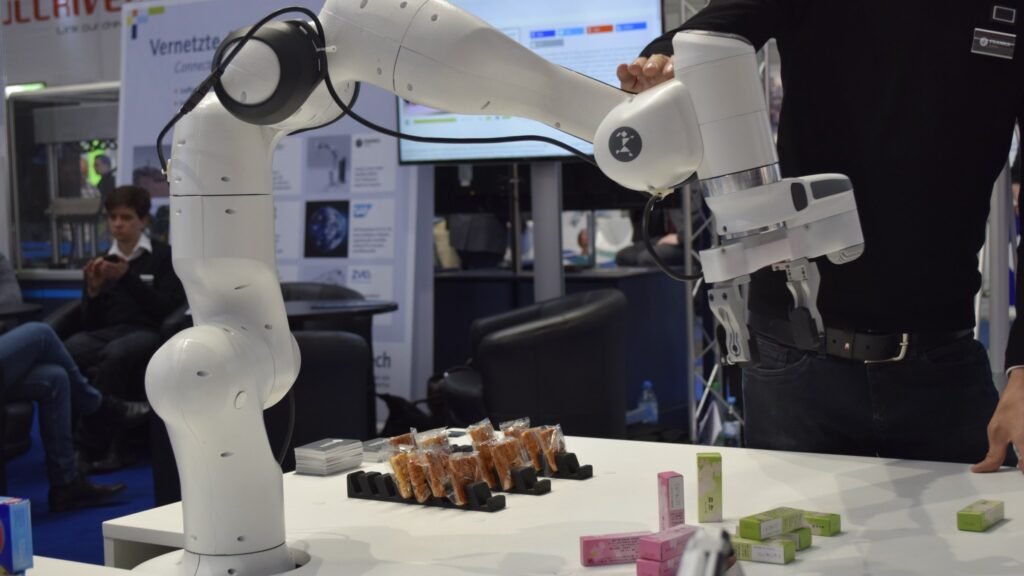
Lead image: A Franka Emika collaborative arm, an earlier model than the Franka FR3 used in Runway’s tests, photographed March 23, 2017, at a trade show. It is not from Runway’s lab and does not show Praxis-1 in control. Photo by Ims via Wikimedia Commons, CC BY-SA 4.0. Cropped and resized for this post.