





The Federal Communications Commission on Wednesday authorized SpaceX to put up to 1 million “Starmind” satellites into orbit as data centers, the first such license in US history, the agency said in a press release. The 14-page order, signed by Space Bureau chief Courtney Reinhard, also denied petitions from Amazon’s Kuiper Systems (Amazon Leo), Viasat and the American Astronomical Society.
Read the grant line by line and the thing the FCC actually licensed is a radio. The authorization covers Ka-band frequencies for “backup and emergency” telemetry, tracking and command, used only if Starmind’s laser links fail. The FCC regulates radio, so that thin slice of spectrum is its legal hook for the whole constellation. Almost everything else the critics raised, the agency said, is outside its job.
Key points
- The FCC granted SpaceX partial authority for up to 1 million Starmind data-center satellites; the license itself covers backup Ka-band radio, with lasers doing the real work, per the Space Bureau order.
- SpaceX must have one satellite working by Nov. 25, 2033, 100,000 by 2035, 500,000 by 2038 and all 1 million by Nov. 25, 2040, or the license lapses.
- The FCC waived the surety bond and processing-round rules, and deferred SpaceX’s request to send retired satellites from above 600 km to “heliocentric” or other disposal orbits instead of burning them up.
- The order calls environmental, optical-astronomy and feasibility objections outside FCC authority; the AAS said it was “disheartened and dismayed.”
What the FCC actually approved
SpaceX filed the application in January and the Space Bureau put it on public notice Feb. 4, 2026, according to the order. Starmind satellites would sit in six shells between 500 and 1,002 kilometers up, some at 30-degree inclinations and some in sun-synchronous orbits, where SpaceX says the satellites “capture continuous solar power.” Each one, its Starmind page says, “beams back data via high-bandwidth lasers to the Starlink constellation.”
Because the main links are optical, the radio part is small. SpaceX told the FCC it doesn’t plan to use the Ka-band frequencies (18.8 to 19.3 GHz down, 28.6 to 29.1 GHz up) except for “limited emergency operations.” The bureau granted, on its own motion, a waiver of the US frequency table so those bands can carry standalone command links. It did so even though the full Commission is still asking, in a pending rulemaking, whether its rules already allow that.
The conditions are real but narrow. SpaceX gets no interference protection in those bands and must shut off any transmission that causes documented harmful interference. It must finish coordinating with federal agencies, and notify the FCC and the NTIA, before using the downlink band. It must also file reports every Jan. 1 and July 1 counting close-approach events, satellites pulled from service, reentries, total satellites deployed and how many used the backup radio.
No bond, no processing round, a 14-year runway
The order grants three waivers that usually act as guardrails against companies sitting on spectrum and orbits. SpaceX doesn’t have to post a surety bond. It skips the processing round, the step that normally invites competing applications for the same spectrum. And instead of the old part 25 milestones, it gets the deployment schedule the FCC adopted in its July 2026 “Space Modernization” order.
SpaceX first asked to skip milestones altogether, the order says, then withdrew that request in an Oct. 19 letter. The bureau noted that commenters argued the combination of waivers “eliminates all regulatory guardrails on an untested technology,” and answered that it has waived the same rules for other new technologies, citing grants to Reflect Orbital, Impulse Space and Muon Space.
| Deadline | What SpaceX must have deployed and operating | Pace implied (our math) |
|---|---|---|
| Nov. 25, 2033 | 1 satellite | — |
| Nov. 25, 2035 | 100,000 (10%) | — |
| Nov. 25, 2038 | 500,000 (50%) | About 365 a day for three years |
| Nov. 25, 2040 | 1,000,000 (100%) | About 685 a day for two years |
For scale, SpaceX runs nearly 11,200 Starlink satellites today, Spaceflight Now reported, citing astronomer Jonathan McDowell’s tracking. Ars Technica calculated that a full Starmind fleet would increase the number of satellites in orbit roughly 50-fold. The license term is 15 years, and its clock doesn’t start until SpaceX certifies its first Starmind satellite is in orbit.
The debris plan only covers the low orbits
This is the biggest asterisk in the order. The FCC found that SpaceX’s debris mitigation plan complies with its rules for Starmind satellites operating below 600 km. Above that line, SpaceX wants “flexibility to dispose satellites operating above 600 km altitude into Earth disposal orbits or heliocentric orbits,” meaning parking orbits around Earth or orbits around the Sun instead of reentry. The bureau deferred that waiver because SpaceX “has not provided sufficient information.” SpaceX has to file a modification before launching any satellite that won’t be disposed of by reentry.
| Nominal shell | Inclination | Debris plan status |
|---|---|---|
| 550–568 km | 26–32° | Below 600 km: plan accepted |
| 565–585 km | 97.7° (sun-synchronous) | Below 600 km: plan accepted |
| 686–718 km | 30° | Above 600 km: needs modification |
| 707–744 km | 97.2° (sun-synchronous) | Above 600 km: needs modification |
| 946–978 km | 30° | Above 600 km: needs modification |
| 967–1,002 km | 99.4° (sun-synchronous) | Above 600 km: needs modification |
So four of the six shells are on hold for now. SpaceX’s Michael Nicholls previewed the idea at the International Astronautical Congress in October, Spaceflight Now reported: “it may make sense that for Starmind we may not want to re-enter satellites into the Earth’s atmosphere.” He called it “new conops that we have not had to design for in the past,” using industry shorthand for concept of operations.
For satellites that do come down, SpaceX committed in an Oct. 7 letter that each one “fully demises during reentry,” and that it will steer reentries over the ocean, the order says. SpaceX also says it will test satellites low before raising them. Those are company commitments, and the FCC accepted them as stated.
What the FCC said it couldn’t look at
The order spends its last pages ruling things out. Citing an October 2026 order on the National Environmental Policy Act, the bureau said satellite operations are “extraterritorial” and don’t trigger environmental review. Launch emissions belong to the FAA, it said. Pollution from satellites burning up on reentry is “speculative and not supported in the record.”
On astronomy, the bureau said SpaceX’s promise to coordinate with the National Science Foundation was enough and declined to add conditions. The AAS had argued that waste heat from 1 million data centers would brighten the infrared sky. The order called that a “non-spectrum related” impact outside the scope of review. Comments doubting that orbital data centers work at all got the bluntest answer: the FCC won’t “substitute the government’s judgment regarding the viability of business endeavors for that of the applicant.”
The AAS said the license lacks “formal coordination requirements” and that it is “gravely concerned about the future of federally funded astronomical research.” Ars counted about 1,500 public comments on the application. Earthjustice senior attorney Jan Hasselman criticized the holiday-week timing and the lack of environmental review, CNBC reported. Amazon had told the FCC in March that it would take SpaceX “centuries” to build the system, per CNBC; Amazon declined to comment Wednesday.
The satellite keeps getting bigger
SpaceX’s pitch has grown since June. In a video before its IPO, SpaceX described AI1, the first Starmind design, as a 150 kW peak, 120 kW average machine with a 70-meter wingspan, according to DatacenterDynamics and Tom’s Hardware. The Starmind page now lists more.
| AI1 spec | June 2026 reveal | SpaceX page, Nov. 25 |
|---|---|---|
| Compute payload | 150 kW peak / 120 kW average | 250 kW peak / 175 kW average |
| Wingspan | 70 m | 75 m |
| Deployed height | 20 m | 30 m |
| “Vehicle efficiency” | 70 kW per ton | 75 kW per ton |
Nvidia said in August that the first-generation Starmind satellite will be based on an optimized Vera Rubin NVL72 rack-scale system. Starmind is effectively one AI server rack per satellite, wrapped in solar panels and radiators.
Our math: 1 million satellites at SpaceX’s 175 kW average works out to about 175 gigawatts of compute. The International Energy Agency estimates the world’s data centers used about 415 terawatt-hours in 2024, an average draw near 47 GW. That would make a full Starmind fleet nearly four times every data center on Earth in 2024. That figure is SpaceX’s spec times SpaceX’s satellite count, not a forecast.
Mass is the other wall. If “75 kW per ton” means average compute per metric ton of satellite (SpaceX doesn’t say), each AI1 weighs roughly 2.3 tons, and the fleet about 2.3 million tons. Starship is designed to carry “100+” tons to orbit, SpaceX says. At 100 tons a flight, that’s on the order of 23,000 full Starship launches. That’s our rough estimate, and it ignores the fact that a 75-meter satellite may run out of volume before it runs out of mass.
When the first one flies
Elon Musk said at a Baron Capital event that he expects the first Starmind launch in the third quarter of 2027, with “significant volume probably in ’28 and then very large volume in ’29,” Spaceflight Now reported. SpaceX says its Bastrop, Texas, “Gigasat Factory” could start producing “thousands of AI satellites” as soon as late 2027. Starship, the rocket meant to carry them, has made two orbital flights and deployed 52 Starlink V3 satellites, according to Spaceflight Now. We covered SpaceX catching a Starship coming home from orbit this month.
SpaceX isn’t alone. Google is testing chips in orbit through Project Suncatcher (our October story), and Blue Origin asked the FCC in March for up to 51,600 satellites for “Project Sunrise,” per CNBC. The FCC press release says it is “continuing to review additional orbital data center proposals.”
Our read
The FCC granted the most permissive version of this license it could. That isn’t the same as an endorsement of the engineering. The agency never says orbital data centers will work. It says that question isn’t its business, and the press release still promises the project brings humanity “closer to a Kardashev II civilization.” A 2040 deadline, no bond, and a 2033 date for the first satellite give SpaceX room to try and walk away cheaply if it can’t. Carr has said Amazon is falling short of its own deployment milestone, per CNBC, and a ULA failure cost it 40 Leo satellites this month. That weakens its standing to complain.
The catch
- 1 million may be a ceiling. The BBC noted it’s unclear whether SpaceX will launch that many or asked for more than it will use, and AP reported that scientists are skeptical.
- It’s a license, not a launch. No Starmind satellite exists in orbit. Every capability figure here is a SpaceX spec or a Musk forecast.
- Four of six shells are blocked. Anything above 600 km waits on a debris-disposal plan the FCC said was incomplete.
- Nobody else reviewed the big questions. The FCC sent launch impacts to the FAA and called reentry pollution speculative. The order points to no other agency review of what 1 million reentries would do.
- The paperwork is sloppy in places. The order gives the filing date as Jan. 30 in one footnote and Jan. 20 in another. Small, but it’s a 14-page document licensing 1 million satellites.
The takeaway
The FCC just made 1 million the new ceiling for a single constellation. What to watch: whether SpaceX accepts the conditions (it has 30 days, until about Dec. 25), its modification filing for the shells above 600 km, any petitions for reconsideration from the AAS, Amazon or Earthjustice, the first Starmind launch Musk wants in Q3 2027, and how fast the FCC rules on the other orbital data center applications.
Last checked: Nov 25, 2026, 8:00 p.m. PST. SpaceX had not commented beyond Musk’s post on X thanking Carr.
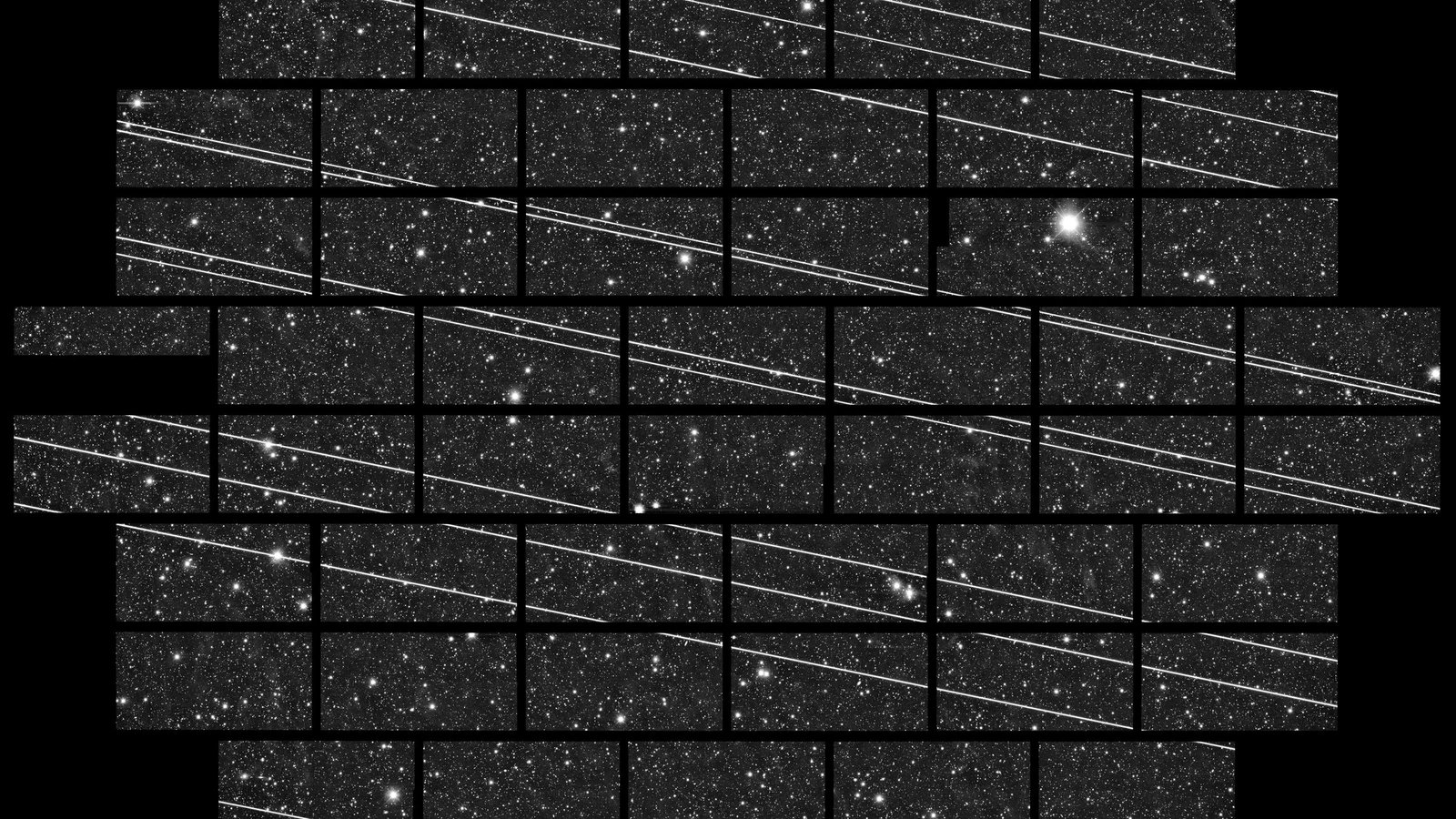
Lead image: Starlink Satellites Imaged from CTIO (Nov. 2019, Starlink satellites, not Starmind), by NSF’s NOIRLab/CTIO/AURA/DELVE, CC BY 4.0, via Wikimedia Commons, cropped to 16:9.
Hype in. Signal out.


