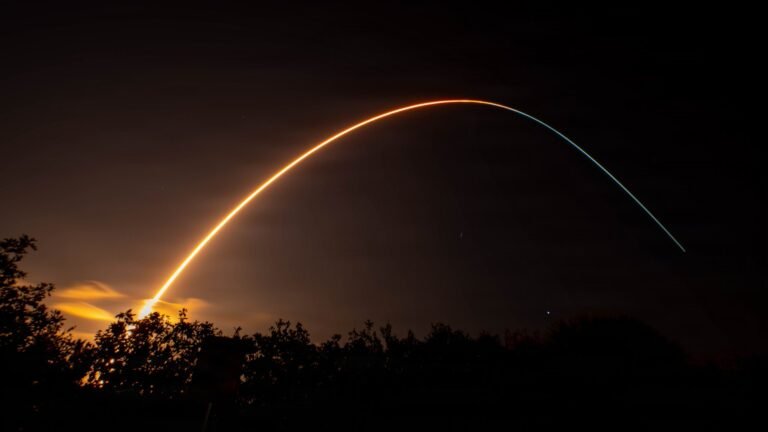






SpaceX caught a Starship upper stage with its launch tower for the first time on Saturday, after the vehicle spent about 22.5 hours in orbit. Ship 42 dropped through the clouds over Starbase, Texas, lit its engines, flipped upright and settled into the tower’s mechanical “chopstick” arms at about 4:20 p.m. ET (1:20 p.m. PT), Space.com reported. The other half of the plan didn’t make it: on Friday the Super Heavy booster aborted its own catch, diverted over the Gulf, and its flight termination system fired, according to SpaceX’s Flight 15 recap.
Last checked: Nov 14, 2026
Key points
- SpaceX caught Ship 42 with the arms of its Pad 2 tower at Starbase on Nov. 14 after about 22.5 hours in orbit, the first catch of a Starship upper stage.
- Friday’s Super Heavy booster aborted its own catch after its boostback burn ended early on a low fuel mass alarm, and its flight termination system fired over the Gulf.
- SpaceX said the ship’s route home had to cross inhabited parts of northern Mexico and southern Texas, a first for a returning Starship.
- Elon Musk has said the next milestone is reflying both stages, but SpaceX hasn’t said what condition Ship 42 is in after the catch.

How the catch went
Flight 15 lifted off from Pad 2 at Starbase on Friday, Nov. 13, at 5:47 p.m. ET, carrying 26 Starlink V3 satellites. Ship 42 reached orbit, deployed all 26 by about 1 hour 17 minutes into the flight, and then coasted for most of a day while flight controllers worked through three planned “early return” checks that could have sent it to a Pacific splashdown instead. It passed all three, the last at about 20 hours 41 minutes, per SpaceX’s flight timeline.
SpaceX says the ship then relit a single Raptor sea-level engine for a deorbit burn (Space.com clocked it at about 10 seconds, at roughly 3:23 p.m. ET), reentered, flew back toward the Texas coast and made “a final swoosh maneuver out over the Gulf.” Over the pad, three Raptors ignited for the landing flip, the ship stepped down to two engines and then one, and “Mechazilla’s waiting arms” closed on it. CNBC reports the ship circled Earth 14 times before coming home.
SpaceX’s Nov. 7 explainer spells out the mechanics: the arms close “rapidly” on two catch fittings just below the ship’s forward flaps, and once the ship registers contact, it shuts down its last engine. Its official account posted on X: “Mechazilla catches Starship!”
“That was the missing link,” SpaceX spokesperson Dan Huot said on the company’s webcast, as quoted by Space.com. “That was the holy grail of spaceflight, plummeting through fire to be snatched out of the air by steel. We caught a Starship, and now everything changes.” The webcast played “Baby Come Back” over the landing. Subtle, it was not.
Why the top half is the hard half
SpaceX has caught Super Heavy boosters on three earlier flights, starting with Flight 5 in October 2024. Boosters are a different problem. They separate a couple of minutes after liftoff, turn around, and fly back to a pad a short distance away. A ship that has been in orbit is coming back from orbital speed and has to survive the heat of reentry with its tiled heat shield intact enough to be worth flying again.
Until Saturday, every Starship upper stage ended its flight in the ocean. On Flight 14 on Sept. 28, the first Starship to reach orbit splashed down north of Hawaii and, as Spaceflight Now noted, tipped over and exploded as ocean-landed ships usually do. That flight was also cut to about three hours instead of the planned 10; SpaceX said it limited time in orbit “out of an abundance of caution” after an engine shut down early on ascent.
For Flight 15, SpaceX leaned on the satellites themselves for the go/no-go. Three of the 26 Starlinks were modified to photograph the ship’s heat shield after deployment, the company said in its explainer. Huot said during the flight that the heat shield team reviewed imagery from those satellites and from long-range ground cameras and “confirmed the heat shield is in a good posture for a reentry and return to the launch site,” per Space.com’s live coverage. The ship’s inspection camera is now one of its own payloads. That’s either elegant or a little dystopian, depending on how you feel about satellites taking selfies.
Meanwhile, the booster
The headline SpaceX wanted was a double catch: Booster 22 back in the tower about 6.5 minutes after launch, Ship 42 a day later. Booster 22 was the first Super Heavy of the newer V3 design to attempt a catch, Space.com reported. (Space.com says SpaceX previously recovered three V1 boosters and reflew two of them.)
SpaceX’s recap says the booster relit 32 of its 33 planned Raptors for the boostback burn, the maneuver that sends it back toward the pad, but the burn “ended early due to low fuel mass, with the root cause under investigation.” The booster’s guidance, navigation and control system then triggered an automated abort and steered it to an offshore landing spot. It hovered over the Gulf on its landing burn, cut its engines, and its flight termination system, the built-in self-destruct, fired.
SpaceX’s explanation shifted overnight. Huot first attributed the abort to a guidance (GNC) issue. On Saturday he walked that back: “I did a disservice to our booster GNC guys last night,” he said, adding that GNC “detected that the booster was not in the place that it was supposed to be” and aborted as designed, Space.com reported. SpaceX’s Kate Tice later pointed to “a low fuel mass alarm.” That’s consistent with the recap. What caused the low fuel reading is the open question.
Our read: the abort logic did its job, and that matters more than it sounds. A booster that decides on its own that it’s in the wrong place, and leaves, is exactly what you want before anyone lets a rocket booster fly at a tower full of expensive hardware. But a V3 Super Heavy still hasn’t been caught, and that’s half of the reuse story.
The first trip home over land
Saturday was also the first time a Starship upper stage was routed home over populated ground. In its Nov. 7 update, SpaceX said reaching Starbase requires a trajectory “over inhabited areas in northern Mexico and southern Texas,” and that controllers could end a bad reentry early by “intentionally tumbling Starship to ensure that it breaks up in the atmosphere before reaching land,” with a late option to divert into the Gulf. The company pointed out that Space Shuttles, Dragon capsules, Soyuz and Shenzhou have all reentered over land, and warned Cameron County residents they might hear sonic booms.
The FAA approval for the flight came on Friday afternoon, Space.com reported, “pretty late in the game.” It landed on a strange day for American airspace: the same afternoon, the FAA had a nationwide ground stop under way over a telecom failure. Then, at 1:55 p.m. Hawaii time on Friday, the Hawaii Department of Transportation said all West Coast flights had been halted “due to debris from SpaceX launch,” Hawaii News Now reported. Both orders were later lifted. That pause landed on travelers already stuck in the ground stop, which is a reminder that rocket debris rules have a real cost for people who never bought a launch ticket.
What “full reuse” does and doesn’t mean yet
Elon Musk set the stakes in October: “If we do so, that’ll be the first time that there’s been full recovery of an orbital class rocket,” he said of the ship catch, according to Teslarati. Flight 15 didn’t deliver that, because the booster was lost. What it did deliver is the first tower catch of a rocket’s upper stage returning from orbit.
Some precedent is worth keeping straight. The Space Shuttle orbiter came back from orbit and flew again for 30 years, but the external tank was thrown away on every flight. Falcon 9 has landed its first stages since 2015 and first reflew one in March 2017, but its upper stages are expended. Starship is meant to be the first system where both stages come back to the pad, get checked, and fly again. Saturday proved one of those stages can get back to the pad.
Catching isn’t reusing. Ship 42 now has to be inspected, and SpaceX hasn’t said what condition it’s in. CNBC reports Musk posted a video on X inspecting the vehicle after the catch. Musk has said “the next big milestone would be to refly both the booster and the ship.” But NASASpaceflight reported in October that Flight 16 currently looks set to use new vehicles, Booster 23 and Ship 43, targeting December and possibly the first Starship launch from Florida’s Launch Complex 39A. So the first reflight of a caught ship may not come next.
The economic claims are still claims. According to Teslarati’s reading of SpaceX’s IPO filing, Starship V3 is designed to carry 100 metric tons to orbit fully reusable, SpaceX aims to cut the cost of reaching orbit by 99% or more, and tower catches should allow “multiple launches per day.” SpaceX has also said one Starship can carry up to 60 Starlink V3 satellites, per CNBC; Flights 14 and 15 carried 26 each. None of that is demonstrated by a single catch. It does depend on many more of them.
Timeline: from first booster catch to first ship catch
- April 2023: Starship’s first integrated flight test, as SpaceX counts it.
- Oct. 13, 2024: Flight 5, first Super Heavy booster caught by the tower arms (the booster in our photo above).
- Sept. 28, 2026: Flight 14 puts Starship in orbit for the first time and deploys 26 Starlink V3s; the ship splashes down north of Hawaii after about three hours.
- Nov. 13, 2026: Flight 15 launches; the first V3 booster catch attempt ends in an abort and a Gulf flight termination.
- Nov. 14, 2026: Ship 42 is caught by the Pad 2 tower after about 22.5 hours and 14 orbits.
That’s about 25 months between the first booster catch and the first ship catch, and seven weeks between the first orbital flight and the first orbital return to the pad. The second gap is the one that shows how fast this phase is moving.
Why NASA cares
NASA’s plan to land astronauts on the Moon runs through a lunar version of Starship, which we covered in October. That lander has to be refueled in orbit by a series of tanker flights (NASA’s inspector general has described more than 10, Teslarati notes), which only works at a sane pace if ships and boosters come back and fly again quickly. SpaceX says it has transferred about five metric tons of cryogenic propellant between tanks within a single vehicle in space, per a 2025 update. A full ship-to-ship transfer hasn’t been attempted. A caught ship is a prerequisite for that schedule, not a substitute for it.
What to watch next
- The booster’s low-fuel root cause. SpaceX says the boostback burn ended early on a low fuel mass alarm and is investigating. Watch whether it was a real propellant shortfall, a sensor problem or an engine issue (one of 33 engines didn’t relight), and whether the FAA treats the Gulf termination as a mishap.
- Ship 42’s condition. The real test of a reusable upper stage is how many heat shield tiles, flaps and engines need work after the catch. SpaceX hasn’t published that yet.
- Who flies Flight 16. If SpaceX reflies Ship 42 or a recovered booster soon, that’s the milestone Musk promised. If Flight 16 uses Booster 23 and Ship 43 out of Florida, the reflight milestone slides.
- Repeatability over land. One clean return over Mexico and Texas is a start. Watch for reports of sonic booms around Cameron County and how quickly the FAA clears the next return-to-launch-site profile.
Starship spent 22 and a half hours in space and ended the day hanging from a tower like a very expensive coat. The booster that launched it is in pieces in the Gulf. Both facts are the story, and only one of them made the webcast’s soundtrack.
Hype in. Signal out.
Image credit: Super Heavy booster returning to the Starbase launch tower during Starship Flight 5, Oct. 13, 2024 (not Flight 15). Photo: Steve Jurvetson, via Wikimedia Commons, licensed CC BY 2.0; cropped to 16:9.