





Amazon’s Ring on Tuesday launched a new line it calls Ring Robotics: a flying indoor security camera for homes and a wheeled patrol robot for businesses. In Ring’s announcement, the company lists the Ring Drone Cam at $249.99, with U.S. shipments starting Jan. 27, 2027, and the Ring Rover Cam at $999.99, with shipments starting Dec. 16, 2026. The same post says the drone “has not been authorized as required by the rules of the Federal Communications Commission” and “is not, and may not be, offered for sale or lease, or sold or leased, until authorization is obtained.”
That is a real product announcement, not another hiring leak. It is also a pair of machines that still have to clear a regulator, a subscription, and the long shadow of Amazon’s last home robot, Astro.
Key points
- Ring announced Ring Robotics on Nov. 10, 2026, listing the Ring Drone Cam, an indoor flying camera, at $249.99 with a company-stated U.S. ship date of Jan. 27, 2027, and the Ring Rover Cam, a business security robot, at $999.99 with a company-stated ship date of Dec. 16, 2026.
- Amazon’s announcement says the Drone Cam has not been authorized by the FCC and may not be offered for sale until that authorization is obtained.
- Ring says both devices use a navigation system it calls AI Pilot, and its product pages say a compatible Ring subscription is required for scheduled patrols. Official Ring Protect plans start at $4.99 a month or $49.99 a year for one device.
- Ring describes the Rover Cam as a purpose-built security robot inspired by feedback from Amazon Astro customers. The Verge notes Amazon previously sold Astro for Business at $2,349.99 and discontinued it about a year later.
Last checked: Nov 10, 2026
What Ring actually announced
Ring, the Amazon-owned maker of video doorbells, says Ring Robotics is a new category of “autonomous, mobile security” — devices that patrol, investigate and respond, instead of sitting on a wall. Both machines are controlled from the Ring app and are designed to work with the cameras, doorbells, sensors and alarms the company already sells, according to the About Amazon post.
Both are powered by what Ring calls AI Pilot, which it describes as a custom system that uses the devices’ cameras, “specialized vision models, on-device sensors, and cloud processing” to map a space, suggest patrol points and navigate around obstacles.
Jamie Siminoff, Ring’s founder and chief inventor, is quoted in the announcement: “For years, customers told us they wanted eyes in the places a fixed camera couldn’t reach, and peace of mind in the spots they’d never want one.” The honest answer, he said, “wasn’t more cameras.” CNBC’s Annie Palmer, who attended a New York demo on Monday, reported that he also framed the drone as a deterrent: if a motion alert is followed by spotlights and “something flying across the window,” he told CNBC, “You’re probably not going to go into that house.”
The indoor drone, and the limits Ring put on it
The Ring Drone Cam product page lists the flying camera at $249.99. Official specs say it records 2K video at 1920×1920, with a 148-degree field of view horizontally and vertically, and can rotate 360 degrees. It uses dual-band Wi-Fi, is listed in gray, and is rated for indoor use only between 41°F and 95°F (5°C to 35°C).

Flight time is “up to 8 minutes per flight,” Ring says, tested “with a new, fully-charged battery under controlled conditions.” Actual time “will vary based on environment, usage, and battery condition.” When the flight ends or the battery runs low, the drone is supposed to return to its dock. WIRED reported flight times of five to eight minutes and put the drone’s weight at 165 grams, a figure that does not appear on the official specs sheet we reviewed.
Several things the drone does not do matter as much as the things it does. Ring’s own FAQ says it has no microphone or speaker, so it does not record audio or support two-way talk. It has no siren. It does not use infrared night vision; it relies on LED spotlights in the dark. And it “only records while it’s flying.” When it is in the dock, Ring says, the camera is off. You do not fly it like a toy drone: Ring says it is controlled from the app, by sending it to a room, a saved viewpoint, a point on the map, or a patrol route. Scheduled patrols require a compatible subscription.
WIRED reported that users cannot manually pilot it, that its navigation intelligence “sits entirely in the cloud,” and that it can land on its own if it loses its internet connection. Those last details are WIRED’s reporting from Ring, not claims on the public specs sheet. Amazon’s announcement says the Drone Cam has not been authorized by the FCC and may not be sold until it is. CNBC reported that Siminoff said the drone cannot fly outside, citing FAA rules, and that Ring has “put guardrails in there to make it so it doesn’t fly outside.” WIRED reported that, because it is indoor-only and well under the 250-gram FAA registration threshold, it does not need to be registered, and that Siminoff said it is assembled in Texas.
This is not Ring’s first try: WIRED reported that Siminoff had the idea in 2016 and that Ring previewed an indoor drone, the Always Home Cam, in 2020 and nearly launched it last year, then moved most of the intelligence into the cloud.
The Rover Cam is Astro, rebuilt as a guard
The Ring Rover Cam product page lists the business robot at $999.99 and marks it as a preorder, with U.S. shipments starting Dec. 16, 2026, according to the announcement. Official specs put the robot at 16.7 by 9.8 by 17.3 inches and 20.6 pounds. Video is “up to 4K,” with a 152-degree diagonal field of view, person detection, two-way talk, a remote-activated siren, infrared night vision and dual-band Wi-Fi. Ring says the battery “charges in approximately 45 minutes” on the included charger.
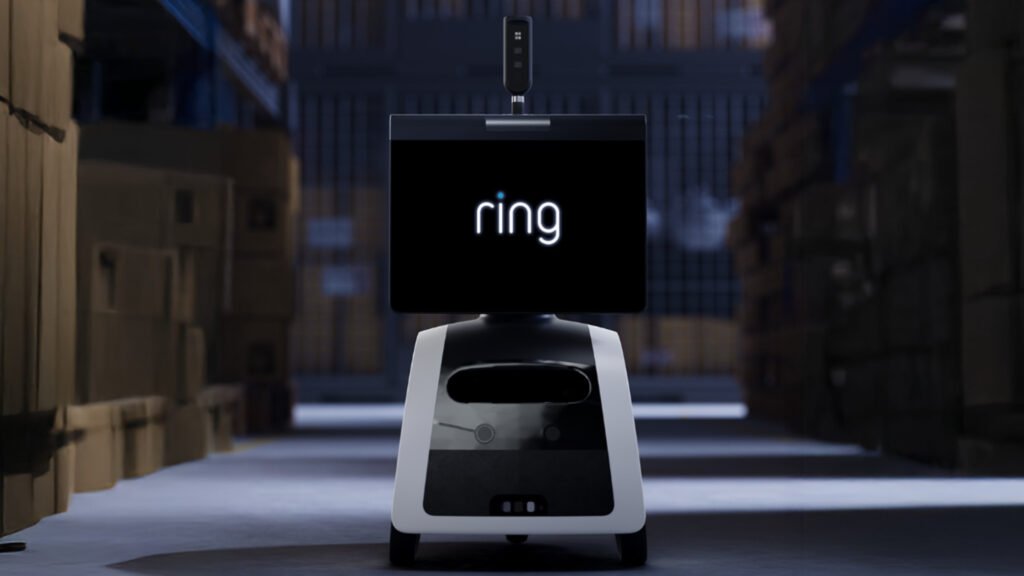
Ring says the rover can “cover up to 5,000 sq ft” and is for “indoor use only and single floor spaces,” and that it is “not suitable for use around children under 3 years of age or small pets.” It does not record 24/7: Ring says it records when it detects people while docked, and anytime it is moving. Scheduled patrols require a compatible subscription. The Verge and WIRED both reported battery life of about 30 minutes; that figure is not on the public specs sheet we reviewed, so treat it as press reporting, not a published official rating.
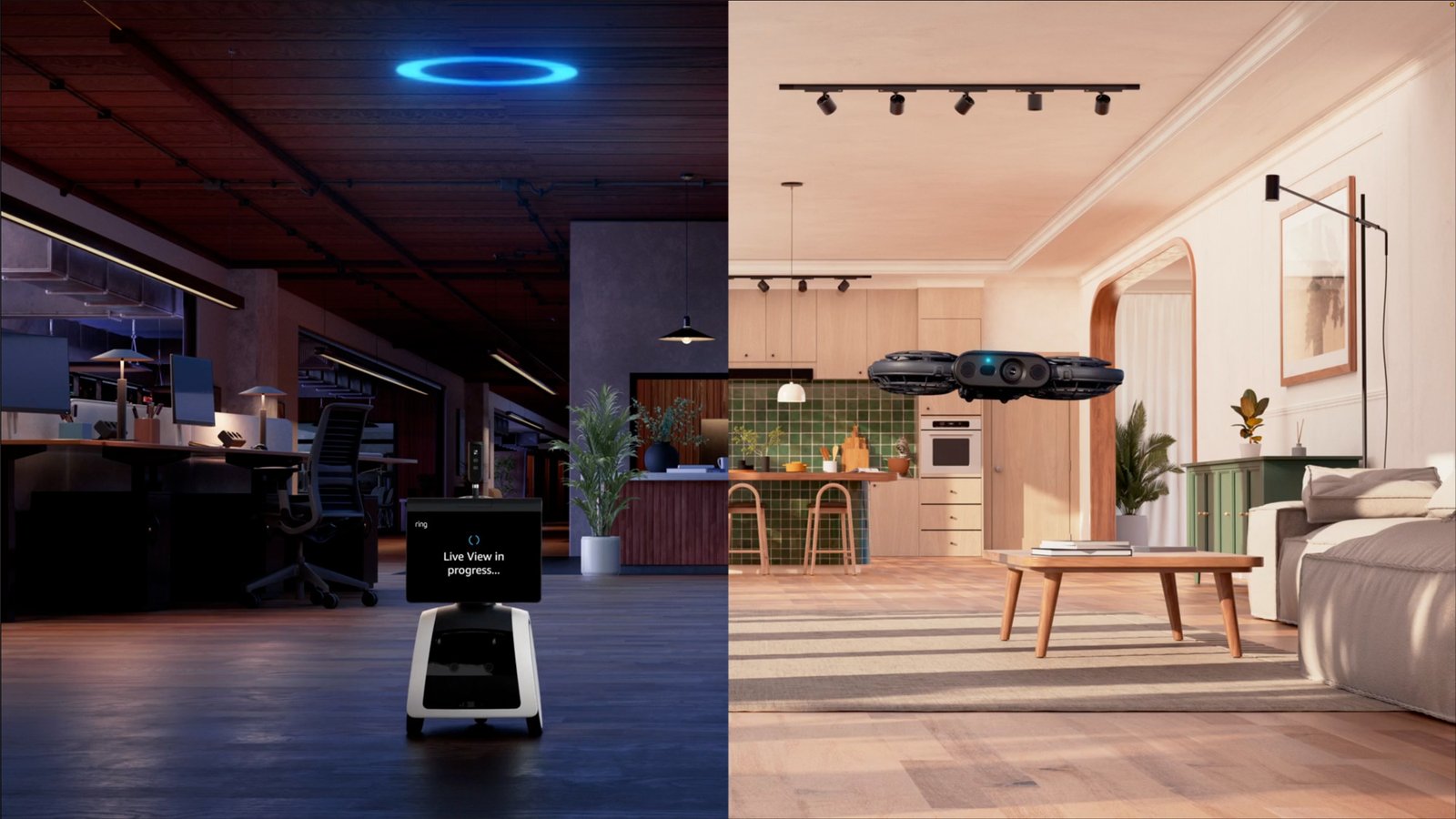
The resemblance to Amazon’s earlier home robot is not a coincidence. Ring says the rover “was originally inspired by feedback from Amazon Astro customers who said the feature they loved most was roving security,” and that the team “leveraged the best of Astro” to build “a purpose-built security robot.” The Verge describes a two-wheeled base, an upgraded 4K periscope camera, and a stubby tower — in place of Astro’s cupholder — with a siren, a flashing red light, and a blue ring projected onto the ceiling so the robot is easier to spot in a warehouse. That halo is visible in Ring’s own press photo. There is no Alexa on the rover, The Verge noted; the screen shows status messages, including when it is recording.
We covered Amazon’s latest home-robot hiring push on Nov. 8, including Astro’s afterlife. The consumer version never left invite-only sales. Amazon later sold Astro for Business at $2,349.99, The Verge reported, then discontinued it; as The Verge reported in 2024, those robots stopped working on Sept. 25, 2024, with refunds and a $300 credit. The new rover is less than half that launch price. Buyers still have to decide whether “purpose-built” is enough to trust a company that has already bricked a security robot once.
Privacy is the default, with an asterisk
Ring says “privacy is the default.” The drone, according to the announcement, powers down in its dock with the camera off until a flight is triggered. The rover has a Sleep Mode that retracts the periscope and turns off the microphone. Both have LED indicators when they are recording, and Ring says the drone’s propellers “aren’t quiet” and the rover’s light tower is “bright and easy to spot.” WIRED reported that the loud buzz is also a hedge against someone hijacking the drone to snoop: you would hear it.
Video from both devices, Ring says, will be protected by Throw Away the Key encryption, or TAKE, which the company calls its “strongest default encryption yet.” WIRED’s account is more specific than the launch post: TAKE encrypts video in transit and rotates keys every few minutes, but “Ring temporarily holds the key to run cloud-based AI features before deleting its copy.” That brief server-side window, WIRED noted, “makes it less foolproof than true end-to-end encryption.” Ring also requires two-factor authentication on every account, according to WIRED.
The privacy argument does not start from a blank slate. WIRED reported that Ring “has even handed Ring videos to cops without warrants,” and quoted Thorin Klosowski of the Electronic Frontier Foundation saying people should “think through” how a device like the Drone Cam will make others in the home — or visitors — feel. CNBC noted that earlier this year Ring canceled an integration with Flock Safety, a cancellation Ring posted on its press page dated Feb. 12, 2026.
The sticker price is not the whole bill
Ring lists the Drone Cam at $249.99 and the Rover Cam at $999.99. The announcement’s starred features, and both product pages, say a compatible Ring Protect plan is required for scheduled patrols and for storing and replaying recorded video. On Ring’s official plans page, Ring Protect Solo is $4.99 a month or $49.99 a year for one device, and Ring Protect Multi is $9.99 a month or $99.99 a year for all devices at one location. A free 30-day trial starts when you set up a new device, Ring says, unless a plan is already on that location. Higher-tier plans add professional monitoring.
Ring’s own FAQ is clear that a plan is not required to use the hardware for some features, and equally clear that video history and scheduled patrols sit behind a subscription.
The Rover Cam can be preordered on Ring’s product page. The Drone Cam is listed on its own product page, but Amazon’s announcement still says it cannot be sold until the FCC authorizes it. We could not independently verify Amazon.com product listings or ASINs for either new machine today, so we are not publishing Amazon buy links for them. Existing Ring cameras and doorbells, which the new robots are designed to work with in the same app, are sold on Amazon: Ring Video Doorbell, Ring Indoor Cam and Ring Pan-Tilt Indoor Cam 2K.
Why it matters, and the catch
The pitch is simple: one moving camera instead of a camera in every room. A lot of people will accept a doorbell camera who will not accept a lens over the crib or the dinner table. A drone that lives in a dock and only flies when something trips is Ring’s answer to that discomfort. The catch is that the uncomfortable part may just have been moved into the air, and into Amazon’s cloud.
Three open questions sit under the launch. First, the Drone Cam is not legally for sale until the FCC says it is, whatever date is on the product page. Second, both machines depend on Wi-Fi, a subscription for the features that make them “autonomous” on a schedule, and, according to WIRED, cloud software to decide where to go. A robot that has to call home to think is only as reliable as the network. Third, Amazon has already built a rolling security robot, sold it to businesses, and then shut it off. The Rover Cam is cheaper and more focused. It is also a request that customers try that idea again.
What to watch
- FCC authorization for the Drone Cam, without which Ring’s own announcement says the device may not be sold, and whether the Jan. 27, 2027 ship date holds.
- Whether the Rover Cam actually ships on Dec. 16, 2026, and whether Amazon keeps supporting it after sale — the test Astro for Business failed.
- Independent tests of flight time and Wi-Fi dropouts, and a clearer public description of how long Ring holds TAKE encryption keys to run cloud AI features.
Hype in. Signal out.
Image: The lead photo is an official Ring / Amazon press image from the company’s Nov. 10, 2026 Ring Robotics announcement, showing the Ring Rover Cam at left, in an office or warehouse with a blue ceiling locator light, and the Ring Drone Cam at right, flying in a living room. Additional official press photos of each device appear in the story. Source: About Amazon / Ring announcement, used for editorial coverage of that launch.