




Jensen Huang is no longer running Nvidia. The company’s board accepted his resignation on Nov. 11 as president, CEO and director, effective immediately, and announced it Thursday morning, Nov. 12. Chief financial officer Colette Kress is now interim CEO and keeps the CFO job too. Harvey C. Jones, a director since 1993, becomes the board’s first-ever chair. Four days earlier, the same board said it “has confidence in Jensen.” On Tuesday, Kress hosts the quarterly earnings call he would have led.
Key points
- Nvidia’s 8-K says the board accepted Huang’s resignation as president, CEO and board member on Nov. 11, effective immediately, without giving a reason.
- CFO Colette Kress is interim CEO while keeping the finance job, Harvey C. Jones is the first board chair in Nvidia’s history, and the board says it will consider internal and external candidates.
- The exit came three days after the board voiced confidence in Huang, and the same day The New York Times reported a second relationship, with an executive who reported to him.
- Nvidia still plans to report quarterly results on Nov. 17, and lawmakers in both chambers want Huang to answer questions about a woman US officials reportedly believe is a Chinese intelligence asset.
Last checked: Nov 13, 2026
Huang co-founded Nvidia in 1993 and ran it for 33 years, turning a graphics-card company into the supplier nearly every AI lab depends on. He leaves in the middle of a week-old scandal that started as a spy story and ended, at least for his job, as a workplace-conduct story. Here’s what the company has actually put on the record, what it hasn’t, and why the next seven days matter more than the usual post-founder hand-wringing.
What the filing says, and what it leaves out
The Form 8-K is short. On Nov. 11 the board “accepted the resignation of Jen-Hsun Huang” from all three roles, appointed Kress, 59, as interim CEO “while the Board conducts a search,” and named Jones, 73, chair. It is signed by Kress, under a title that now runs to three jobs: interim CEO, executive vice president and CFO.
The press release adds quotes from Jones and Kress, a line that the board “will consider internal and external candidates,” and a promise that “operations, customer commitments and product roadmap” will “continue without interruption.” In a separate statement reported by TechCrunch, the board called Huang’s contributions “profound” and thanked him.
What neither document contains: a reason for the resignation, any finding from the board’s investigation, any separation or severance terms, and any quote from Huang himself. CRN and CNBC both noted the missing Huang quote.
The word “resigned” is also doing some work. The Wall Street Journal reported late on Nov. 11 that the board was preparing to oust Huang, according to TechCrunch. Rep. John Moolenaar, who chairs the House China Select Committee, skipped the euphemism entirely: his statement calls it “Jensen Huang’s firing from the company he founded.” Nvidia hasn’t used that word, and the filing doesn’t say who initiated the exit.
Three days from “confidence” to gone
We covered the start of this on Nov. 9. The speed of what followed is the story, so here is the sequence, with sources:
- Nov. 8: Huang sends staff a memo admitting “I was unfaithful to my wife,” without naming anyone. The board opens an independent investigation into reports that he was “the target of a foreign intelligence effort,” says it has “no reason to believe” any secrets were compromised, and says it “has confidence in Jensen and his leadership team” (CNBC published both in full).
- Nov. 10: President Trump calls Huang and urges him to fight to keep his job, The New York Times reported, per CNBC.
- Nov. 11: The Times reports that Huang also had a relationship with an Nvidia vice president who reported directly to him, citing five employees, TechCrunch reported. The board meets the same day, CNBC reported, and per the 8-K accepts his resignation.
- Nov. 12: Nvidia announces the change Thursday morning. Its shares fall as much as 16% during the day and close down 4.3%, NBC News reported.
Our read: the first allegation, that a customer’s executive was a Chinese intelligence asset, rests on anonymous US officials and is still unproven in public; China calls it a smear. The second is more ordinary and, for a board, much easier to act on. Like many companies, Nvidia has rules discouraging relationships between managers and the people who report to them, the Times noted, according to TechCrunch. We haven’t seen Nvidia confirm that report, and we aren’t naming the executive here.
We have seen this playbook before: Intel, 2018
The closest precedent we know of comes from the same city: Santa Clara. On June 21, 2018, Intel announced that CEO Brian Krzanich had resigned after an investigation “confirmed a violation of Intel’s non-fraternization policy, which applies to all managers,” and named CFO Robert Swan interim CEO, effective immediately. Swan got the job permanently on Jan. 31, 2019, about seven months later.
Side by side, the two announcements differ in ways that matter:
- The reason. Intel named the policy and said an investigation had confirmed the violation. Nvidia gives no reason at all.
- The bench. Intel said its board had “a robust succession planning process in place.” Nvidia’s release makes no such claim. TechCrunch reports there was no heir apparent or succession plan, and that Huang ran an unusually flat company with about 60 direct reports.
- The founder factor. Krzanich was a career Intel manager, not the founder. Huang built Nvidia, was its public face and its most prominent lobbyist in Washington, and is its largest individual shareholder.
- The chair. Intel already had a chairman, Andy Bryant, who spoke for the board. Nvidia had to create the role on the same day.
Why the chair matters: until this week, the person who ran Nvidia also sat on the board that oversaw him, and no one held the title of chair. Jones, a former CEO and executive chairman of chip-design software company Synopsys, now runs the board and, presumably, the CEO search. Huang owns about 3.5% of the shares and has no supervoting stock, TechCrunch notes, so unlike many Silicon Valley founders, he could always be outvoted. This week, he was.
The CFO is now also the CEO, with earnings on Tuesday
Kress has been CFO since September 2013 and spent nearly 25 years in finance roles at companies including Cisco and Microsoft before that, according to the release. She knows the numbers better than anyone, which is useful, because the first test is numbers. Nvidia says it will report third-quarter fiscal 2027 results on Tuesday, Nov. 17, at about 1:20 p.m. PT, with the call at 2 p.m. PT, “as previously scheduled.”
Then on Nov. 18 at 9 a.m. PT, she hosts a company meeting, according to her staff email, published by The Verge. “The Board, Estaff and I recognize that this has been an extraordinarily difficult period,” she wrote. Jones’s email called her “a key architect of NVIDIA’s growth and capital strategy.”
The catch: one person doing both the CEO and CFO jobs is a stopgap, not a structure. A public company’s chief executive and chief financial officer each certify its quarterly reports; for now, at Nvidia, that’s the same person. Our read: that’s a reason the search can’t comfortably drag on as long as Intel’s did.
Why this is bigger than one company
Nvidia doesn’t just sell chips to the AI industry; it helps finance it. As of the end of its second quarter, Nvidia reported $99 billion in investments and a further $25 billion in commitments, plus $36 billion in cloud service commitments, TechCrunch reports. Those are different kinds of money and shouldn’t be added together. They include stakes in OpenAI, Anthropic, CoreWeave and Nebius, all struck on Huang’s watch. On Thursday, CoreWeave fell 7% and Nebius 17%, though Nebius also posted guidance investors didn’t like, NBC News reported.
Then there’s China policy, where Huang was the industry’s loudest voice for looser export rules. JPMorgan analysts wrote that “the risk of more restrictive guidelines on shipments directly or indirectly into China has risen,” per NBC. Moolenaar wants Congress to “pass bipartisan export control legislation in the year-end national defense bill.” And Democrats Sen. Ron Wyden and Rep. Richard Neal have opened an investigation into the administration’s approval of Nvidia AI chip exports to Chinese government-linked companies, CNBC reported.
And there’s the White House. Trump, who called Huang “an honorable guy” last weekend, per NBC, posted on Truth Social that “only one man” could replace him: Apple executive chairman Tim Cook, who stepped down as Apple’s CEO on Sept. 1. “A Legend replaces a Legend!” he wrote, TechCrunch reported. A president naming a preferred CEO for a private company’s board is unusual, and it gives the board one more audience to manage.
What’s still open
The investigation. The board’s Nov. 8 probe was about whether Huang was the target of foreign intelligence and whether anything was compromised. He’s gone, but the security question isn’t, and the board hasn’t said whether the review continues, who’s on it, or whether findings will be published.
Congress. Rep. Brian Mast says Huang has agreed to brief lawmakers on his relationship with the woman at the center of the spy reports and on Nvidia’s security protocols, with timing still being negotiated, NBC News reported. Separately, Senate Banking Committee chairman Tim Scott has asked Huang to testify publicly on Dec. 3, and Commerce Secretary Howard Lutnick on Dec. 10, per CNBC. Huang now appears as a private citizen, not as Nvidia’s CEO, which changes who speaks for the company.
The spy claim itself. As we reported Nov. 9, the core allegation comes from anonymous officials quoted by the Times, the Financial Times and NBC; no US agency has said it publicly, China denies it, and Singapore says it never investigated her. Nothing in Nvidia’s filing changes that.
What to watch next
- Nov. 17 call: does Kress repeat the “without interruption” line with numbers, and does Nvidia give a search timeline or hire a search firm?
- A second 8-K: any separation agreement for Huang, or a change to his equity awards, would normally show up in a filing.
- The board’s findings: whether the foreign-intelligence review is completed, published, or quietly closed now that its subject has left.
- Washington: whether export-control language makes it into the year-end defense bill, and whether Huang’s briefing and the Dec. 3 hearing actually happen.
The company Huang built is not going to stop shipping GPUs this quarter. What it lost is the one person who could sell Nvidia to customers, investors and the White House all at once. Figuring out how many people it takes to replace that is now Harvey Jones’s job.
This story is not investment advice.
Hype in. Signal out.
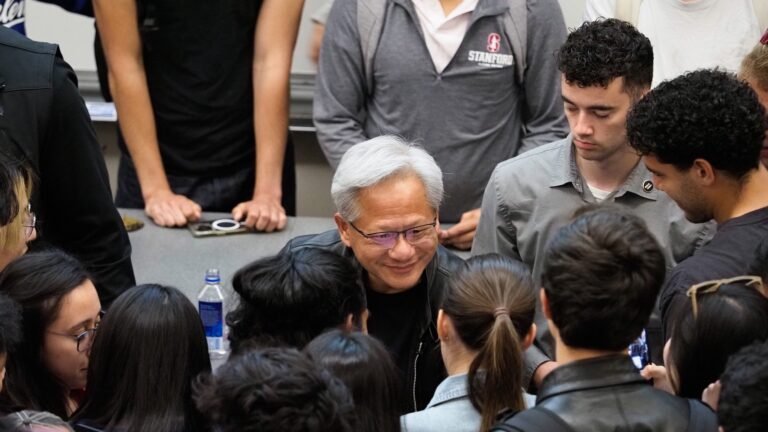
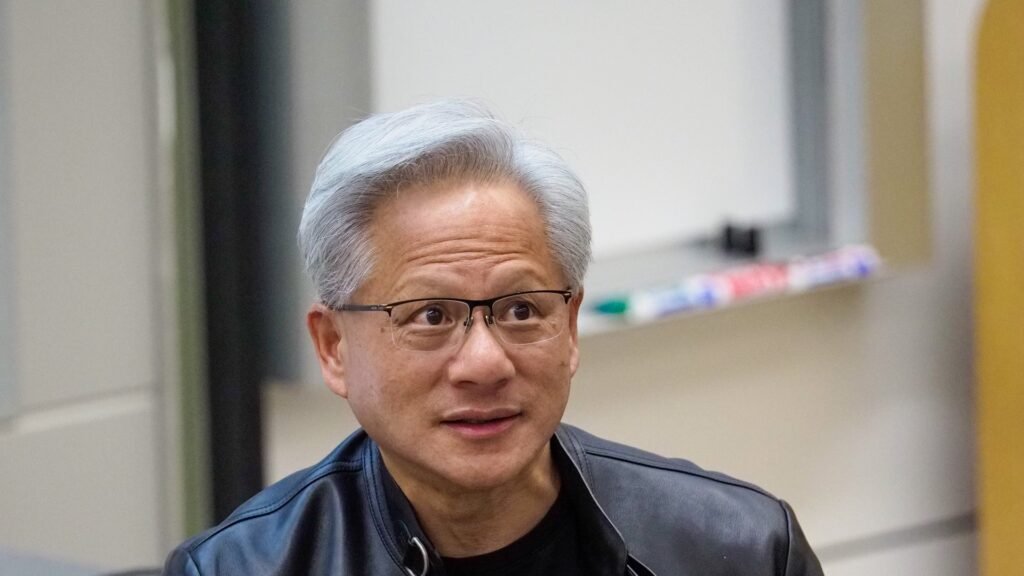
Lead image: Jensen Huang, then Nvidia’s CEO, speaking in Stanford University’s CS 153 course on April 30, 2026. Photo by Anderseidesvik via Wikimedia Commons, CC BY-SA 4.0. Cropped and resized for this post.