


Three days after Jensen Huang resigned as Nvidia’s CEO, an online open letter asking the board to bring him back says it has 163,965 signatures. That’s the figure its own site reported when we checked at 4:44 p.m. PT on Sunday, Nov. 15. Elon Musk says he signed. So did a long list of tech founders, and the site counts 8,070 people who say they work at Nvidia. The catch is printed on the site itself: affiliations are self-reported, and identities, employment and job grades “are not verified.”
Last checked: Nov 15, 2026
Key points
- The “Stand with Jensen” site reported 163,965 signatures at 4:44 p.m. PT on Nov. 15, including 8,070 people who say they are current Nvidia employees; the site says none of those identities are verified.
- The letter asks Nvidia’s board to reinstate Huang while an independent investigation runs, give him a fair hearing, and publicly explain its decision; it says it is not endorsed by Nvidia or Huang.
- Signers listed on the site include Elon Musk, Tim Sweeney, Garry Tan, Amjad Masad and Travis Kalanick, and investors Brad Gerstner and Gavin Baker separately asked the board to keep a Huang return on the table.
- Treasury Secretary Scott Bessent said Sunday that Nvidia should look outside the company for its next CEO, two days before Nvidia reports earnings without Huang.

If you missed the last week: Nvidia’s board accepted Huang’s resignation as president, CEO and director on Nov. 11, effective immediately, according to its 8-K filing, and announced it the next morning without giving a reason. CFO Colette Kress is interim CEO. We covered the exit on Nov. 13. It followed Huang’s admission of an affair with Alice Huang, a Megaspeed executive whom U.S. intelligence officials reportedly suspect of spying for China, and a New York Times report of a second relationship, with an Nvidia executive who reported to him. China has denied the spying claim, and Attorney General Todd Blanche said Thursday that the Justice Department had not concluded whether she was a spy, Business Insider reports.
Now the internet is trying to un-resign him. Here’s what the petition actually is, what its numbers can and can’t tell you, and why a signature count is a strange way to pick the CEO of the world’s most important AI chip company.
What the letter asks for
The open letter, addressed to Nvidia’s board, makes three demands. Reinstate Huang “while an independent investigation establishes the facts,” or give “a specific, evidence-based explanation” of why his absence is necessary. Disclose the investigation’s scope, independence and timeline, and let Huang respond before a final decision. And publicly explain “the concerns, the evidence supporting them, and how employees’ and shareholders’ interests were weighed.”
It’s careful about what it doesn’t claim. “We have not been shown evidence substantiating the allegation that the woman at the center of this controversy was a spy,” it says, and “suspicion or association alone is not a sufficient basis for ending Jensen’s leadership.” Its closing line is the one that’s traveled: “Jensen deserves due process, not mob justice.” It says it is independent and “not endorsed by NVIDIA or by Jensen Huang.”
Our read: the letter argues mostly about the spy allegation, which is the weakest part of the public case against Huang. It says much less about the second relationship, which is the more ordinary workplace-conduct issue a board can act on without proving anything about espionage. Nvidia hasn’t said which, if either, drove its decision.
Who signed, according to the site
The site’s public list puts well-known names at the top, “prioritized by campaign organizers.” When we pulled it, the first entries included Musk, Replit CEO Amjad Masad, Atreides Management’s Gavin Baker, Epic Games CEO Tim Sweeney, Uber co-founder Travis Kalanick, YouTube co-founder Steve Chen, Shopify CEO Tobi Lütke, Y Combinator’s Garry Tan, Hugging Face’s Julien Chaumond, Cohere’s Aidan Gomez and Ruby on Rails creator David Heinemeier Hansson. Several confirmed it themselves: Musk wrote on Nov. 13 that “a petition is underway to reinstate Jensen and I’m signing it too,” and Lütke and Hansson posted that they signed on Sunday.
Kalanick’s note on the site reads: “He has erred, yes – to err is to be human – but I do not believe anything he has done rises to the bar of separating him from his company,” which AFP also quoted. Musk’s argument is about supply chains: “many of those deals were a handshake with Jensen, not a written contract,” he posted Saturday, and “without Jensen, at least some of those critical deals will be lost.” That’s Musk’s claim; we haven’t seen Nvidia or a supplier say so.
Some entries carry senior Nvidia titles. One for Jim Fan, listed as a director at Nvidia, reads: “Jensen is the reason I get to do my life’s work in robotics.” But not everyone at Nvidia is on board. Bryan Catanzaro, Nvidia’s vice president of applied deep learning, wrote on X on Nov. 13 that “a made-up letter circulating online” asking the board to reinstate Huang had claimed his involvement. “This letter is obviously fake, and even if it were real I would not sign it,” he wrote, adding that he fully supports the board and Kress. He didn’t name which letter he meant, and we can’t tell from his post whether it was this one.
The numbers, and what’s missing from them
The site publishes its own tallies. At 4:44 p.m. PT Sunday its campaign data showed:
- 163,965 total signatures
- 86,590 who chose “shareholder”
- 67,825 “supporters”
- 8,070 current Nvidia employees and 1,480 former employees, both self-reported
Only 106,529 names were on the public signer list at the time, so roughly 57,000 people signed without appearing publicly. The site divides its 8,070 self-reported employees by about 42,000 Nvidia staff, a headcount it takes from Nvidia’s January 2026 annual report, and gets 19.2%. It calls that “an approximate comparison, not a verified workforce participation rate.” Of those employee signatures, the site says it couldn’t place 4,201 at any job level.
The trend is easy to rebuild from published snapshots. Business Insider counted more than 108,000 on Saturday afternoon. TechCrunch’s Saturday count, more than 115,000, came with 5,965 current employees, 1,108 former employees and 63,063 shareholders. AFP put it at more than 158,000 on Sunday. By our pull, the self-reported employee count grew by about 2,100, or 35%, in roughly a day, and the shareholder count by about 23,500.
The verification problem isn’t hypothetical. Business Insider reported that the list included “Tim Cruise, Hollywood actor” and “Xi Jingping.” Organizers posted on Nov. 13 that they were “actively working to remove fake entries and prevent trolls from abusing our page.” The site’s methodology note says organizers add researched job titles where they can, but it still says identities aren’t checked. A counter that removes trolls is better than one that doesn’t. It’s still not a headcount.
Founders have been petitioned back before. Results vary
Two recent cases show what moves a board, and what doesn’t:
- OpenAI, November 2023. After the board fired Sam Altman, about 700 of OpenAI’s roughly 770 employees signed a letter threatening to quit unless the board resigned and reinstated him, NPR reported. Altman returned as CEO with a new board.
- Uber, June 2017. After investors pushed Travis Kalanick out as CEO, a letter with more than 1,000 employee signatures asked the board to return him “to an operational role,” The Verge reported, citing Axios. Uber had about 15,000 employees. Kalanick did not return as CEO.
The difference isn’t volume. OpenAI’s letter came from about nine in ten employees, with a threat to quit attached. Uber’s came from under a tenth, without one. Stand with Jensen sits at a self-reported fifth of Nvidia’s staff, makes no threat, and pads its total with people who have no vote at all. Kalanick, the founder that last petition failed to save, is now signing this one.
There’s also a structural problem for any comeback. Huang owns about 3.5% of Nvidia and has no supervoting shares, TechCrunch has reported, which we noted in our Nov. 13 story. Unlike founders at many tech companies, he can’t outvote the board that let him go. A petition doesn’t change that math. Big shareholders voting their shares could.
The investors who matter are asking for something smaller
The more consequential letter came from two funds. Altimeter Capital CEO Brad Gerstner and Atreides Management’s Gavin Baker asked the board to “pursue a slow, measured, and deliberate process” that keeps open “the potential return of Jensen Huang,” CNBC reports. Altimeter held about 9.4 million Nvidia shares and Atreides about 1.2 million as of June 30, together worth about $2.13 billion at the time, per CNBC. Their letter did not call for immediate reinstatement, and it said Nvidia will be “capably led” by Kress in the meantime.
Washington is pulling the other way. Treasury Secretary Scott Bessent said on Fox News on Sunday that Nvidia’s board should look outside the company for its next CEO and needs a “dramatic shakeup,” CNBC reports. “I want to keep coming back to what was the culture at Nvidia, and were they pressing these seemingly illicit sales to goose their revenues and their earnings?” he said. That’s a question, not a finding. But it’s a cabinet secretary saying it two days before earnings.
And Huang himself? According to the Financial Times, as reported by AFP, he has discussed a possible return with people close to him. The campaign’s X account seized on that Sunday: “Jensen is reportedly considering a comeback!” Huang hasn’t said anything publicly about the petition, and Nvidia’s board hasn’t responded to it.
The earnings call is now part of the campaign
Organizers have picked their next venue. The site and its X account urge institutional investors to dial into Nvidia’s third-quarter call on Tuesday, Nov. 17, at 5 p.m. ET (2 p.m. PT), and ask the board’s three questions for them. As the site notes, only institutional investors and analysts can ask questions on that call. Nvidia says the results date is unchanged, and Kress, who now holds both the CEO and CFO jobs, will host it.
Our read: if an analyst does ask about Huang, the most likely answer is the one Nvidia has already given in writing: the board is running a search and will consider internal and external candidates. The interesting tell will be whether Kress or Harvey Jones, the new board chair, says anything about the investigation’s scope or timeline. That’s the second of the letter’s three demands, and the only one the board could meet without picking a side.
What to watch next
- Whether the employee number survives scrutiny. If the 8,070 self-reported Nvidia staff hold up, that’s about a fifth of the company publicly breaking with its board. If the organizers ever publish how they check names, that matters more than the next 50,000 signatures.
- Tuesday’s call, and Wednesday’s all-hands. Kress’s first earnings call as interim CEO is Nov. 17; her company meeting is Nov. 18 at 9 a.m. PT, per the staff email published by The Verge. Either is where the board could say something about the investigation.
- Large holders beyond Altimeter and Atreides. Two funds with about $2.1 billion in stock asked for patience. We haven’t seen public statements from Nvidia’s largest index-fund holders, and their shares are the real vote count.
- Washington’s timetable. Trump travels to China this week for the APEC summit, and Commerce Secretary Howard Lutnick has agreed to testify to the Senate Banking Committee on Dec. 10 about chip exports, per CNBC. Any official finding about Megaspeed or Alice Huang would change the petition’s central argument, in either direction.
A petition can’t vote shares, and this one can’t even confirm who signed it. What it can do is show the board that a lot of loud people, some of them very rich and a few thousand of them maybe on its payroll, think it moved too fast. Whether that matters depends on whether the investors with actual votes agree, and on what the investigation finds. Neither has spoken yet.
This story is not investment advice. Nvidia’s resignation filing is here.
Hype in. Signal out.
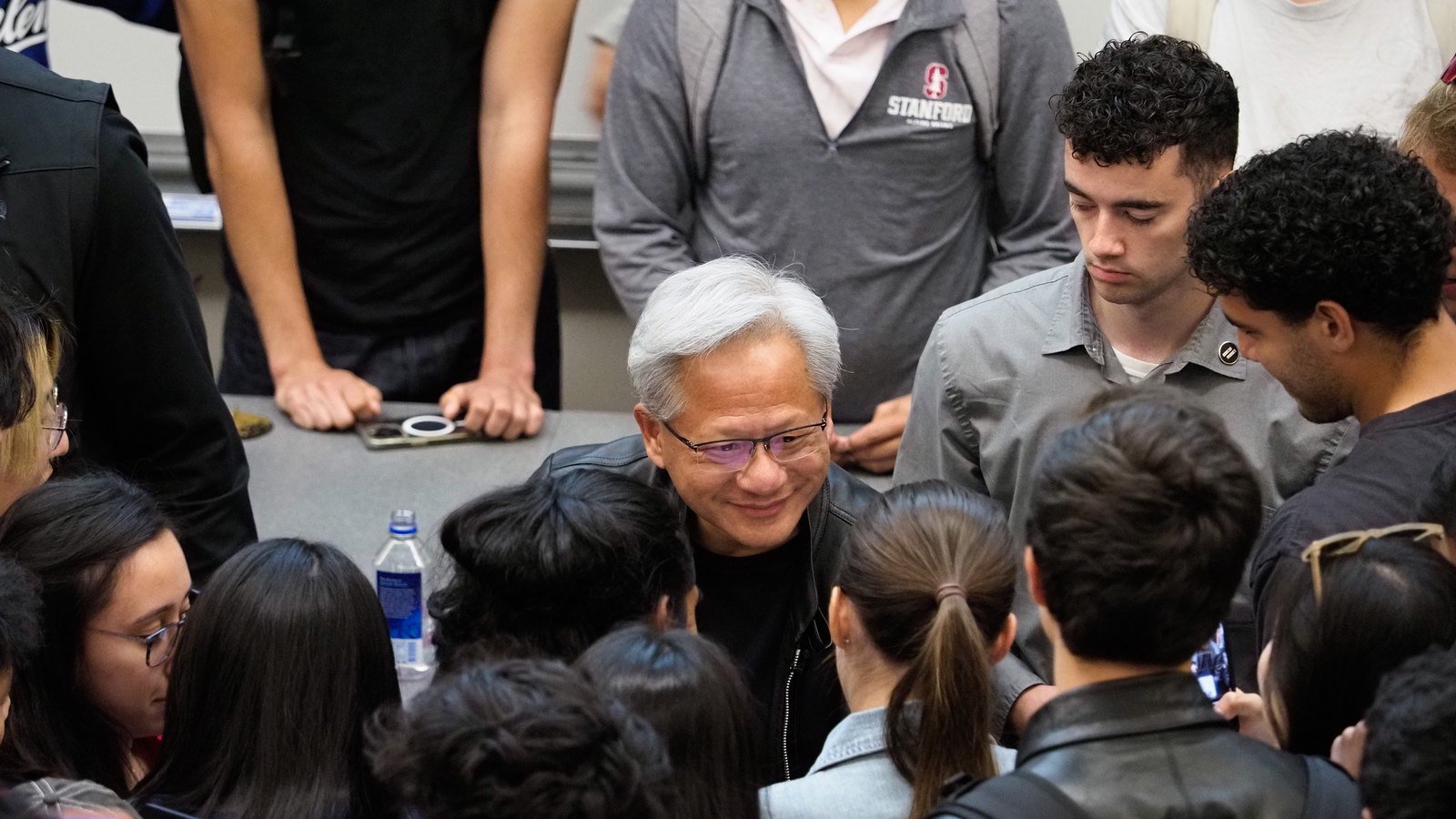
Image credit: Jensen Huang with students at Stanford University, April 30, 2026. Photo by Anders Eidesvik, via Wikimedia Commons, licensed CC BY 4.0; cropped to 16:9.