


The European Space Agency’s Euclid space telescope has published its first major batch of survey data. The release, called DR1-Foundation and posted on Nov. 12, catalogs more than 900 million galaxies across about 1,900 square degrees of sky, according to ESA and the Euclid Consortium. It is Euclid’s first major data release since the telescope launched in July 2023, and it still covers only about 14% of the sky the mission plans to survey.
There’s one thing it doesn’t include yet: the dark energy answer. ESA says the full Data Release 1, with the weak-lensing measurements Euclid was built to make, is due in mid-2027.
Last checked: Nov 16, 2026
Key points
- ESA and the Euclid Consortium released DR1-Foundation on Nov. 12: about 13 months of observations, more than 900 million galaxies and spectra for more than 160 million sources across about 1,900 square degrees.
- The release includes around 15,000 strong gravitational lens candidates, which ESA calls the largest strong-lens catalog ever, about 30 times the 500 in Euclid’s March 2025 preview.
- The weak-lensing and galaxy-clustering products needed to test dark energy aren’t in this release. ESA and NASA’s IRSA archive say they arrive with the full DR1 in mid-2027.
- The data are free to download through ESA and NASA’s IRSA archive, but ESA’s terms license DR1 for noncommercial use only.
The headline numbers are huge, and they’re real. But the reason Europe built Euclid was dark energy, the unexplained something that is speeding up the universe’s expansion. That question now has a firm date on the calendar, and it isn’t this week.
What’s in the box
DR1-Foundation covers observations from spring 2024 to spring 2025, the first 13 months or so of Euclid’s main survey, which began on Feb. 14, 2024. ESA lists the contents this way:
- More than 900 million galaxies.
- Around 15,000 strong gravitational lens candidates.
- More than 60 million quasar candidates (a quasar is the brilliant core of a distant galaxy, lit up by gas falling into its central black hole).
- Spectra for more than 160 million sources.
- About 1,900 square degrees of the Euclid Wide Survey, which ESA puts at 1.7 million gigabytes of data.
NASA’s IRSA archive at Caltech, which also hosts the release, describes the full DR1 as about 1.8 petabytes. ESA ties its 1.7 million GB figure to the Wide Survey, while IRSA’s also counts deep and calibration fields, so the two numbers may not measure quite the same thing. Either way, nobody is downloading this onto a laptop. Both archives push researchers toward cloud platforms that run the analysis next to the data, and IRSA says its catalogs are being added “incrementally over the coming weeks.”
The consortium says the release holds about 10,000 science images from Euclid’s two instruments: VIS, a visible-light camera, and NISP, a near-infrared instrument that also spreads light into spectra. Eight science papers and 18 technical papers describing the processing went up alongside it. The consortium dedicated the release to Yannick Mellier, a gravitational-lensing pioneer and its former lead.
The scale jump, by the numbers
Euclid’s first preview of survey data, called Q1, came out in March 2025. According to ESA’s release at the time, Q1 covered 63 square degrees and held about 26 million galaxies and a first catalog of 500 strong-lens candidates. Here’s how DR1-Foundation compares, by our math from ESA’s own figures:
- Sky area: about 1,900 square degrees vs. 63, roughly 30 times more.
- Galaxies: more than 900 million vs. about 26 million, roughly 35 times more.
- Strong-lens candidates: about 15,000 vs. 500, about 30 times more.
And the 14% figure tells you how big the finished survey is meant to be. If 1,900 square degrees is 14% of the plan, the full wide survey comes out to roughly 13,500 square degrees, or about a third of the whole sky. ESA’s Valeria Pettorino, the mission’s project scientist, called this “a change in scale.” That’s fair. It’s also only the first slice.
15,000 cosmic magnifying glasses
The standout result is the lens catalog. A strong gravitational lens forms when a massive foreground galaxy bends the light of a more distant one into arcs, rings or multiple images. ESA says the DR1-Foundation catalog is “bigger than all previous catalogues combined.” The candidates were found with a mix of machine learning, thousands of citizen scientists on the Zooniverse project Space Warps, and expert checks.
Lenses matter because they let astronomers weigh galaxies, including the dark matter they sit in, and they magnify very distant galaxies that would otherwise be too faint to study. “Over 10 years ago, we forecast that Euclid would revolutionise the field of strong lens discovery. That day is finally here,” said Natalie Lines of the University of Portsmouth, a consortium member.
Euclid is running ahead of its own forecast on this one. In March 2025, ESA said Euclid would capture “some 7000 candidates” in a major cosmology release then planned for the end of 2026. This release, at mid-November 2026, has about twice that. The consortium now expects more than 100,000 lens systems over the six-year mission, and simply scaling 15,000 candidates from 14% of the sky to 100% lands right around that number.
The catch: these are candidates. ESA says only one galaxy in several thousand acts as a lens, and the catalog flags about one in every 60,000 of the galaxies in this release, so it’s a list of the lenses Euclid could spot and the teams could vet, not a full census. The consortium says automated modeling has been applied to thousands of them, which isn’t the same as confirming them one by one.
Where’s the dark energy?
That’s the question this release doesn’t answer, and ESA is upfront about it. The full DR1 in mid-2027 will add “observations of weak lensing,” the tiny, statistical warping of millions of galaxy shapes that maps dark matter across the sky, plus the galaxy-clustering measurements. Those are the tools Euclid needs to measure how dark energy has behaved over the past 10 billion years. IRSA says the same: higher-level products for “galaxy clustering and weak lensing studies” come with the complete DR1 in mid-2027.
The stakes went up last year. In March 2025, the ground-based Dark Energy Spectroscopic Instrument (DESI) reported that combining its data with other measurements pointed toward dark energy weakening over time, rather than staying constant as the standard model of cosmology assumes. Depending on which datasets were combined, the preference ranged from 2.8 to 4.2 sigma, short of the 5-sigma bar physicists use to claim a discovery. DESI’s own release noted that “many 3-sigma events in physics have faded away with more data.”
Our read: Euclid is the independent check everyone is waiting for, from space and with a different method. That’s why the 2027 release matters more than this one. It’s also worth keeping track of the schedule. In March 2025 the major cosmology release was pegged for the end of 2026. Today ESA says mid-2027. That’s a normal slip for a big science pipeline, but it’s a slip.
The pretty pictures, and what they show
ESA released a set of images with the data. The largest, a northern-sky mosaic, is about 500 gigapixels, built from 740 observations covering 367 square degrees, according to ESA’s overview graphic and Scientific American. In the south, a 148-square-degree view of the Horologium Supercluster was stitched from 370 observations gathered over 18 days.
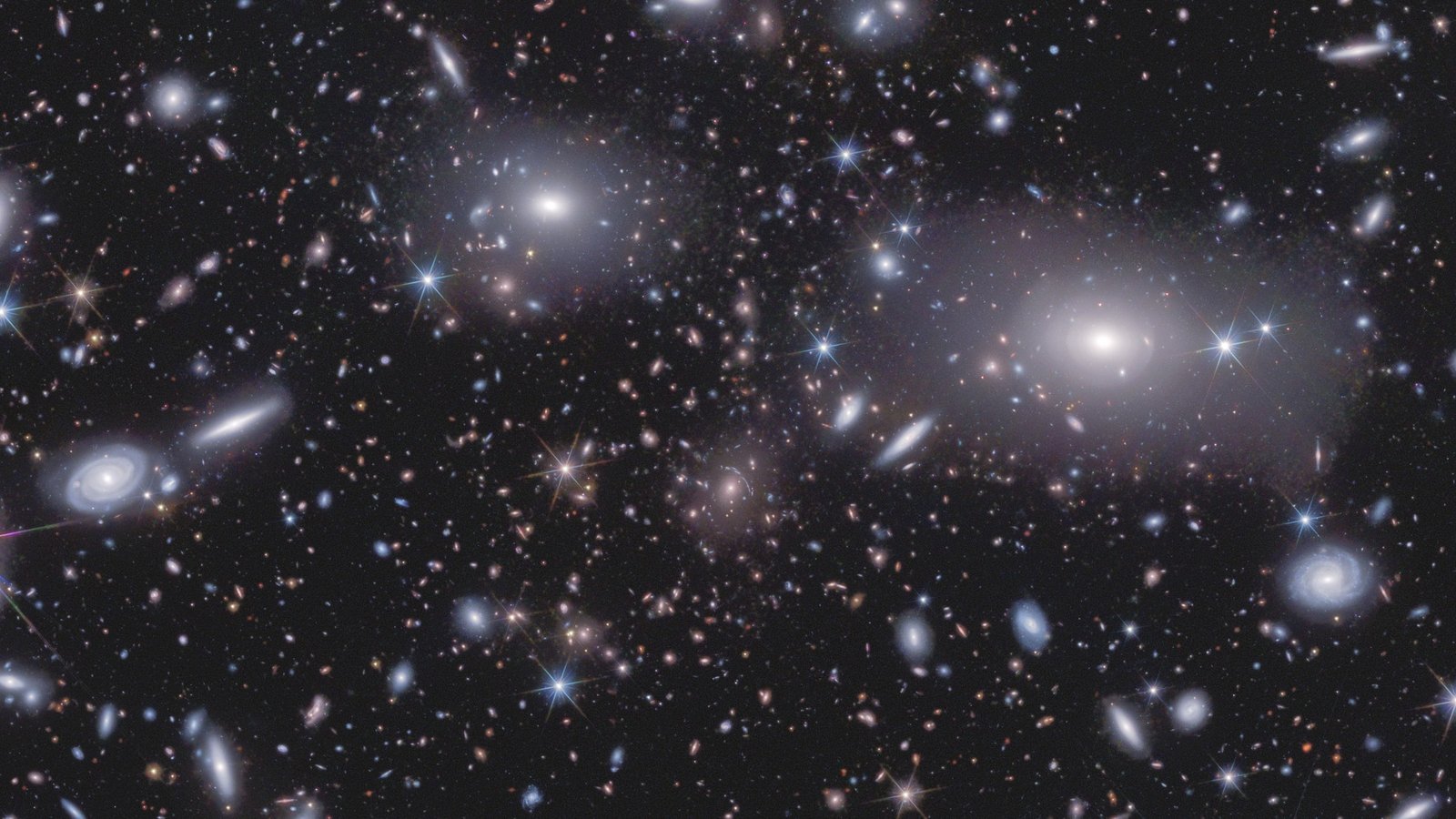
Our lead image, a close-up from that southern patch, shows the galaxy cluster Abell 3128, about 800 million light-years away. ESA says the frame took Euclid about 70 minutes and covers 0.12 square degrees, just over half the size of the full Moon. The blue arcs at its center are a strong lens. A second, unrelated cluster called ACT-CL J0330-5227 also shows up in the frame. ESA says the two clusters are about 5 billion light-years apart and only overlap along our line of sight.
ESA’s own video zooms through the northern mosaic:
The science that’s already in
The eight science papers go beyond lenses. According to the consortium, they include 15 very faint stellar systems resolved into individual stars for the first time, including five new discoveries and some candidate satellites of the Milky Way. They also include a study of 40 million galaxies showing that “puffy,” three-dimensional galaxies become rarer as the universe ages, with many settling into flat, rotating disks. The consortium also says the same data led, a few months ago, to the discovery of the two most distant quasars known.
Euclid has been finding things it wasn’t designed to find, too. In October, ESA said Euclid had discovered its first new comet, C/2026 S1 (Euclid), in images taken Sept. 16 to 24. That’s a nice bonus for a telescope that deliberately avoids the part of the sky where comets usually turn up.
Who can use it, and how
Anyone can access the data through ESA’s Euclid Data Space, the ESASky viewer and NASA’s IRSA archive. There’s one fine-print item for anyone hoping to build a product on top of it: ESA says all DR1 data is released under a CC BY-NC 3.0 IGO license, which bars commercial use. The press images carry a different license, CC BY-SA 3.0 IGO, which is why we can run one here.
The consortium behind the data is big: more than 2,000 members from more than 300 labs in 15 European countries, plus Canada, Japan and the United States. The consortium says it designed and built Euclid’s instruments in partnership with ESA and NASA, and NASA’s IRSA runs the U.S. archive.
What we still don’t know
- Whether dark energy is changing. Nothing in DR1-Foundation answers that. The first real test comes with the weak-lensing data in mid-2027.
- How many lenses are real. Around 15,000 candidates is a catalog, not a confirmed count. Watch for follow-up papers that report confirmation rates.
- Whether mid-2027 holds. The cosmology release has already moved once, from end-2026. ESA hasn’t named a specific month.
The takeaway
Euclid just did what survey telescopes are supposed to do: it turned a year of steady, unglamorous scanning into a catalog big enough that rare things stop being rare. Fifteen thousand lenses is a real result, and it beat the mission’s own forecast. But Euclid exists to answer one question, and DR1-Foundation is the setup, not the answer. The date to watch is the full DR1 in mid-2027, when weak lensing either backs DESI’s hint of changing dark energy or helps put it to rest.
Hype in. Signal out.
Image credit: Euclid’s view of galaxy cluster Abell 3128 (DR1-Foundation, released Nov. 12, 2026). ESA/Euclid/Euclid Consortium/NASA, image processing by J.-C. Cuillandre and E. Bertin, CC BY-SA 3.0 IGO, via ESA; resized.