





Apple researchers have taught a humanoid robot to walk to things, sit down, duck under tables and shove boxes around real rooms it had never seen, without a single hour of a human puppeteering it first. In a paper posted to arXiv on Nov. 4, 2026, eight authors listed under Apple describe HALO, a system trained on motion data generated entirely in 1,000 simulated homes. They report a 91% success rate across 360 single-task trials in six unmapped real environments. The robot doing the walking is a Unitree G1. The brain riding on its back is a Mac mini.
Key points
- Apple researchers say HALO, trained on synthetic data staged in 1,000 procedurally generated rooms, succeeded in 91% of 360 single-task trials across six real environments it had never seen (arXiv:2611.06908).
- Chaining skills was harder: the paper reports a 70% average across three multi-step sequences, tested 10 times each in a single real environment, with the three-step sequence working 5 times out of 10.
- The stack runs onboard a Unitree G1 with a Mac mini M4 Pro in a backpack enclosure; generating the training data took 48 hours on 250 Nvidia H100 GPUs, the authors say.
- Apple published code but has not tied HALO to any product, and the paper says each new skill still needs a human to write prompts and author keyframes.
What Apple actually published
The paper is titled Perceptive Humanoid Motion from Simulation. Its authors are Siyuan Hu, Abulikemu Abuduweili, Yue Meng, Shipeng Liu, Quentin Leboutet, Chen Chen, Matthias Müller and Vladlen Koltun, all listed with an Apple affiliation. Alongside it, Apple put up a project page with demo clips and an interactive simulation viewer, plus a GitHub repository with the data-generation pipeline, training code and deployment code for both MuJoCo simulation and a physical G1.
HALO stands for “Humanoid Autonomy, Learned in simulation, running Onboard.” The robot takes free-form spoken or typed requests and turns them into six learned skills: walk to a named object or person, sit on a chair or sofa, sidestep through a half-open door, crouch under a table, crawl under a lower one, and push a box. It can also chain those skills, so “sit on the chair” can become crouch, approach, sit if there is a table in the way.
That is the whole repertoire: no grasping, no laundry. This is a whole-body movement paper, not a butler.
The pitch: data that scales with GPUs, not people
The problem the authors go after is the one every humanoid company keeps running into. To map pixels and language onto joint commands, you need paired examples: a camera view, an instruction, and the exact whole-body motion that satisfies it.
The usual fix is teleoperation or wearable capture rigs, which the paper says “require at least an hour of human time to produce an hour of data.”
HALO swaps the human for a pipeline. According to the paper:
- Motion: Kimodo, a kinematic motion-diffusion model, generates whole-body movement from text prompts, waypoints and keyframe poses. Geometric checks throw out candidates with sliding feet, floor penetration or impossible hops.
- Rooms: Infinigen, a procedural 3D scene generator, built 1,200 rooms (living rooms, offices and bedrooms). 1,178 finished generating; 1,000 were used for training and the rest held out for testing.
- Rendering: each episode is replayed in simulation and rendered from a virtual copy of the robot’s fisheye head camera, with randomized blur, noise, exposure and tint so fake rooms look less fake.
- Scale: the main corpus is 300 hours of episodes. Generating it took 48 hours on 250 Nvidia H100 GPUs “without human intervention,” the authors write. The motion generator trained on 64 Nvidia B200s; the tracker used 4 H100s.
The honest footnote is in the appendix. Some human motion data is still in the mix: the crawl and crouch keyframes came from phone videos of a person going under a table, the push skill splices in a motion-capture recording, and the tracker’s first training phase uses clips from LAFAN1, a public human motion-capture dataset, as Humanoids Daily also noted. The claim is “no teleoperation,” not “no humans anywhere.”
A Unitree with a Mac mini backpack
The hardware is a stock Unitree G1 humanoid with two additions, per the paper: a custom head mount with an OAK-1W wide-angle camera, and a rear enclosure holding a Mac mini with an M4 Pro chip and 64GB of memory. The robot runs untethered.
Control is split into three layers running at different speeds:
- Orchestrator, about every 2 seconds: an off-the-shelf vision-language model breaks a request into subtasks, moves on when one succeeds and retries when one fails. By default it is Qwen3.6-35B-A3B in 4-bit precision, running locally on the Mac mini so the robot works without internet. It can optionally call frontier cloud models over their APIs.
- Motion generator, about 3 times a second: a frozen Qwen3.5-2B vision-language encoder feeds a diffusion-transformer decoder that plans five seconds of whole-body motion from the camera image and the current subtask.
- Motion tracker, 50 times a second: a reinforcement-learning policy on the G1’s built-in Nvidia Jetson Orin NX follows that plan using a downward-facing depth camera and the robot’s own joint sensors, sending targets to all 29 joints.
Our read: the most Apple detail here isn’t the Mac mini. It’s that the default setup runs its planner, a Qwen model with 35 billion total parameters, on the robot instead of phoning a data center. Apple sells “on-device” as a privacy feature for phones; a camera-carrying robot in your living room is where that pitch would matter most.
The scorecard, read carefully
Here are the paper’s own numbers. Single tasks ran 10 times per environment, in 100 held-out simulated rooms and six real ones. Multi-step sequences ran in 50 simulated rooms and one real environment.
| Task | Simulation | Real world |
|---|---|---|
| Go to a named object | 98% | 92% |
| Sit | 84% | 85% |
| Sidestep through a door | 91% | 93% |
| Crouch under a table | 95% | 100% |
| Crawl under a table | 84% | 90% |
| Push a box | 93% | 88% |
| Single-task mean | 91% | 91% |
| Door, then go to object | 71% | 100% |
| Crouch, then sit | 73% | 60% |
| Crouch, go to object, push box | 64% | 50% |
| Multi-task mean | 69% | 70% |
Three things are worth knowing before you repeat “91%” at a party.
It’s an average of six easy-to-define skills. The 360 real trials are 6 skills × 6 environments × 10 tries. Each skill got 60 real attempts. The paper’s comparison table shows rival teleoperation-free systems reporting 45 to 300 real trials, so this is a solid count. It is still small enough that a few lucky or unlucky runs swing a skill by several points.
Chains are where it breaks. The real multi-task numbers rest on 10 trials per sequence in one environment. The three-step crouch-walk-push job worked 5 times out of 10. The authors are candid about why: chained success falls below what the single-task rates would predict, because one skill can end with the robot facing the wrong way. In 3 of the 5 failed crouch-walk-push runs, the robot finished crouching with its head turned away from the box, never saw it, “and is distracted by other objects.” Two crouch-then-sit runs tried to sit on a sofa instead of the chair.
“Success” has a definition, and it is generous. In simulation, the paper counts Go-To as a success if the robot stops within 1.0 meter of the target, Push if the box moves at least 0.3 meters, and Sit if the robot ends seated within 0.9 meters of the chair. Any fall fails the run. Those are reasonable research bars. They are not “fetch my glasses from the nightstand.”
What the ablations quietly admit
The paper’s most useful table is the boring one. On the sit task in held-out simulated rooms, training on one room gave 43% success. Ten rooms gave 64%, 100 rooms gave 81%, and the full 1,000 gave 84%.
So environment diversity matters a lot, right up until it starts to matter a little. Going from 100 to 1,000 rooms bought three percentage points. “Data scales with compute” is true, but on this evidence the curve bends, and the next gains probably come from somewhere other than more fake living rooms.
Other ablations are starker: without the trick that stitches successive motion plans together smoothly, sit success fell to 24%; without depth in the tracker, 74%.
The catch list
The authors write their own skeptic’s paragraph, which saves us some work:
- Humans still design every skill. Adding a task “still requires a human to write its prompt and author the keyframes of its motion sequence, so the repertoire grows only as fast as a person can specify additional tasks.” The training corpus has ten fixed instructions in total, such as “walk to basketball” and “crawl under the table”; the orchestrator maps free-form requests onto those.
- No sense of touch. The robot is mostly vision-driven. Once an object leaves the camera’s view, “the policy has no signal that it is still there.”
- The tracker doesn’t know what it’s doing. It “follows the kinematic plan without knowing what the plan is for.”
- No head-to-head. The paper compares capabilities and trial counts with systems like ZeroWBC, VLK, GRAIL and TANGO, but does not run them on the same tasks under the same conditions.
Two more from us. The six real environments were picked and run by the authors, and the paper doesn’t name them beyond “real-world home environments” and the photos in its figures. And the release is code, not a ready-to-run robot brain: a note in the repository’s README says no tracker weights ship, so anyone reproducing the results has to train the tracker themselves.
Why Apple, and why it matters anyway
Apple doesn’t sell a humanoid and hasn’t said it plans to. Nothing in the paper, project page or repository connects HALO to a product or a timeline. The only Apple robot on the rumor board is far tamer: The Information and Bloomberg’s Mark Gurman have reported on a tabletop device, code-named J595, with a display on a motorized arm, aimed at 2027 or 2028, according to coverage by TechRepublic and iClarified. Apple hasn’t announced it.
The paper matters regardless of Apple’s product plans because of what it argues about the industry’s bottleneck. The default way to feed humanoid models is to pay people to puppeteer robots or wear capture gear. HALO is a well-documented data point for the other bet: that a big enough pile of procedurally generated rooms and diffusion-generated motion can carry a real robot through real doors. Publishing the pipeline lets other labs test that bet instead of taking Apple’s word for it.
There’s also a hardware subplot. Apple’s robotics researchers did this on a Unitree G1, built by Hangzhou-based Unitree. Apple isn’t the only lab using one: Humanoids Daily points out that ETH Zürich contact-planning research it covered last month also ran on a G1. That lands in a Washington where the FCC in July added foreign-made “advanced robotic devices,” including humanoids, to its Covered List. The FCC’s national security determination blocks equipment authorization for new models, not robots already authorized, as we noted in our robot-imports story. The paper says nothing about that, and there is no indication it affects this work. It is still a little funny that one of the more carefully documented sim-to-real humanoid papers of the fall runs on Chinese legs.
What to watch next
- Skill count. Six skills and ten training instructions is the baseline. A follow-up that adds manipulation, or shows new skills without hand-authored keyframes, would answer the paper’s own biggest limitation.
- Independent reproduction. With code public and G1s widely available, the real test is whether an outside lab can retrain the stack and hit anything close to 91% in rooms Apple never touched.
- Longer chains, more rooms. The 70% multi-task figure rests on 30 real trials in one environment. Watch for the search-and-turn recovery behaviors the authors propose, and for chained results across many homes.
- Whether Apple says anything at all. Any link to a product has to come from Apple, not from us squinting at a Mac mini.
Apple built a robot’s childhood out of 1,000 rooms nobody lives in, and it mostly learned to behave in real ones. Mostly is the right word. It’s also more than most humanoid demos can show with receipts.
Hype in. Signal out.
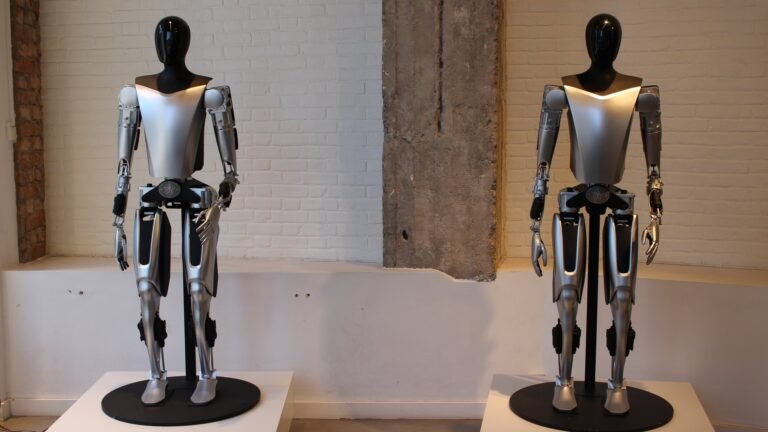
Featured image: A Unitree G1 humanoid on stage at Japan Mobility Show 2025, Tokyo Big Sight, Oct. 31, 2025. Photo by RuinDig/Yuki Uchida via Wikimedia Commons, CC BY 4.0. Cropped for this post. This is not the modified robot used in Apple’s HALO research.