Nvidia announced DSX POD at GTC Berlin on Wednesday, October 21. It’s a reference design for AI data centers that are built and tested inside shipping containers at a factory, then trucked to a site and plugged in.
The company says the approach cuts deployment at a prepared site “from six months to as little as 14 days.” Partners are expected to start delivering units in early 2027.
The idea is clever. The phrase “prepared site” is doing a lot of work.
What’s in the box
Each pod holds seven liquid-cooled Vera Rubin NVL72 racks, CNBC reported. Vera Rubin is Nvidia’s current flagship AI platform, and an NVL72 rack links 72 of its GPUs so they behave like one very large accelerator.
The container is roughly the size of a standard shipping container and weighs about 28,000 kilograms (nearly 62,000 pounds), according to Nvidia. It’s designed to travel by truck on normal roads.
The rack-to-rack cabling, wiring, piping for liquid cooling, rack-level power and functional testing all happen at the factory. “The only thing that has to happen when it gets to the site is it’s placed in its location, connected to the rest of the other containers, and validated through final burning and testing,” Ian Buck, Nvidia’s VP of hyperscale computing, told reporters, per CNBC.
Pods are meant to be building blocks: drop several side by side, connect them, and you have a larger cluster. Nvidia also pitches a power-management layer, DSX MaxLPS, to squeeze the most work out of a fixed power budget.
Who builds it
Nvidia isn’t manufacturing these itself. DSX POD is a reference design, a blueprint that partners build to. The list is long: Anduril, Armada, Bull, Crusoe, DayOne, Dell, Delta, Eaton, Foxconn (Ingrasys), Gigabyte, HPE, Lenovo, Pegatron, Quanta Cloud Technology, Schneider Electric, Vertiv and Wistron.
A few names stand out. Anduril is a defense contractor. Armada builds rugged, portable data centers for edge sites. Crusoe builds AI data centers near cheap power. That mix hints at customers beyond the usual cloud giants: military, remote and energy-adjacent deployments where trucking in finished compute beats building on site.
Not a new idea, at a new scale
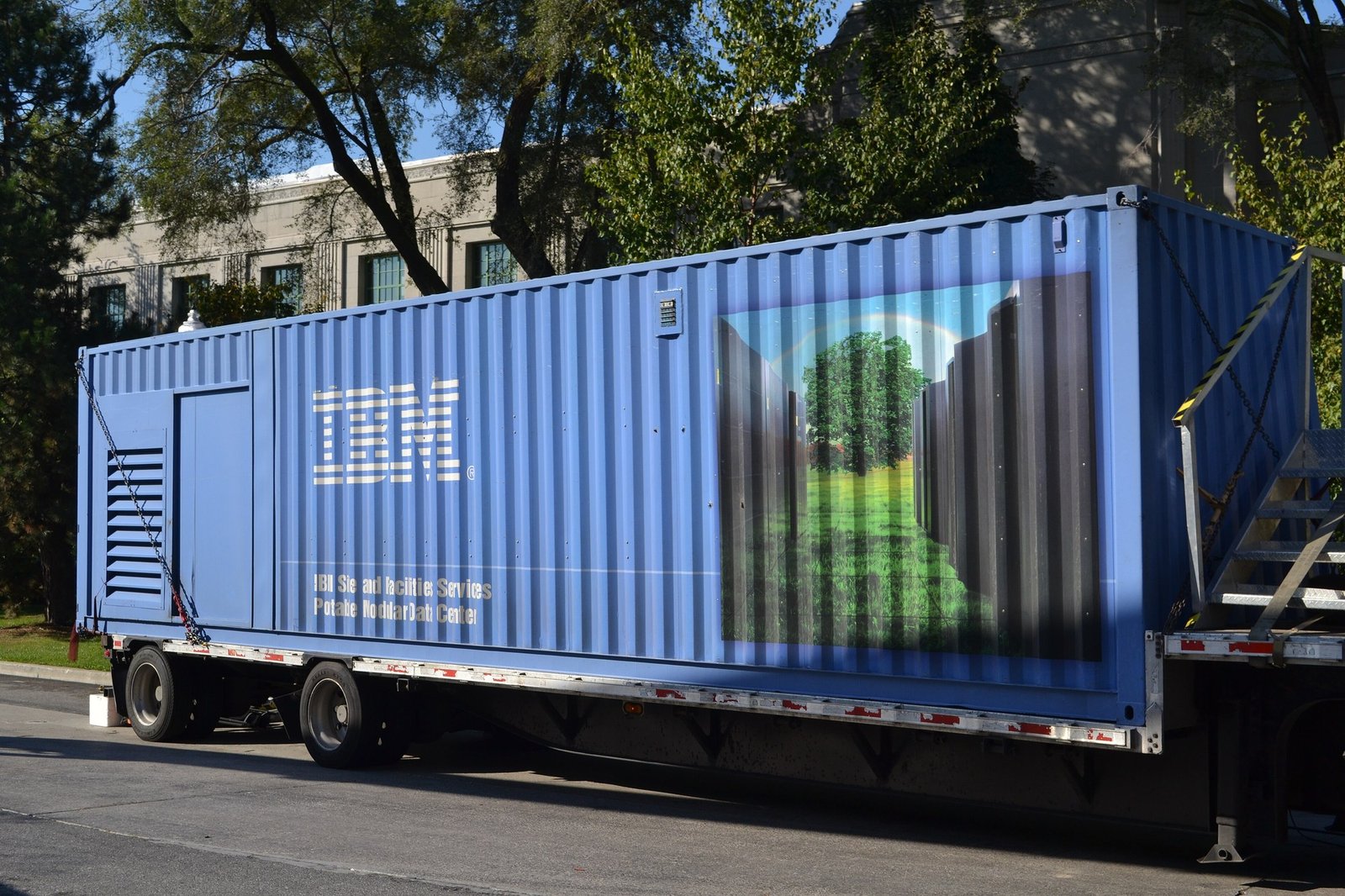
Shipping data centers in containers has been tried for nearly two decades. Sun Microsystems showed off its “Project Blackbox” container data center in 2006, and IBM, HP and others sold portable modular units, like the one pictured above. They found niches (disaster recovery, military, temporary capacity) but never replaced conventional buildings.
What’s different now is density and urgency. Today’s AI racks are far denser and more power-hungry than the servers those early boxes held, they need liquid cooling, and they’re expensive enough that every idle week costs real money. That’s the economic argument Nvidia is leaning on: “An AI factory creates value when it starts producing tokens — not when construction is complete,” CEO Jensen Huang said in the release.
The fine print
Nvidia didn’t announce a price. Analysts told CNBC a single Vera Rubin rack can cost more than $7 million, so a seven-rack container is, conservatively, about $50 million of hardware before you count the box.
Huang has said his company’s share of the spend is rising. “What we offer into one gigawatt went from about $18 billion or so per gigawatt, to $20-something billion per gigawatt, to now $40-plus billion per gigawatt,” he said on a podcast, per CNBC. DSX POD is one more way to capture more of each gigawatt.
And “14 days” comes with an asterisk the size of a substation. Nvidia’s own product FAQ asks “Does the design eliminate onsite work?” and answers: “No.” Customers still need a prepared site with power, facility water, cooling and network connections. The initial target is large, greenfield (built from scratch on undeveloped land), liquid-cooled builds.
Why it matters
Why it matters: the bottleneck for AI capacity has been shifting from chips to everything around them, including construction crews, specialized electricians, cabling, cooling and, above all, grid power. DSX POD moves a big chunk of the labor into a factory, where it can be repeated, standardized and tested. That reduces the risk of costly onsite mistakes and component delays.
Nvidia pitched it partly as a fix for Europe, where building large data centers is slow and expensive. It’s also Nvidia climbing further up the stack. It started by selling chips, then boards, then servers, then whole racks. Now it’s specifying the data hall, minus the building.
For Nvidia’s partners, it’s a mixed blessing. Server makers like Dell and HPE get a new product to sell. They also become more interchangeable assemblers of an Nvidia-defined unit.
The skeptical read
The catch: the slowest part of building a data center usually isn’t installing racks. It’s getting power. In Europe’s main data center hubs (Frankfurt, London, Amsterdam, Paris and Dublin), it takes an average of seven to ten years to connect a data center to the grid, and up to 13 in some cases, according to a 2025 analysis by energy think tank Ember.
A container that installs in two weeks still waits years for that connection. DSX POD compresses the last few months of a multi-year project. That’s valuable for operators who already have power and want revenue sooner. It doesn’t create new capacity where there’s no grid to plug into.
There’s also the question of what “six months” is measured against. Nvidia’s comparison is a traditional onsite fit-out at an already-prepared site, not the full time from land purchase to first token. Buyers should read the claim that way.
Our read
Our read: prefab data centers are a smart answer to a real construction problem, and Nvidia has the leverage to make a standard stick where earlier container efforts stayed niche. But this is a product for customers who have already solved the hard part, which is electricity.
What to watch:
- The first customer deployments in early 2027, and who they are. A defense or energy customer would say a lot.
- Real pricing, and whether partners compete on it or just resell Nvidia’s design.
- Whether the “14 days” figure survives contact with an actual field in an actual country.
- Whether European grid operators’ “smarter connection” deals, which Ember says could cut queue times to around a year, arrive fast enough to give these boxes somewhere to plug in.
Image: Raysonho @ Open Grid Scheduler / Grid Engine / Wikimedia Commons, CC BY-SA 3.0