
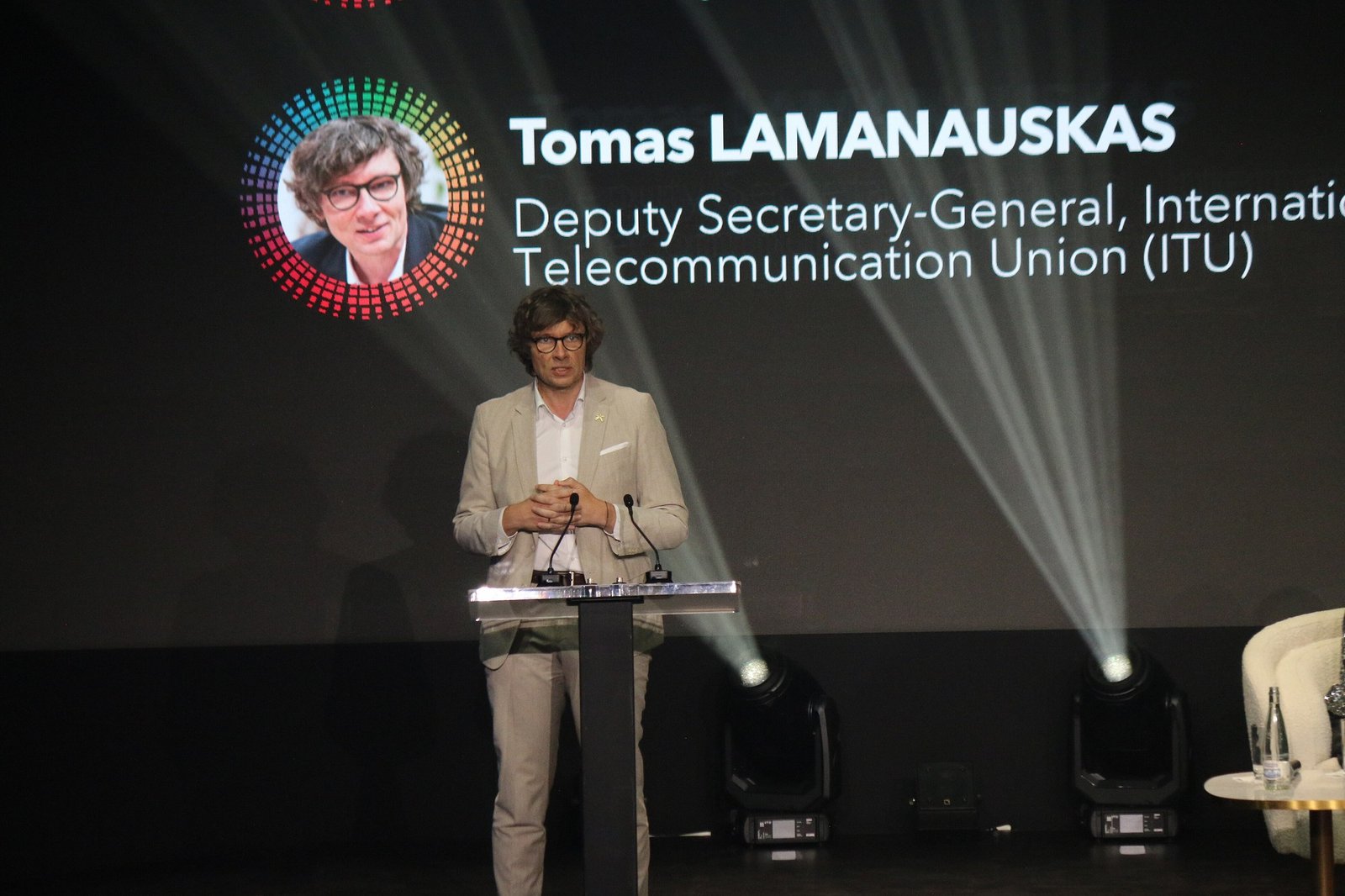
While this week’s AI news was full of trillion-parameter models and billion-dollar chip deals, a UN official in Doha offered a reality check about who gets to use any of it. Tomas Lamanauskas, deputy secretary-general of the International Telecommunication Union, told Al Jazeera on Sunday that unequal access to AI risks leaving poorer countries further behind.
“AI has the huge potential of powering health, education, public services, industries, agriculture, trade,” he said on the sidelines of the UN Conference on Trade and Development’s World Investment Forum in Doha, Qatar. “So a great divide could really mean an opportunity divide, and really could deepen the socioeconomic divide.”
Who’s talking
The ITU is the UN agency for information and communication technology. It sets global telecom standards, coordinates radio spectrum and has spent decades tracking the “digital divide,” the gap between people who have internet access and people who don’t.
Lamanauskas’s point is that AI changes the stakes of that gap. “It’s really not just about the digital divide,” he said. Being offline used to mean missing out on information and services. Being left out of AI could mean missing out on productivity gains in nearly every industry at once.
The numbers
Lamanauskas put figures on the gap:
- Compute: Africa and Latin America together account for just 3.3% of global data-center capacity.
- Connectivity: 2.2 billion people still have no internet access.
- Adoption: about 29% of working-age people in developed countries use generative AI, against 16% in developing countries.
- Language: only 7% of African languages are represented in AI translation tools.
- Cost to fix: roughly $2.8 trillion in digital infrastructure investment by 2030.
The adoption gap matters most day to day. “This actually affects your ability to be productive and to be part of job-market opportunities,” Lamanauskas said.
The language figure is easy to skip, and shouldn’t be. A tool that doesn’t work in your language isn’t available to you, however cheap it is.
Why it matters: in a week when a single company’s chip financing ran into the tens of billions, that 3.3% figure says a lot. The infrastructure being built is concentrated where the money already is.
Not a new warning
The UN has been building this case for a while. In December 2025 the UN Development Programme warned that AI could trigger a new era of inequality between nations, reversing decades of progress in narrowing economic gaps. Countries with unreliable power, limited connectivity and few technical skills, it said, risk missing AI’s gains entirely.
The 2026 International AI Safety Report, published in February, put AI’s user base at around a billion people. It estimated that about 60% of jobs in advanced economies and 40% in emerging economies could be exposed to AI’s effects, while noting there’s no concrete data yet.
That split cuts both ways. Lower exposure in poorer economies means less immediate disruption, but also less of the productivity upside.
Jobs: net positive, personally painful
Lamanauskas cited estimates that AI could displace 90 million jobs while creating 170 million. Those figures closely track the World Economic Forum’s Future of Jobs Report 2025, which projected 170 million jobs created and 92 million displaced by 2030 across all the trends it studied, not just AI.
Even with a “net positive impact,” he warned, many people will personally feel the disruption, with an estimated 40% of workplace skills potentially changing by 2030.
Oxford AI governance researcher Fazl Barez told Al Jazeera “the fears are real,” but drew a line between AI “automating tasks and replacing entire jobs.” “Those involving routine cognitive work are particularly exposed, but the scale remains uncertain,” he said. He also warned that “AI-driven automation threatens to erode government tax bases, lower living standards, and disempower citizens.”
The catch: those big job numbers are forecasts built on assumptions, and the net figure hides who loses and where. A job created in a Bangalore data center doesn’t help a displaced clerk in Lagos. Nobody, including the UN, knows the real numbers. What’s measurable today is the infrastructure gap, and that’s the stronger part of the argument.
Not a call to stop
Lamanauskas was clear he isn’t arguing for a brake. “AI is here to stay, and AI is here to transform our lives,” he said, noting that 104 countries now have AI strategies, compared with four a decade ago. “AI is not a technology that can be controlled by one person or organisation or one company.”
His prescription is more investment in infrastructure, education and regulation, so developing countries help shape the technology instead of just receiving it. “The way forward is really to invest to make sure that the AI benefits everyone, to recognise and acknowledge the fears and anxieties that people feel,” he said.
Our read
Our read: this is a familiar UN message, but the AI version has a sharper edge. Earlier tech waves mostly needed phones and connectivity. Frontier AI also needs power, data centers and chips, all expensive and concentrated in a few countries and companies.
There’s a counterargument. Most people won’t need a local data center to use AI; a phone and an internet connection to someone else’s cloud will do. Cheaper open-weight models, which anyone can download and run, help too.
The catch: renting intelligence from abroad isn’t the same as owning a stake in it. Countries that only consume AI get the apps but not the jobs, tax revenue or say over how the models behave. And cloud access still depends on the connectivity 2.2 billion people don’t have.
Who this affects
- Developing economies: the gap is in power, connectivity, skills and language, not just chips.
- Cloud and chip companies: the next billion users are mostly in places with little data-center capacity today.
- Workers everywhere: skills churn applies in rich countries too, just with more of a safety net.
The takeaway
The takeaway: the AI divide is first an infrastructure divide, measured in megawatts, fiber and language data. Strategies are easy to write. Data centers aren’t.
What to watch:
- Whether any of this year’s big cloud and chip buildouts land meaningfully in Africa or Latin America.
- Whether the 104 national AI strategies come with budgets.
- Progress on AI tools for under-served languages.
- Whether development banks and the UN turn the $2.8 trillion estimate into actual financing.
Image: Xuthoria / Wikimedia Commons, CC BY-SA 4.0